
Living
Bangkok Digital Nomad Guide: Live and Work Remotely
A practical Bangkok digital nomad guide: visa routes, choosing an area, first-week setup, internet, air quality, tax exposure and the honest downsides.

On this page
Bangkok works for remote work because it combines a real, dense city with cheap logistics: fast internet in most buildings, a rail network that removes the need for a car, a huge range of food and housing at every budget, and a time zone that gives you a usable overlap with both US and European clients. It fails people who expected a beach-town pace, who can’t tolerate heat and traffic, or who don’t plan around the annual smog season. This guide covers both sides plainly.
Why Bangkok, structurally
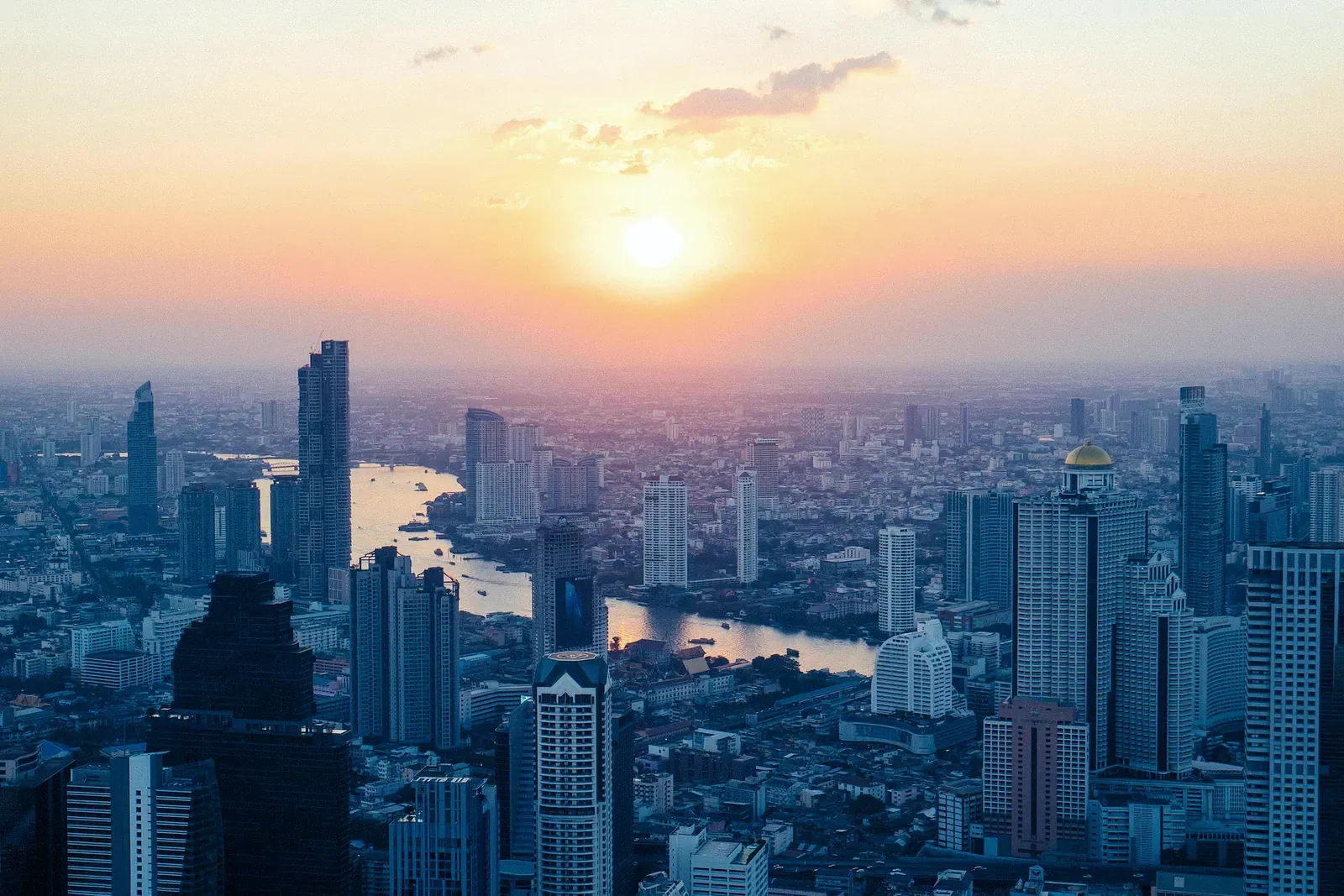
Bangkok is a capital city of roughly 10 million people (more across the metro area), which means the nomad infrastructure (coworking spaces, fibre internet, English-speaking clinics, international schools, gyms, and a large existing foreign resident population) already exists for reasons that have nothing to do with nomads. You’re not the market; you’re a side effect of it. That’s an advantage: prices for internet, transport and everyday services are set by local demand, not by a tourist premium.
The BTS Skytrain and MRT subway cover the areas most nomads live and work in (Sukhumvit, Silom, Sathorn, Ari, Phrom Phong, Thong Lo, Ekkamai), so day-to-day life doesn’t require a car or a motorbike. That single fact removes a lot of the friction that makes some Southeast Asian cities exhausting to live in long-term.
Where it fails: Bangkok is not calm. Traffic off the rail lines is genuinely bad, the heat is real for most of the year, construction and street noise are constant in many neighbourhoods, and bureaucratic tasks (banking, visas, SIM registration) take patience. If you came for a quiet, slow-paced base, look elsewhere or plan a split year, see Bangkok vs Chiang Mai for digital nomads for a direct comparison with the country’s other major nomad hub.
Visa reality: know the categories, verify the details
This is the part people get wrong by reading outdated blog posts. Thai immigration rules change, and what follows is a structural map of the categories, not a set of instructions to act on. Before applying for anything, check current requirements directly with the Thai Immigration Bureau or a Thai embassy or consulate in your home country, or use a licensed visa agent or immigration lawyer for anything non-trivial.
Tourist entries. Many nationalities can enter Thailand visa-exempt or with a standard tourist visa for a limited stay, extendable once at an immigration office. This route is not designed for remote work and carries no legal permission to work, even remotely: some nomads use it anyway for short stints, which is a personal risk decision, not something this guide recommends.
The Destination Thailand Visa (DTV). Thailand introduced the DTV specifically to cover remote workers and people pursuing “soft power” activities (things like Muay Thai training, cooking courses or medical treatment). In principle it’s built for exactly this audience: a longer-duration, multiple-entry visa that permits remote work for an employer or clients based outside Thailand, without the right to work for a Thai company. It typically asks for proof of remote income or an employment relationship, and evidence of funds. The exact financial thresholds, document lists and fees change and vary by embassy, so treat any number you read (including in other guides) as indicative until you confirm it on the day you apply.
Education routes (ED visas). Enrolling in a long-term course (often Thai language study) has historically been a route some nomads used to get a longer stay, though it isn’t designed as a work visa and comes with its own compliance requirements (attendance, reporting). It suits people genuinely studying, not people using it purely as a work permit workaround.
Business and investment routes. Setting up or working legally for a Thai company involves a work permit tied to a Thai entity, with capital and staffing conditions attached. This is a different, heavier path aimed at founders and employees of Thai-registered businesses, not short-stay remote workers. If you’re building a company from Bangkok rather than just working remotely from it, treat this as a separate research task.
The bottom line. These categories differ in who they’re for, what they let you do, and what they demand as proof. None of them is a simple “nomad visa” in the way some countries now offer; each has trade-offs in cost, paperwork and flexibility. Rules on maximum stay, extensions, financial thresholds and required documents change often enough that a guide written even a year ago can be wrong. Confirm everything with the Thai Immigration Bureau, a Thai embassy or consulate, or a licensed immigration adviser before you commit money or plans to a specific route.
Choosing a base area
Where you live changes your daily life more than almost any other decision. Broad guidance, not a ranking:
- Sukhumvit (Asok, Phrom Phong, Thong Lo, Ekkamai) is the default nomad and expat corridor: dense with coworking spaces, cafés, gyms and restaurants, well served by the BTS, and expensive relative to the rest of the city. Thong Lo and Ekkamai lean quieter and more residential; Asok is louder and more central.
- Sathorn and Silom suit people who want proximity to the central business district, embassies and some hospitals, with a more corporate, less nightlife-driven feel after dark.
- Ari is smaller, leafier and increasingly popular with long-stay nomads who want a neighbourhood feel with good cafés, still on the BTS, generally cheaper than Thong Lo.
- Riverside (Charoennakhon, Khlong San) trades transport convenience for river views and space, often via the BTS Gold Line or ferry rather than the main lines, better for people who don’t need to be near a station every day.
- Bang Na and the outer east are cheaper and better for larger, newer condos, at the cost of longer commutes into the centre.
Whatever you pick, visit in person or take a short-let before signing a long lease: photos on rental sites don’t show noise, construction next door, or how far the “5-minute walk” to the station actually is. For the money side of this decision, see cost of living in Bangkok for digital nomads, which breaks down rent by area tier.
The first-week checklist
A structured first week saves weeks of friction later.
- SIM or eSIM. Buy a local SIM or activate an eSIM on arrival: airport kiosks and malls both sell tourist and longer-term packages. You’ll need this before most other steps, since some registrations expect a Thai number.
- Cash and cards. Bring a card that doesn’t charge foreign-transaction fees, and carry cash for the first few days: many small vendors, markets and some taxis are cash-only. ATMs are everywhere but charge a foreign-card withdrawal fee on top of your own bank’s fee.
- Bank access. Opening a Thai bank account as a short-stay visitor is difficult and increasingly restricted; many nomads run on a foreign card plus a Thailand-friendly international account or transfer app instead. If you’re on a longer-stay visa, opening a local account becomes realistic once you have proof of address and the right visa category, check current requirements at the branch, since they vary.
- Transport card. Get a Rabbit card (BTS) or the MRT’s stored-value card so you’re not queuing for single tickets daily.
- Accommodation. Book a short let (two to four weeks) rather than a long lease sight unseen, so you can test the area before committing.
- Groceries and laundry. Locate the nearest wet market or supermarket, and check whether your building has laundry or you’ll need a local service: most neighbourhoods have same-day laundry shops at a low price.
- Coworking trial. Take day passes at two or three spaces near your accommodation before buying a monthly membership; noise levels, meeting-room availability and community differ a lot between them.
- Health insurance. Confirm your policy covers Thailand and check the nearest hospital with English-speaking staff, even if you’re healthy, this is a five-minute task that matters if something goes wrong later.
Internet and power
Most condo buildings in the areas nomads live in carry fibre internet as standard, and speeds are generally more than sufficient for video calls and cloud work. The real risk isn’t the headline speed, it’s building-specific: older buildings sometimes have unreliable in-unit wiring, and mobile data can be inconsistent inside concrete high-rises. Before signing a lease, ask the landlord which provider is installed and whether you can add your own router if needed. Power cuts are rare in central Bangkok but not unheard of during storms; a small UPS or a fully charged laptop and phone habit covers the gap.
Coworking spaces and a wide range of cafés offer a reliable fallback if your building’s connection has a bad day, worth knowing the two or three closest options near wherever you end up living, whichever area that is.
Timezone fit for US and EU clients
Thailand is UTC+7 year-round (no daylight saving). Against European business hours, that gives a genuine overlap in the local morning: European afternoons land in the Bangkok evening, but a Bangkok 9am-1pm block generally lines up with the European working day starting. Against US clients, the overlap is thinner and depends on the coast: US East Coast evenings can land in the Bangkok morning, while US West Coast hours are close to a full inversion, meaning async work or occasional late calls become the norm rather than the exception. If your work is EU-facing, Bangkok’s time zone is a genuine advantage over date-line countries; if it’s US West Coast-facing, expect to shift your schedule.
Healthcare and insurance basics
Bangkok has a strong private hospital sector by regional standards, with English-speaking staff at the major private hospitals and generally short wait times for paid care. This is one of the city’s real strengths for older nomads and for anyone who wants peace of mind. It is not free, and public-system access for foreigners on short-stay visas is limited, so travel or expat health insurance that explicitly covers Thailand is close to essential, not optional. Compare policies for outpatient cover (useful for routine GP visits, which add up) versus catastrophic-only cover, and check the claims process before you need it, not after.
The burning season and air quality
From roughly December through March or April, Bangkok and much of northern and central Thailand experience elevated PM2.5 levels driven by a mix of crop burning, regional haze and traffic emissions trapped by weather patterns. Air quality varies day to day and area to area within the city (it isn’t constant), but on bad days it’s genuinely unpleasant and a real health consideration, especially for anyone with respiratory issues, older nomads, or families with young children.
People who plan around it typically do one or more of: checking a real-time air quality index before outdoor exercise, keeping an air purifier running in their apartment, using masks rated for particulate filtration on the worst days, or scheduling travel out of the country (or south to the islands) during the peak weeks. Chiang Mai’s burning season is typically worse than Bangkok’s on the worst days, which matters if you’re weighing where to spend that stretch of the year, see Bangkok vs Chiang Mai for digital nomads for how the two compare season by season.
Community and loneliness
Bangkok has one of the largest and most established remote-worker and expat communities in Southeast Asia, with coworking spaces, run clubs, language exchanges, hobby meetups and long-running online groups organised by area and interest. Finding people is rarely the hard part; finding people who stay is. Once the settling-in admin is done, Bangkok once you’ve already done the tourist list covers the recurring, joinable activities that fill out life beyond week one. Bangkok’s nomad population has high turnover (many people pass through for a few weeks or months), which means the city rewards people who put in effort over a few months rather than expecting an instant, stable friend group in week one. Long-stay visa routes like the DTV are shifting the population slightly toward longer average stays, which has been improving continuity in some communities.
Tax exposure, in outline
This section is general information, not tax or legal advice. Thailand’s tax rules for foreign residents, and the interaction between visa status and tax residency, are genuinely complex and have changed in recent years. Take professional advice from a Thailand-based tax adviser or accountant before making decisions based on your specific situation.
Structurally, the two concepts that matter are:
- Day-count residency. Spending more than roughly six months (the commonly cited threshold is 180 days) within a calendar year in Thailand can make you a Thai tax resident for that year, regardless of your visa type. This is a day-count test, not a visa-type test: the visa you hold and your tax status are separate questions that happen to interact.
- The remittance principle. Thailand taxes Thai tax residents on foreign-sourced income in a way that depends on whether and when that income is brought (“remitted”) into Thailand. The rules on this have been actively revised in recent years, including which tax year’s income is affected and how remittance is assessed, so any specific explanation risks being outdated by the time you read it.
What this means practically: if you expect to spend more than half the year in Thailand, or you’re on a long-stay route like the DTV, it’s worth a paid consultation with a Thailand tax specialist early, not after a full tax year has passed. Keep records of your income, your remittances, and your day counts regardless: they’re the first thing any adviser will ask for.
The honest downsides
Bangkok sells itself well online; the parts that don’t make the highlight reel matter just as much when you’re planning a base, not a two-week trip.
- Heat. Most of the year is hot and humid, and the hottest months (roughly March to May) are genuinely draining, especially for outdoor activity. Air-conditioned everything is the norm, which has its own cost, see the budget breakdown in cost of living in Bangkok for digital nomads.
- Traffic. Anywhere off the rail network can mean long, unpredictable journeys by road, especially in rain or rush hour.
- Noise. Construction, traffic and nightlife noise are constant in many popular areas; test an apartment at night before committing.
- Bureaucracy. Visa runs, extensions, reporting requirements and bank processes take real time and patience, and rules change with little notice.
- Cost creep. A “cheap” first month, run on street food and public transport, is easy. A month with a nice condo, coworking membership, a few taxis instead of the BTS, imported groceries and evenings out adds up fast: Bangkok can be as cheap or as expensive as almost any city depending entirely on lifestyle choices, which is exactly why the budgeting guide separates lean, comfortable and high spending patterns rather than quoting one number.
None of this makes Bangkok a bad base. It makes it a real city with real trade-offs, which is a more useful starting point than a list of reasons to move here.
Common questions
Do I need a visa specifically for remote work in Bangkok?
There’s no visa-exempt or tourist route that legally permits remote work, even though many people work informally on tourist stays. The DTV was created specifically to cover remote workers and soft-power activities, but eligibility, required documents and fees change and must be confirmed with the Thai Immigration Bureau or a Thai embassy before you apply.
How long can I stay in Bangkok before I’m a tax resident?
The commonly cited threshold is around 180 days within a calendar year, but whether and how you’re actually taxed depends on the remittance rules and your specific income sources, which have changed in recent years. This is general information; get advice from a Thailand tax specialist if you’ll be close to that threshold.
Is Bangkok’s internet reliable enough for video calls all day?
In the areas nomads typically live (Sukhumvit, Sathorn, Ari and similar), fibre internet in modern buildings is generally reliable and fast enough for continuous video calls. Building-specific wiring and older properties are the main risk, so ask about the connection before signing a lease, and keep a coworking space or café as a backup.
How bad is the air pollution really?
It’s a genuine seasonal problem, roughly December to April, with day-to-day variation rather than constant bad air. Many long-stay nomads plan around it with an air purifier, an air-quality index habit, and sometimes travel out of the city during the worst weeks, rather than treating it as a reason to avoid Bangkok altogether.
Should I choose Bangkok or somewhere calmer like Chiang Mai?
It depends on what you want from your base: Bangkok gives you scale, transport, healthcare and career-adjacent networking; Chiang Mai gives you a slower pace and lower costs at the price of a smaller city and, often, worse air quality in burning season. See Bangkok vs Chiang Mai for digital nomads for a full comparison, including the split-year pattern many people end up choosing instead of picking one exclusively.
Part of
Written by
Mike Brochlowski
Founder and editor, travel photographer and designer
I'm Mike Brochlowski, a travel photographer and designer, and I currently live on Koh Samui, Thailand. I built BangkokWiki to put practical, checked information about Bangkok in one place. Every page is researched from official and primary sources, and the text names them. Where a page shows a checked date, that is when its facts were last confirmed. I also run samui69.com, a non-commercial guide to Koh Samui. If you spot an error or something out of date, tell me through the contact page and I will check it and correct the page.
Read all articles
Visas and paperwork
Staying in Thailand longer?
Visas, extensions, documents and banking for longer stays. Rules and fees change often and offices apply them differently, so check the official source before you act.

Places to stay
Find a hotel
Explore the other desks
More from Living
- 9 min read
 9 min read
Bangkok's Digital Nomad Scene in 2026: What Actually Changed
 9 min read
Bangkok vs Chiang Mai for Digital Nomads

Newsletter
You're subscribed as