Transport
Suvarnabhumi Airport to Bangkok City Guide
How to get from Suvarnabhumi or Don Mueang airport into Bangkok: train, taxi, ride-hailing, bus and private transfer compared by cost, time and luggage.
On this page
Bangkok has two international airports, and which one you land at changes your best option into the city. Suvarnabhumi (east of the city) has a direct train link; Don Mueang (north of the city) does not, and leans more on road transport. Neither airport experience is difficult once you know the layout, but each has its own queueing points, surcharges and scam patterns worth knowing before you land.
The two airports, briefly
Suvarnabhumi (BKK) is the larger, newer airport, handling most full-service international carriers. It connects to the city by the Airport Rail Link (ARL), by a public taxi rank with a structured queueing system, by ride-hailing pickup from a designated zone, and by airport bus and van services.
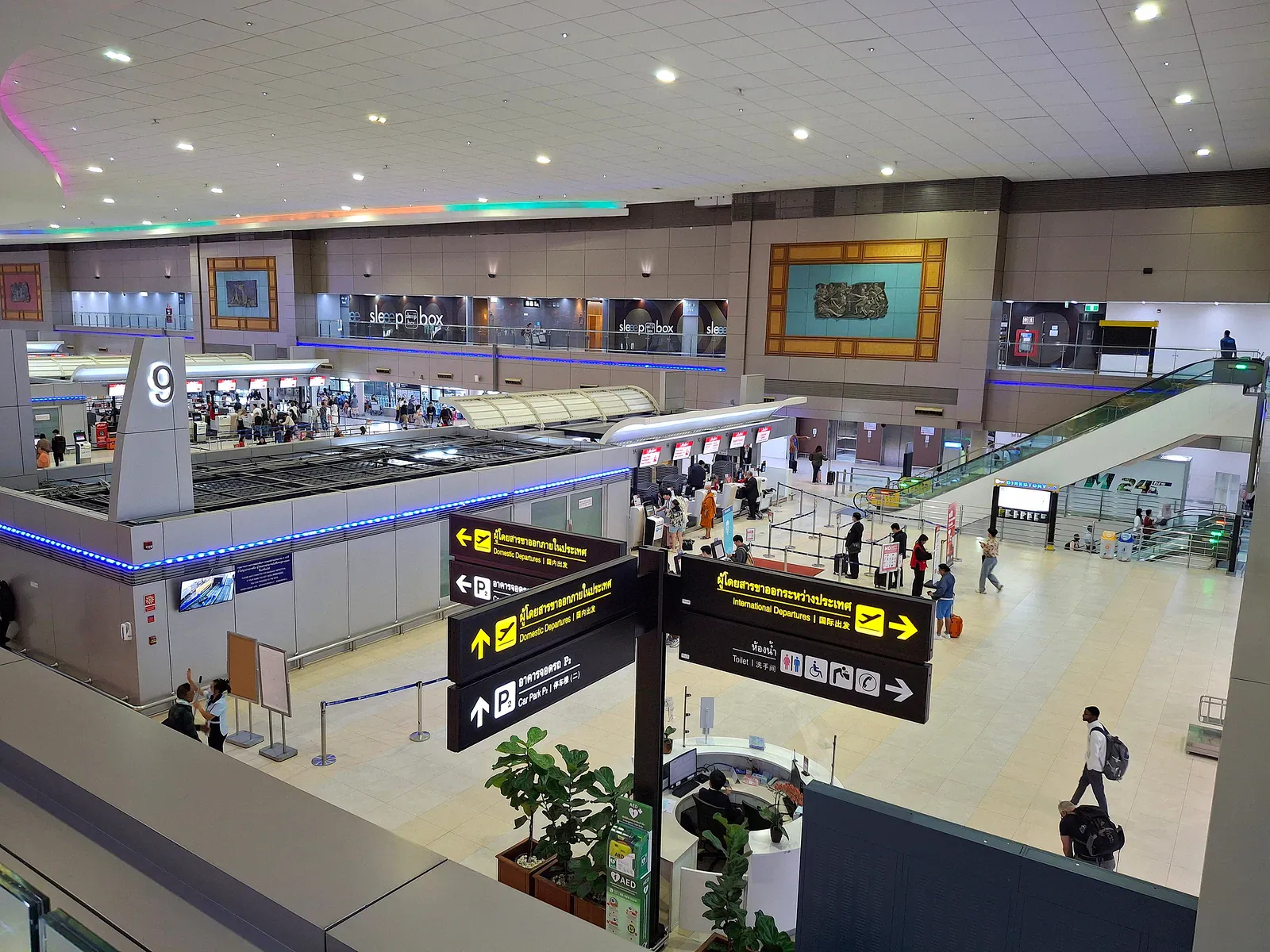
Don Mueang (DMK) is the older airport, now mainly used by low-cost carriers and some domestic and regional routes. It has no direct rail link into central Bangkok: the nearest useful rail connection is a walk or short shuttle to an SRT commuter rail station, which is a workable but slower option than most travellers expect. Road transport (taxi, ride-hailing, bus) is the realistic default from Don Mueang.
Knowing which airport you’re using before you plan your route matters more than most first-time visitors expect: advice that’s correct for Suvarnabhumi (take the train) can be actively unhelpful at Don Mueang. If you are heading to a golf hotel, see golf resorts near Bangkok.
From Suvarnabhumi: your options compared
| Option | Approx. cost (indicative, 2026) | Approx. time to central Bangkok | Luggage | Best for |
|---|---|---|---|---|
| Airport Rail Link (City Line) | ฿15-45 (about $0.40-1.30) | 30-45 min to Phaya Thai, plus onward BTS/MRT | Fine for 1-2 bags, harder with more | Light packers near a rail-connected hotel |
| Public taxi (metered + surcharges) | Roughly ฿300-500 (about $9-14) total with tolls and surcharge | 45-75 min depending on traffic and destination | Good: trunk space, one trip | Most travellers, especially with 2+ bags |
| Ride-hailing (Grab and similar) | Broadly similar range to a public taxi, fare shown in-app before booking | Similar to taxi, subject to traffic | Good | Travellers who want an upfront fare and no language barrier |
| Airport bus / van services | Lower than taxi, a fraction of the metered fare | Longest of the motorised options, plus transfer time | Workable but tighter with large luggage | Budget travellers, no time pressure |
| Private transfer (pre-booked) | Higher than a metered taxi, fixed in advance | Similar to taxi | Best: vehicle matched to luggage/group size | Late-night arrivals, groups, families, anyone wanting zero uncertainty |
These are broad planning ranges, not quotes: tolls, exact destination, and time of day all move the number, and current fares are best confirmed on the operator’s own app or the airport’s official transport counters. Treat the table as a way to compare shape (cost, time, hassle) rather than to budget to the baht.
Airport Rail Link (ARL)
The ARL City Line runs from Suvarnabhumi to Phaya Thai station in around half an hour to 45 minutes depending on the service pattern, stopping at several stations along the way. At Phaya Thai you can transfer to the BTS Sukhumvit line, though (as covered in the BTS and MRT guide) that’s a walk-and-re-tap transfer on a separate fare, not a single-ticket journey.
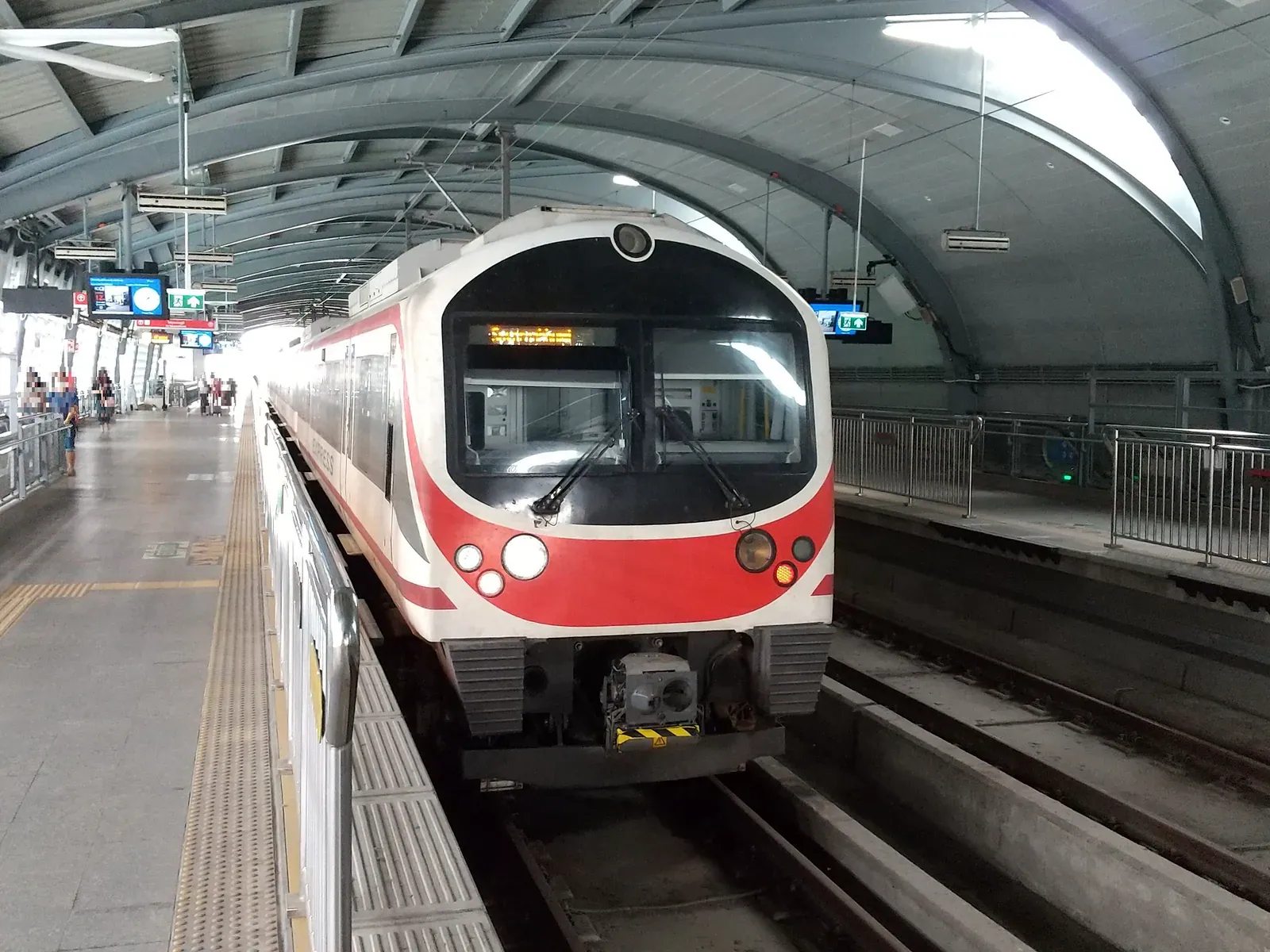
The train is the cheapest and, outside of very light traffic, often the fastest way to a BTS-adjacent hotel, and hotels near Suvarnabhumi Airport or hotels near Don Mueang Airport cut the transfer to almost nothing. Its drawbacks: stations have stairs and escalators more consistently than universal lifts, carriages get crowded with luggage during the day, and if your final destination isn’t near a BTS or MRT station, you’re adding a taxi leg anyway, which can erase the time saving once you count the interchange walk and wait.
Public taxi rank
Suvarnabhumi has an organised public taxi queue system: you take a ticket from a machine or counter, which assigns you to a taxi bay and driver in sequence, avoiding the free-for-all touting you’d find unmanaged. The fare is metered, and on top of the meter you should expect an airport pickup surcharge and any expressway tolls the driver uses to speed up the trip: both legitimate, standard add-ons, not overcharging, as long as the base fare is running on the meter. For a broader look at how metered taxis work day to day, see the taxi and Grab guide.
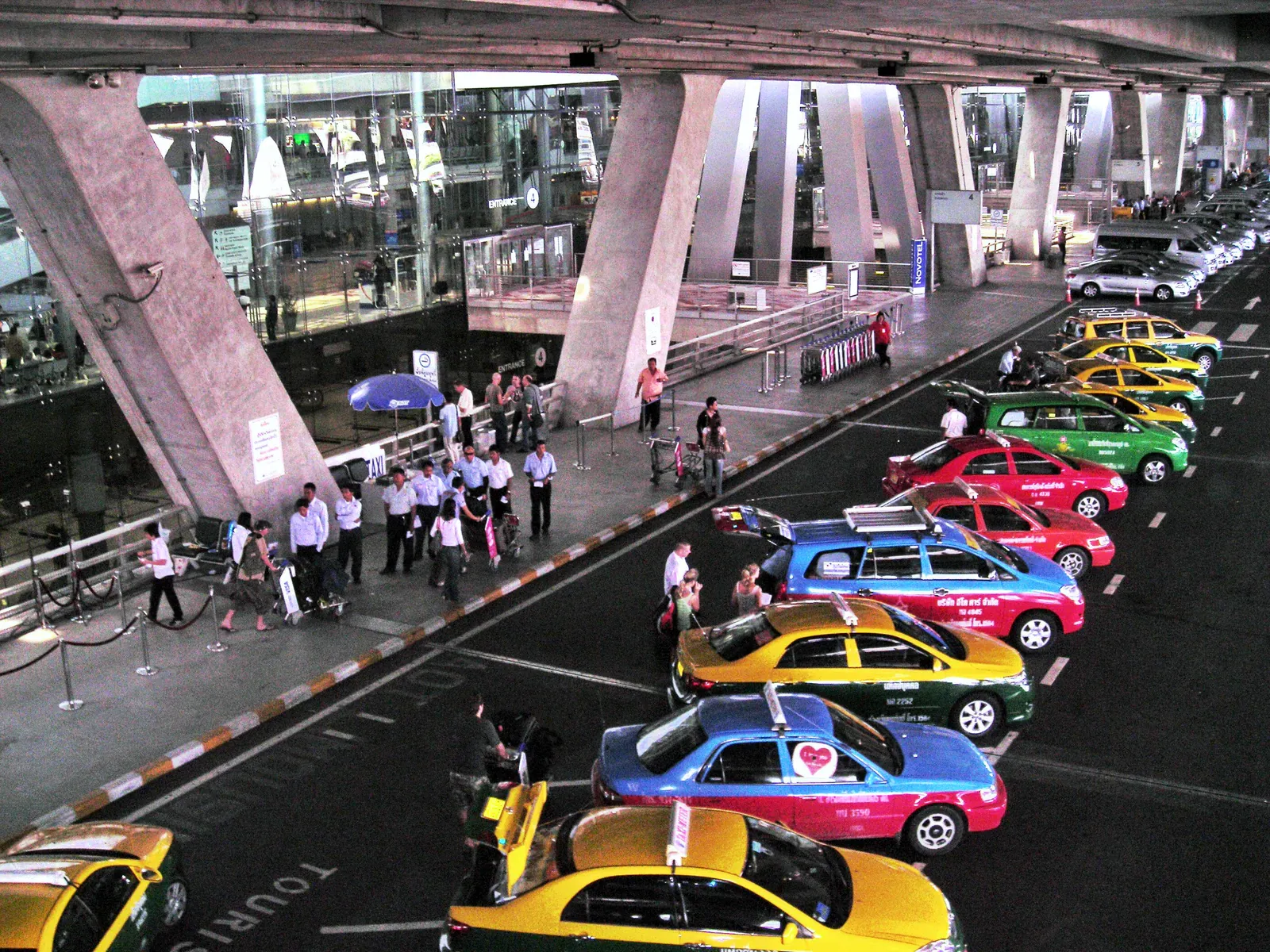
Insist the meter is switched on as the taxi pulls away. A driver who claims the meter is broken or quotes a flat fare instead is not using the official queue system as intended: walk back to the taxi counter staff if this happens at the rank itself, or simply ask for the meter again before the car leaves the airport perimeter.
Ride-hailing
Grab and other ride-hailing apps operate at Suvarnabhumi, with a designated pickup zone separate from the public taxi rank: follow the airport’s signage or your app’s in-terminal pickup instructions rather than trying to flag a ride-hailing car at the taxi queue. Booking in-app gives you an upfront estimated fare and driver details before you commit, which some travellers find reassuring after a long flight. Actual pricing and surge behaviour vary and aren’t something this guide claims specifics on, check the fare shown in your app at the time.
Airport buses and vans
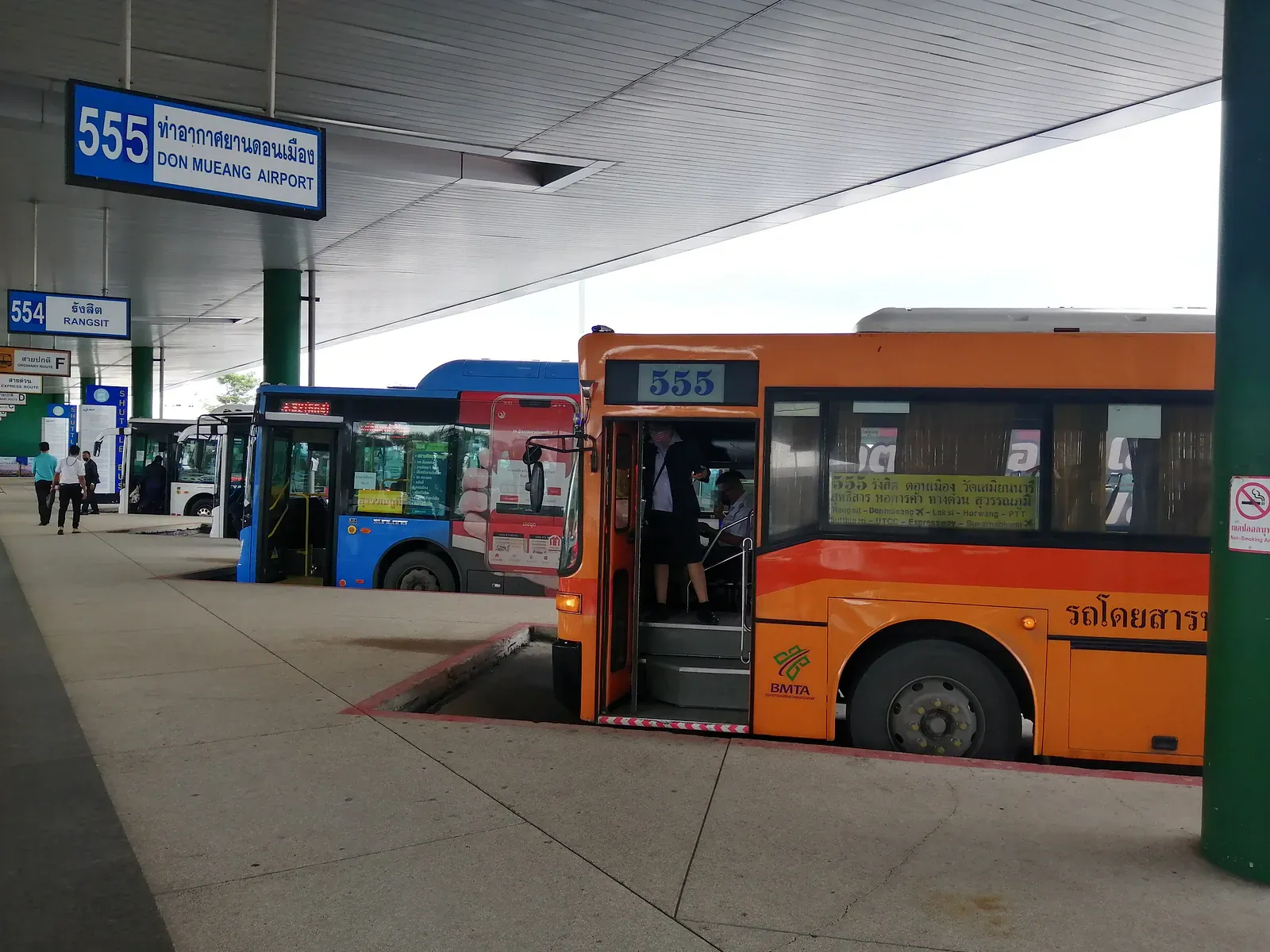
Scheduled bus and van services connect Suvarnabhumi to various parts of the city and to bus terminals, at a lower cost than taxi or ride-hailing but with a longer total journey and less flexibility on drop-off point. These suit travellers without heavy luggage and without a tight schedule, or anyone heading to a destination directly on a bus route rather than needing point-to-point delivery.
Private transfer
Pre-booked private transfers (arranged through your hotel or a transfer operator ahead of arrival) cost more than a metered taxi but remove every point of uncertainty: a named driver, a fixed price agreed before you land, and a vehicle sized for your group and luggage. This is the option worth paying for on a late-night arrival, when the public taxi queue may be thinner-staffed and you’re more tired and more exposed to opportunistic overcharging, or when travelling with young children, elderly relatives, or more luggage than a standard taxi trunk comfortably takes.
From Don Mueang: your options compared
Don Mueang’s road-transport options mirror Suvarnabhumi’s (a public taxi rank, ride-hailing pickup zone, and bus/van services) but without a direct rail equivalent to the ARL. The Don Mueang to Bangkok city guide covers it in full.
- Public taxi: works the same way as Suvarnabhumi’s queue system, metered plus surcharge and tolls. Journey times into central Bangkok are comparable to or sometimes longer than from Suvarnabhumi, depending on your destination and traffic on the northern approach roads.
- Ride-hailing: available from a designated zone, same logic as Suvarnabhumi.
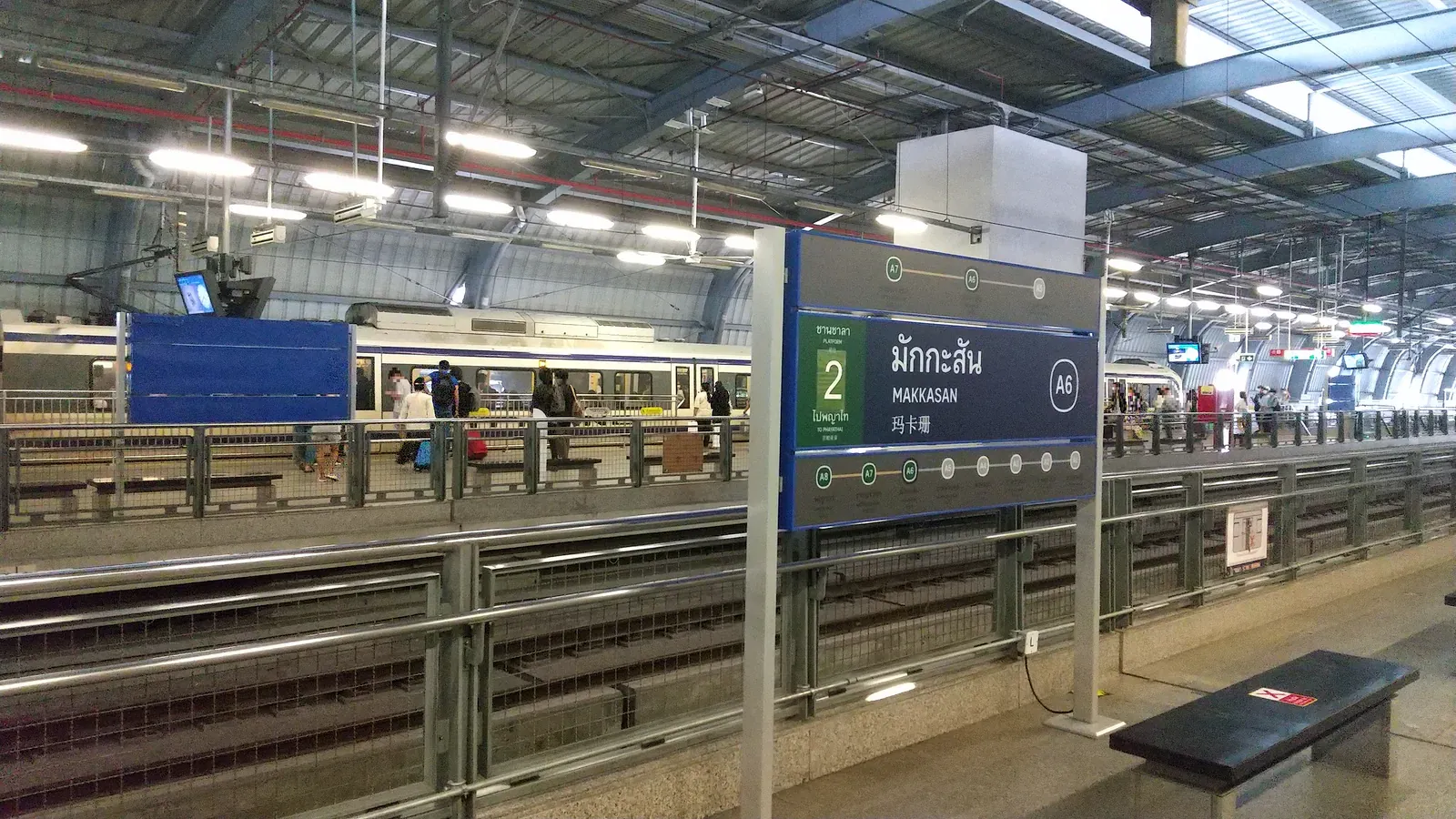
- Rail: there is a nearby SRT commuter rail station reachable by a walk or shuttle from the terminal, connecting into the Red Line network toward Bang Sue Grand Station, where you can change onto MRT. This works, but it’s a multi-leg journey with its own transfer walk, and it suits someone already comfortable navigating the rail network more than a first-time arrival wanting the simplest route.
- Airport bus: Don Mueang has bus connections to various parts of the city and to Suvarnabhumi itself, useful for budget travellers or for the airport-to-airport transfer below.
For most arrivals at Don Mueang, especially with luggage or arriving tired, taxi or ride-hailing remains the simplest default, with the rail option worth it mainly if you’re already rail-savvy and travelling light. If your trip from Don Mueang ends at the theme park, see our Dream World guide.
Transferring between the two airports
If your itinerary has you flying into one airport and out of the other (a common pattern with mixed full-service and low-cost bookings), budget more time than you’d think. Road transport between Suvarnabhumi and Don Mueang typically takes somewhere in the region of 45 minutes to over an hour depending on traffic and time of day, and there is no single direct rail line connecting them (any rail route involves at least one change and is rarely faster than a car once you count the transfers). The Don Mueang vs Suvarnabhumi comparison sets the two airports side by side.
Options for the inter-airport leg:
- Direct taxi or ride-hailing: simplest, door to door, cost broadly similar in shape to a city-to-airport taxi fare but for a longer distance.
- Airport shuttle bus: scheduled services exist between the two airports, cheaper than taxi, slower, and a sensible choice if you have a long connection window and light luggage.
- Private transfer: worth booking ahead if your connection window is tight, since it removes the risk of a queue delay at the second airport’s taxi rank eating into your buffer.
Never plan an inter-airport connection with less than a couple of hours of buffer: traffic between the two, plus check-in and security at the second airport, adds up faster than the raw driving time suggests.
Late-night arrivals
Flights landing after midnight change the calculation at both airports. Public transport options either stop running or thin out significantly overnight, the ARL runs on a daytime-to-evening schedule rather than 24 hours, and airport bus frequency drops. Public taxis and ride-hailing continue operating, but a late-night arrival is exactly when pre-booking a private transfer earns its higher price: you skip queueing, you have a driver who knows you’re coming, and you avoid negotiating in an unfamiliar language at 2am when you’re least equipped to spot a bad deal.
If you do use the public taxi rank late at night, the same rule applies as any other time: insist on the meter, and know roughly what a reasonable surcharge-plus-toll total looks like before you get in, so a padded quote stands out immediately.
Scams that target arriving passengers
A small number of persistent patterns show up at both airports, mostly outside the official taxi queue and pickup zones:
- Touts inside or just outside the terminal offering a “taxi” or “private car” at a flat price, bypassing the official rank. These are typically unlicensed, unmetered, and priced well above a metered fare. Stick to the marked taxi queue or your ride-hailing app’s designated pickup point; don’t accept an approach from someone inside the arrivals hall.
- “The meter is broken” or “that’s a fixed airport rate” from a driver within the official queue. This is not standard practice at either airport’s public taxi rank and is a cue to ask for a different car or flag airport staff.
- Baggage handlers or “helpers” who load your bags uninvited and then ask for a tip as if it were compulsory: you’re not obliged to accept help you didn’t ask for, and it’s fine to decline politely and load your own bags.
- Gem or tour “deals” pitched by friendly strangers near arrivals who steer you toward a taxi that then detours to a shop, a long-running pattern in Bangkok generally, not airport-specific, but arrivals halls are a favourite spot for the opening approach. Politely decline and head to the official transport counters.
None of this should make you anxious about the airports themselves: both have well-organised official systems. The scams specifically exploit travellers who step outside those official systems, so the simplest defence is staying inside them: the marked taxi queue, the marked ride-hailing zone, the airport’s own transfer counters.
A decision table: traveller type to best option
| Traveller type | Suvarnabhumi | Don Mueang |
|---|---|---|
| Solo, light luggage, staying near a BTS/MRT station | Airport Rail Link | Taxi or ride-hailing (rail is a longer multi-leg option) |
| Couple or small group, moderate luggage | Taxi or ride-hailing | Taxi or ride-hailing |
| Family with children, lots of luggage | Private transfer or taxi | Private transfer or taxi |
| Senior traveller, mobility concerns | Private transfer (door to door, no transfers) | Private transfer |
| Budget traveller, flexible schedule | Airport bus/van, or ARL | Airport bus/van |
| Late-night arrival (after midnight) | Pre-booked private transfer, or taxi rank as backup | Pre-booked private transfer, or taxi rank as backup |
| Business traveller, tight schedule | Ride-hailing or private transfer | Ride-hailing or private transfer |
| Connecting between the two airports | Direct taxi/ride-hailing with buffer time | Direct taxi/ride-hailing with buffer time |
Whichever option you pick, cross-check it against how the city’s own transport network behaves once you’re in it: the BTS and MRT guide and the taxi and Grab guide both cover what happens after you arrive at your hotel’s nearest station or drop-off point. First time in the city entirely? Your first two days in Bangkok without a car sequences the whole arrival by fatigue and luggage, not just by mode.
Common questions
Is the Airport Rail Link or a taxi better from Suvarnabhumi?
It depends on your destination and luggage. The ARL is cheaper and often faster to a BTS-adjacent hotel outside rush hour, but it involves stairs, potential crowding, and a further transfer if your hotel isn’t near a station. A taxi is simpler door-to-door and better suited to heavier luggage or a destination away from the rail network.
How do I get from Don Mueang to central Bangkok without a car?
The realistic non-driving options are the airport bus/van network or the SRT commuter rail connection via a nearby station, both of which involve more legs than Suvarnabhumi’s direct rail link. For most arrivals, taxi or ride-hailing remains simpler unless you’re already comfortable with multi-leg rail transfers.
How much does a taxi from Suvarnabhumi to the city cost?
Expect a metered fare plus an airport pickup surcharge and any expressway tolls the driver uses: broadly in the ฿300-500 (about $9-14) range for many central destinations, indicative for 2026 and subject to traffic, distance and toll routes chosen. Insist the meter is running rather than accepting a flat quote.
Can I use Grab at both Suvarnabhumi and Don Mueang?
Yes, both airports have designated ride-hailing pickup zones separate from the public taxi rank. Follow your app’s in-terminal pickup instructions rather than trying to meet a ride-hailing driver at the taxi queue.
How long should I budget to transfer between Suvarnabhumi and Don Mueang?
Plan for at least a couple of hours of buffer beyond the raw driving time (itself often 45 minutes to over an hour depending on traffic), to account for possible taxi queueing, check-in and security at the second airport.
What’s the safest way to arrive very late at night?
Pre-book a private transfer where possible, since public transport options thin out or stop overnight and a tired traveller is the easiest target for touts. If you do use the public taxi rank, stay within the official queue and insist on the meter.
Written by
Mike Brochlowski
Founder and editor, travel photographer and designer
I'm Mike Brochlowski, a travel photographer and designer, and I currently live on Koh Samui, Thailand. I built BangkokWiki to put practical, checked information about Bangkok in one place. Every page is researched from official and primary sources, and the text names them. Where a page shows a checked date, that is when its facts were last confirmed. I also run samui69.com, a non-commercial guide to Koh Samui. If you spot an error or something out of date, tell me through the contact page and I will check it and correct the page.
Read all articles
Where to stay
Pick the area before the hotel
Traffic and heat make Bangkok distances feel longer than they look on a map, so the area shapes a trip more than the hotel does. Our guides match areas to trip types and explain the trade-offs.

Places to stay
Find a hotel
Explore the other desks
More from Transport
- 9 min read
 9 min read
What transport actually costs in Bangkok: three real budgets
 9 min read
Bangkok's Yellow and Pink Line guide: stations and fares

Newsletter
You're subscribed as