Travel
Best Time to Visit Bangkok: A Month-by-Month Weather Guide
Bangkok's cool, hot, and rainy seasons compared month by month, with the honest trade-offs on heat, air quality, crowds, and price.
At a glance
- Reading time
- 14 min read
- Chapters
- 13
- Published
- Sep 20, 2026
On this page
The short answer: November to February has the most comfortable air temperatures, but it also has the worst air quality and the highest prices. If clean air and a quiet, cheap trip matter more than a cool evening, the shoulder months either side of the monsoon are the better call. There is no single “best” month for everyone visiting Bangkok, only the best trade-off for what you’re doing here.
Three seasons, not four
Bangkok runs on three seasons, and the labels are relative. The cool season (roughly November through February) is Bangkok’s mildest stretch, but “cool” here means daytime highs still commonly reach the low-to-mid 30s°C (high 80s to low 90s°F), with mornings and evenings dropping to a genuinely pleasant range that locals wear jackets for. It’s cool by Bangkok’s standards, not by anyone else’s.
The hot season (March through May) is the real test: high heat, high humidity, and little rain to break it up. April is usually the peak, and it’s also when Songkran, the water festival, gives the whole country a reason to spend the hottest week of the year outdoors soaking each other.
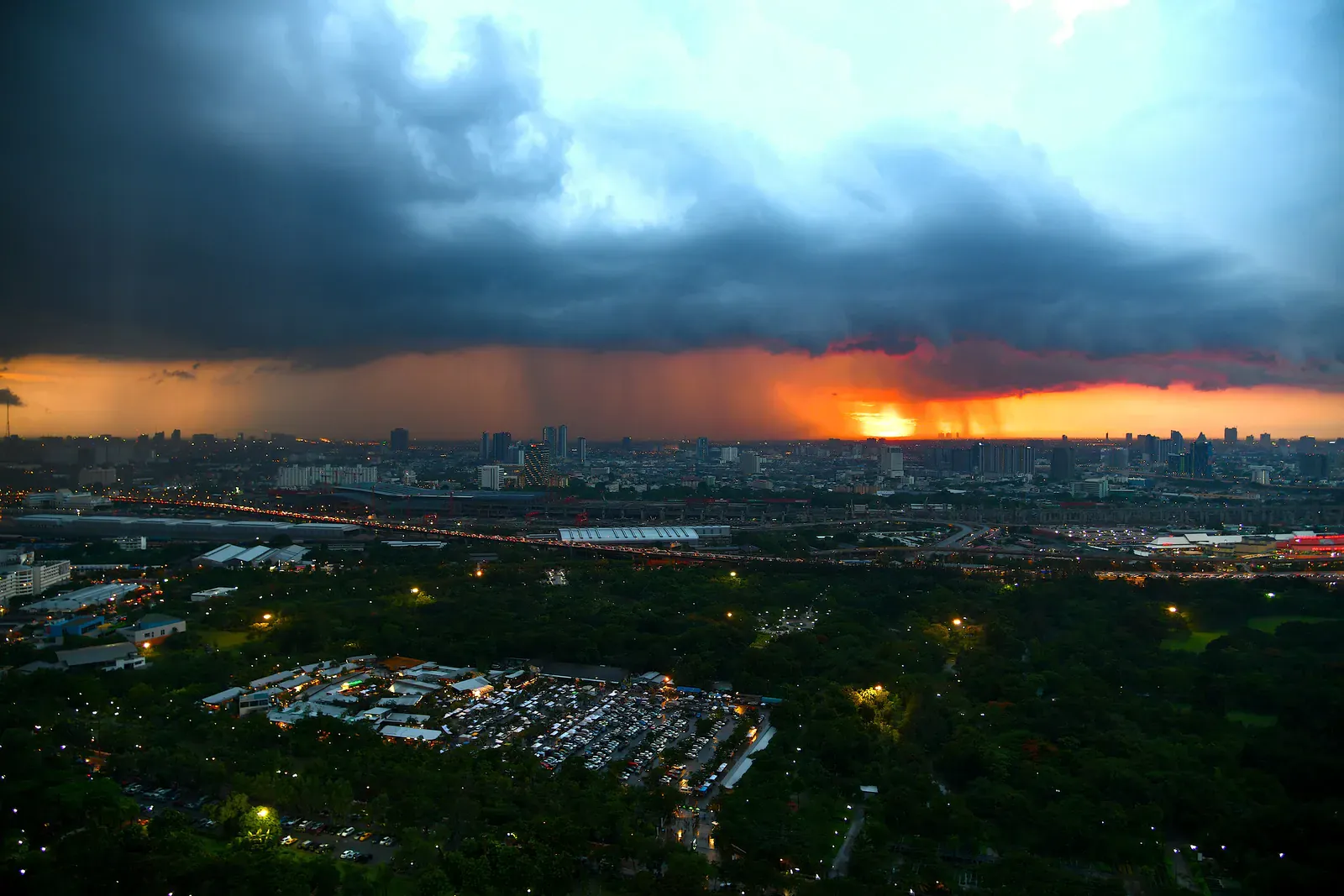
The rainy season (roughly mid-May through October) is driven by the southwest monsoon pulling moisture in from the Indian Ocean. It does not mean rain all day. A typical rainy-season day starts clear, builds humidity through the morning and early afternoon, then breaks into a heavy downpour lasting somewhere between half an hour and ninety minutes, usually in the afternoon or evening, before clearing again. September tends to be the wettest month of the year. Streets can flood locally during the heaviest storms, which is where knowing your rainy-season transit options matters more than the forecast does.
None of these seasons has hard edges. They bleed into each other over two to three weeks, and any given year can run early or late.
Bangkok weather by month
| Month | Heat | Rain | Air quality | Crowds | Verdict |
|---|---|---|---|---|---|
| January | Mild for Bangkok, warm by midday | Low | Starting to decline | High, peak pricing | Best all-round comfort before the haze thickens |
| February | Warm, building | Low | Noticeably worse | High | Good weather, air quality already a concern for sensitive groups |
| March | Hot, humidity rising | Low | Poor, often the worst month | Easing | Skip if respiratory health is a concern |
| April | Very hot, the year’s peak | Low, occasional early storms | Improving late in the month | High around Songkran, then quiet | Songkran is unmissable culturally, brutal if you dislike heat |
| May | Hot, humid | Rain arrives | Good | Low | Strong value, first storms are a relief not a hazard |
| June | Hot, humid | Regular afternoon storms | Good | Low | Reliable pattern, easy to plan around one storm a day |
| July | Hot, humid | Frequent | Good | Low, some family travellers | Cheap and green, pack for daily downpours |
| August | Hot, humid | Frequent | Good | Low-moderate | Similar to July, European summer holidays nudge crowds up slightly |
| September | Hot, humid | Heaviest of the year | Good | Low | Best prices, but the highest chance of local flooding |
| October | Cooling slightly | Easing through the month | Good | Rising | Good value, Vegetarian Festival food in Chinatown |
| November | Mild, drying out | Low | Good | Rising fast | Many locals’ pick for the best all-round month |
| December | Mild to cool | Very low | Good early, mixed by month end | Peak, holiday pricing | Best weather of the year, book everything early |
Cool season: November to February
This is Bangkok’s marketing-brochure season and the reason for it is real: humidity drops, breezes pick up, and mornings can be genuinely cool enough for a light layer. Rooftop bars and river walks stop feeling like an endurance sport. It’s also when the city is busiest and priciest, with hotel rates and flight fares climbing well above the rest of the year, especially around the Christmas and New Year fortnight.
The catch arrives quietly. Regional agricultural burning (sugarcane, rice stubble, and maize fields cleared across upcountry Thailand and neighbouring countries) builds through the season, and Bangkok’s own traffic and construction dust add to it year-round. Cool, still air acts like a lid: the same calm, high-pressure conditions that make the weather pleasant also trap particulates close to the ground. January is usually still fine. By February, sensitive groups are already noticing it. This is worth reading alongside the detail on what actually drives Bangkok’s air quality before booking a cool-season trip around outdoor plans.
Chinese New Year falls somewhere in this window too, on a date that shifts with the lunar calendar: check it for the specific year rather than assuming a fixed week. Yaowarat, Bangkok’s Chinatown, runs its biggest celebrations of the year around it. For month-level detail, see Bangkok in January and February and Bangkok in November.
Good for: first-time visitors who want comfortable sightseeing, families, anyone prioritising walkable weather over price. Harder for: budget travellers (this is peak pricing), and anyone with asthma, COPD, or another respiratory condition, who should treat February onward with more caution than the pleasant temperatures suggest.
Hot season: March to May
March is where the cool season’s pleasant edge disappears and the burning season’s air quality problem usually peaks at the same time: heat, humidity, and haze together, with little rain yet to clear any of it. It’s the least comfortable stretch of the year for outdoor time, and the month most worth avoiding if you’re sensitive to heat or air pollution.
April keeps the heat but usually starts clearing the air, and it delivers Songkran, Thailand’s New Year, in the middle of the month. Songkran runs on the solar calendar so its dates are fixed and predictable each year, unlike the festivals tied to the moon. It’s a nationwide water fight layered over genuine religious and family tradition: temple visits, water poured over Buddha images and elders’ hands as a blessing, then entire streets turned into a soaking free-for-all. It’s one of the best reasons to visit in April despite the heat, provided you don’t mind being drenched by strangers for several days straight.
By May, the first monsoon rains typically arrive and start to break the heat’s grip, even if temperatures stay high. Crowds thin out noticeably after Songkran, and prices follow them down. For more, see Bangkok in April and May.
Good for: Songkran specifically, and travellers who prioritise low prices and low crowds over comfort. Harder for: seniors, young children, anyone with a heart or respiratory condition, and outdoor-heavy itineraries in March in particular.
Rainy season: May to October
The rainy season gets an unfair reputation from travellers who picture monsoon rain as continuous. It isn’t. The pattern is usually a clear or partly cloudy morning, building humidity and cloud through midday, then a concentrated storm in the afternoon or evening that clears within an hour or two. Plenty of rainy-season days have six or seven hours of dry, plannable time either side of the storm.
September is typically the wettest month, with the heaviest and most frequent downpours of the year, and it’s also when short-term local flooding on low-lying streets is most likely. This is the point where knowing how the city copes with rainy-season flooding is genuinely useful rather than just interesting: routes on elevated rail lines, the skywalk network connecting BTS stations, and boat services on the Chao Phraya all keep moving when street level doesn’t.
The upside is substantial: this is the cheapest six months of the year for flights and hotels, the city is at its greenest, and air quality is consistently good because rain washes particulates out of the air. Late October brings the Vegetarian Festival, observed over roughly nine days by Thai-Chinese communities including Bangkok’s Chinatown, with strict vegetarian food stalls appearing across Yaowarat (smaller than the famous Phuket version, but a genuine food-focused reason to visit).
Good for: budget travellers, digital nomads who don’t mind planning outdoor time around a predictable afternoon window, food-focused visitors timing a trip to the Vegetarian Festival. Harder for: anyone with a tight, weather-dependent single-day itinerary, or a low tolerance for humidity.
The trade-off most guides skip
The months everyone recommends and the months that are actually best for a given traveller are not the same thing, and the gap comes down to one interaction: Bangkok’s cleanest air and its most pleasant temperatures do not arrive together.
November and early December offer both: the haze hasn’t built up yet, and it’s dry and mild. That narrow window is arguably the genuine best time to visit Bangkok for most people. But from mid-December through April, the two diverge. Weather keeps improving (by the usual metric of temperature and dryness) while air quality gets worse, peaking in the opposite direction around March. A traveller with asthma who books “the best weather” in February or March can end up breathing worse air than they would on a wet, humid day in July, when the same regional burning simply isn’t happening and rain is scrubbing the sky clean.
This matters most for the audiences who feel air quality first: seniors, people managing a respiratory or cardiovascular condition, parents of small children, and anyone here for medical treatment who needs predictable recovery conditions. For these groups, the calendar question isn’t “when is Bangkok nicest” but “when is Bangkok nicest and clean,” and that window is narrower than the brochures suggest.
Shoulder-season value
Late October to mid-November, and May, are the two windows worth building a trip around if value matters as much as comfort. Both sit just outside the expensive, crowded cool season and just outside the harshest heat or the heaviest rain. Hotel rates in these windows typically run well below peak cool-season pricing: worth checking specific properties, but a meaningful discount is normal, not exceptional. Flights follow the same pattern.
The trade-off is variability: shoulder months can lean either way in a given year, running a week or two ahead of or behind the “typical” pattern. Building in flexibility (a loosely planned itinerary rather than a tightly scheduled one) protects against a shoulder month that runs hotter or wetter than expected. Weighing the city against the beach? See Bangkok or Phuket.
A day in the rainy season
For anyone who hasn’t experienced it, a realistic rainy-season day looks like this:
- Morning: clear or lightly cloudy, comfortable for walking, markets, and temple visits.
- Midday: humidity builds, cloud thickens, still dry.
- Afternoon or early evening: a heavy downpour arrives, often with little warning beyond a darkening sky, lasting roughly 30 to 90 minutes.
- After the storm: streets clear within an hour on higher ground; low-lying sois can hold standing water longer.
- Evening: often clear again, cooler, and comfortable for dinner and night markets.
Carrying a compact umbrella and planning indoor or covered activities (malls, museums, covered markets) for the early-to-mid-afternoon slot turns the daily storm into a scheduling detail rather than a disruption. For month-level detail, see Bangkok in June and July and Bangkok in September.
Heat, seniors, and small children
Bangkok’s heat is dangerous in a specific, avoidable way: it’s the humidity as much as the raw temperature that makes it hard on the body, since sweat evaporates more slowly and cooling becomes less effective. Seniors and young children regulate heat less efficiently than healthy adults, which raises the stakes in March through May in particular.
General precautions worth building into any hot-season itinerary:
- Plan outdoor sightseeing for early morning or after 4pm, not midday.
- Treat air-conditioned malls, museums, and transit as legitimate itinerary stops, not just shelter.
- Increase water intake beyond what feels necessary; thirst lags behind actual fluid loss in heat.
- Watch for headache, dizziness, or unusual fatigue as early signs to stop and cool down, not push through.
- Anyone visiting for medical treatment, or managing an existing heart, lung, or heat-sensitivity condition, should discuss trip timing with their own clinician rather than relying on general travel advice. This is not a substitute for medical guidance.
None of this is unique to Bangkok, but the combination of heat, humidity, and (in cool-season months) haze makes it worth taking seriously rather than assuming a beach-holiday level of caution will do. To read heat and humidity figures, see Bangkok weather and climate.
What to pack, season by season
Cool season (November-February): light layers for the day, one warmer layer for early mornings and evenings or air-conditioned interiors, sunscreen, a mask for sensitive individuals from February onward.
Hot season (March-May): the lightest breathable clothing you own, a refillable water bottle, sunscreen, a hat, and a cooling towel or hand fan for outdoor stretches; consider a proper mask in March given the air-quality overlap.
Rainy season (May-October): a compact umbrella or light rain jacket, quick-dry clothing, a dry bag or waterproof phone pouch, sandals that don’t mind getting wet, and a spare pair of shoes for after a downpour.
Across all seasons: sunscreen and a water bottle are year-round essentials, and comfortable walking shoes matter more than season-specific gear.
Festivals and dates that move
Two of Bangkok’s biggest events sit on fixed or near-fixed dates; two move with the lunar calendar and have to be checked for the specific year:
- Songkran (mid-April, generally the 13th to 15th) follows the solar calendar, so it lands on the same dates every year.
- Chinese New Year falls in January or February and shifts annually with the lunar calendar; Yaowarat runs the city’s biggest celebrations.
- Loy Krathong falls on the full moon of November; the exact date moves year to year and should always be confirmed rather than assumed.
- Vegetarian Festival runs roughly nine days in October, tied to the ninth month of the Chinese lunar calendar; Bangkok’s Chinatown observes it at a smaller scale than Phuket’s well-known version.
Building a trip around any of these is worth it, but check the actual dates for your travel year rather than working from a general “mid-month” assumption, especially for the two lunar-linked events.
Which season suits which traveller
The generic advice above holds, but different reasons for being in Bangkok change the calculation.
Digital nomads and remote workers aren’t tied to a single week, so the shoulder months carry the least downside: lower rents and short-let rates, fewer crowds in co-working spaces and cafés, and good air quality outside the burning season. A nomad who can move dates freely gains more from avoiding March’s haze than from chasing December’s dry air.
Investors and founders touring offices, factories, or partners typically move between air-conditioned interiors and cars, which flattens most of the seasonal difference. The one season worth actively avoiding for a packed meeting schedule is the height of the rainy season in September, when a single bad storm can turn a short taxi ride into an hour stuck in traffic.
Seniors and medical visitors should weight air quality and heat above everything else in this guide, as covered above: the cool season’s dry comfort is real, but so is its haze from mid-February. Rainy-season months, despite the humidity, often suit this group better than their reputation suggests, since the air itself is cleaner.
Tourists on a fixed one- or two-week trip benefit most from the cool season’s reliability if the dates land in November through mid-January, before the haze thickens. A rainy-season trip works fine too, provided the itinerary isn’t built around one irreplaceable outdoor day.
Relocating families settling in for the long term should think less about which month to arrive and more about adapting routines to whichever season they land in: school terms, air purifiers for the cool season, and rain gear for the wet months all matter more than picking an ideal arrival window.
Students on exchange or language programmes usually have fixed term dates that overlap at least two seasons, so packing for both heat and rain, and treating the burning season as a known feature of the second semester rather than a surprise, is the practical approach.
LGBTQ+ visitors heading to Bangkok’s nightlife districts will find the cool season most comfortable for the outdoor bar strips and street life, though the rainy season’s evening storms rarely last long enough to disrupt a night out that starts after the daily downpour has passed.
Muay Thai long-stayers training outdoors or in open-air gyms feel the seasonal swing more than most visitors: the hot season’s combination of heat and humidity makes hard training sessions noticeably tougher, and gyms without strong air-conditioning or good airflow are worth checking before committing to a long training block in March or April.
Common questions
What is the single best month to visit Bangkok?
For most travellers balancing weather, air quality, crowds, and price, November stands out: the rain has usually cleared, the cool season’s dryness has arrived, and the worst of the burning-season haze hasn’t built up yet. December offers similarly good weather but at peak crowds and pricing.
Is Bangkok too hot to visit in April?
April is genuinely hot, often the hottest month of the year, but it’s also when Songkran happens, which is reason enough for many visitors to accept the heat. If you’re heat-sensitive or travelling with young children or seniors, plan indoor and early-morning activities and treat April as a festival trip rather than a sightseeing-heavy one.
Does it rain all day during the rainy season?
No. A typical day has a clear morning, building humidity, then one concentrated downpour lasting roughly 30 to 90 minutes in the afternoon or evening, followed by clearing skies. Planning around that window rather than avoiding the season entirely usually works well.
When is Bangkok’s air quality worst?
Air quality typically declines from around mid-February, gets noticeably worse through March, and often peaks in severity in March before improving into April and May. It’s driven by regional agricultural burning and forest fires layered on the city’s year-round traffic and construction dust, trapped by the still air typical of the cool, dry season.
Is Bangkok safe to visit for someone with asthma or a heart condition?
Bangkok is visited by people managing these conditions every year, but timing matters more here than in many destinations. The rainy season months generally have the cleanest air, while the cool season’s most photogenic weather overlaps with its worst air quality. Anyone with an existing respiratory or cardiovascular condition should talk to their own clinician about trip timing rather than relying on general seasonal advice.
Should I avoid Bangkok during flooding season?
Short, localised flooding on some streets is a normal feature of heavy rainy-season storms, particularly in September, rather than a reason to avoid the city outright. Elevated rail lines, the skywalk network, and river boats keep operating when street-level roads are affected, so it’s more a matter of planning routes than avoiding the season.
Written by
Mike Brochlowski
Founder and editor, travel photographer and designer
I'm Mike Brochlowski, a travel photographer and designer, and I currently live on Koh Samui, Thailand. I built BangkokWiki to put practical, checked information about Bangkok in one place. Every page is researched from official and primary sources, and the text names them. Where a page shows a checked date, that is when its facts were last confirmed. I also run samui69.com, a non-commercial guide to Koh Samui. If you spot an error or something out of date, tell me through the contact page and I will check it and correct the page.
Read all articles
Where to stay
Pick the area before the hotel
Traffic and heat make Bangkok distances feel longer than they look on a map, so the area shapes a trip more than the hotel does. Our guides match areas to trip types and explain the trade-offs.

Places to stay
Find a hotel
Explore the other desks
More from Travel
- 13 min read
 15 min read
Bangkok Rainy Season and Flooding Explained
 11 min read
How to Plan a Bangkok Itinerary: Group by Area, Not Day

Newsletter
You're subscribed as