Living
Bangkok Cost of Living Calculator
Why published Bangkok cost-of-living figures disagree, and how to build a personal monthly budget line by line, with worked examples for three household types.
On this page
Search “cost of living in Bangkok” and you’ll get numbers that disagree by a factor of two or three, sometimes from the same week. None of them are lying; they’re answering different questions. This is a method for building your own number from your own choices, line by line, so you end up with a budget that fits your life rather than a stranger’s average.
Why the published numbers disagree
Cost-of-living indices and expat-forum averages diverge for structural reasons, not because someone got the arithmetic wrong.
- Who was surveyed. A site that pools contributions from long-term residents on local salaries produces a different number from one built on tourist and short-stay spending, or one aimed at corporate relocations with a housing allowance built in.
- Where “rent” means. A figure built on a studio in an outer suburb and one built on a one-bedroom near a central interchange are both “Bangkok rent” and can differ by three or four times. Neither is wrong; they’re describing different tiers. See rent prices by BTS station for how that geography actually works.
- Whether a car is in the number. Most residents in central Bangkok don’t run one. A figure that quietly includes car payments, fuel and parking will run far above one that assumes rail, taxis and ride-hailing, for no difference in actual lifestyle.
- Whether insurance and visa costs are counted at all. Many tourist-facing cost calculators simply omit private health insurance and visa administration because a short-stay visitor doesn’t carry either. A resident’s real monthly number always includes them.
- Averaging versus your actual habits. An average blends someone who cooks every meal at home with someone who eats at hotel restaurants nightly. You are neither of those people; you are whichever habits you actually keep.
The fix isn’t to find the “correct” published number. It’s to stop importing someone else’s average and build your own from the lines below.
The method
- List every recurring line, even small ones: a forgotten ฿500 line multiplied by twelve months is real money.
- For each line, identify its driver: the one or two choices that move that number more than anything else.
- Set a range, not a point. Bangkok costs are genuinely elastic; a range you can defend is more honest than a false-precision single figure.
- Add the lines that don’t happen every month (insurance renewal, an annual flight home, a visa run), divided by twelve so they don’t ambush a single month’s cash flow.
- Total the range, then sanity-check it against the checks at the end of this piece.
The remaining sections walk every line in that order, naming the driver for each.
Housing: rent, lease length and the deposit
Rent is the single biggest lever in any Bangkok budget, and it moves on two axes: area tier (how close to a rail interchange, how new the building) and lease length.
Driver: area tier. A unit near a central interchange costs several multiples of the same size and age of unit five or six stations out on the same line. The full geography of that is its own subject: see rent prices by BTS station for how to read it station by station rather than by district name alone.
Driver: lease length and deposit amortisation. Thai residential leases are typically quoted with one month’s rent as agent or key money (not always charged), plus a deposit of one to two months’ rent, refundable at the end of the lease minus any deductions. A short-term or serviced unit charges a nightly or monthly rate with no lease and no deposit, but at a materially higher headline rent. To compare a 12-month lease against a month-to-month serviced unit fairly, amortise the deposit as a cost of capital rather than ignoring it: if a two-month deposit ties up ฿40,000 (~$1,100) for a year, that’s a real, if small, opportunity cost: add roughly 1-2% of the deposit per year if you’d otherwise have invested it, or ignore it if the alternative was a low-interest savings account.
Worked example - one-bedroom, mid-tier area, one rail stop from a station:
| Item | Amount |
|---|---|
| Monthly rent | ฿22,000 (~$610) |
| Deposit (2 months, one-off) | ฿44,000 (~$1,220) |
| Deposit amortised over a 12-month lease | |
| Effective monthly housing cost |
Furnished units are the market norm in this segment; unfurnished units rent for somewhat less but need furniture cost added back in during the first month.
Utilities: the hot-season swing
Water and internet are close to fixed. Electricity is not, and air conditioning is the reason.
Driver: aircon hours and unit efficiency. A single bedroom cooled overnight in an efficient inverter unit costs a fraction of a whole condo cooled around the clock through the hot season (roughly March to May). Budget a low-use range for the cooler months and a high-use range for the hot season, not one flat number for the year: the swing between the two is the single most common reason a “monthly” estimate turns out wrong in April.
| Line | Cool-season range | Hot-season range |
|---|---|---|
| Electricity (1BR, moderate aircon) | ฿1,200-2,000 (~$35-55) | ฿2,500-4,500 (~$70-125) |
| Water | ฿150-300 (~$5-10) | ฿150-350 (~$5-10) |
| Internet (home fibre) | ฿500-700 (~$15-20) | ฿500-700 (~$15-20) |
Food, by habit
Food is the line where personal choice swamps everything else. Four rough habits, each with a different monthly shape per person:
- Street food and food courts: cheap, fast, genuinely part of local life: the lowest-cost habit by a wide margin.
- Supermarket cooking: cost depends heavily on whether ingredients are local produce or imported goods; imported cheese, wine and packaged Western food inflate this fast.
- Local restaurants: a comfortable middle habit, eating out regularly without it being a special occasion.
- Western/hotel restaurants and frequent delivery: the most expensive habit, and delivery apps typically add a service fee and delivery charge on top of menu price: treat delivery as a restaurant meal plus a 15-25% markup, not as a cooking substitute.
Most residents mix all four across a week. Build the food line as a blend of your actual week, not your aspirational one.
Transport, by pattern
Driver: which pattern you actually use, not which is theoretically cheapest.
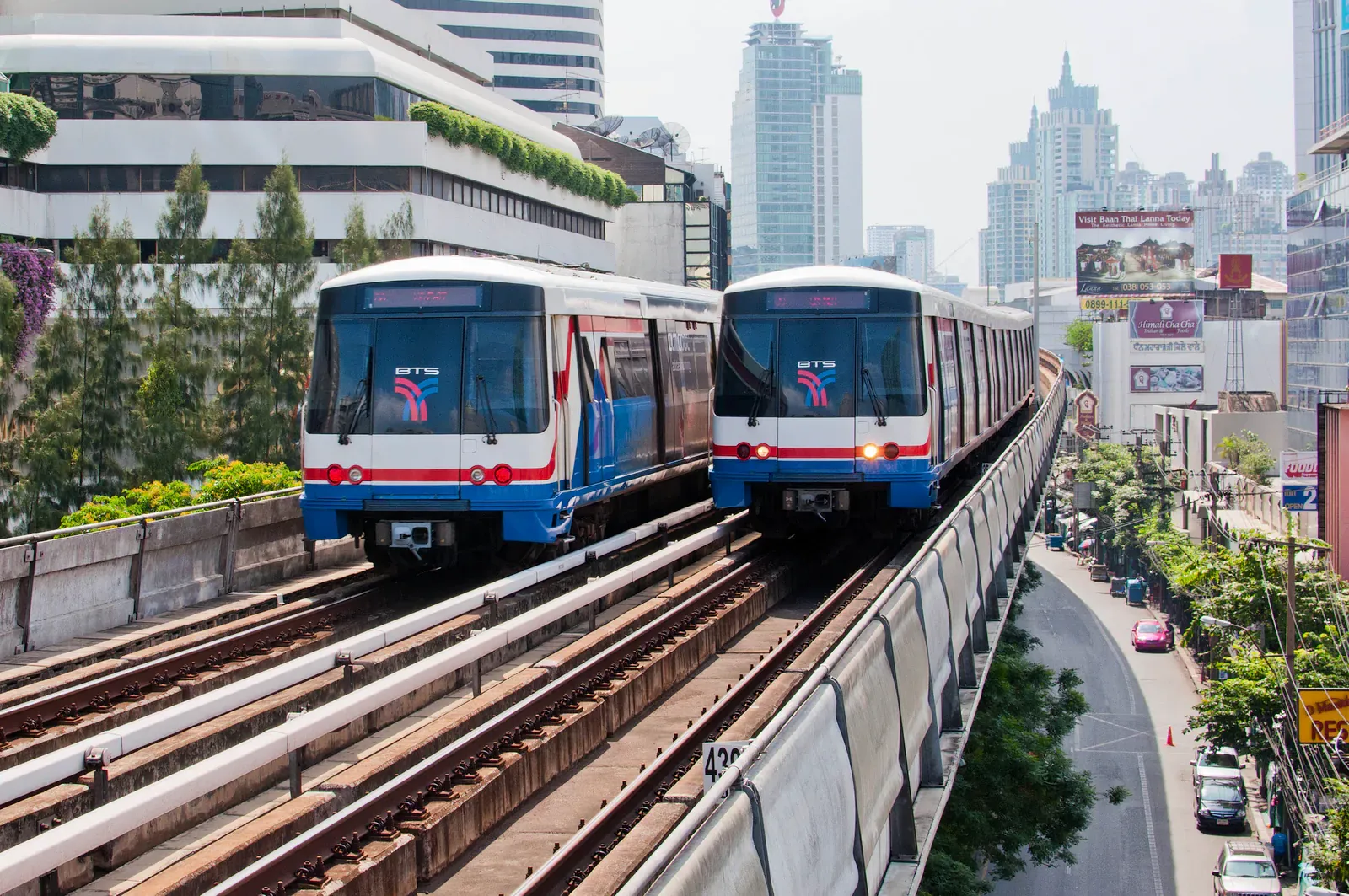
- Rail commuter: a stored-value card topped up regularly, plus the occasional taxi for the last mile or bad weather. The cheapest sustainable pattern for anyone living near a station.
- Taxi/ride-hailing habit: convenient, especially off the rail grid or late at night, but the line item that grows fastest if it becomes the default rather than the backup.
- Motorbike taxi: cheap for short hops, useful for beating traffic on short local trips, not a substitute for longer cross-city journeys.
- Car ownership: the outlier. Purchase or lease, insurance, fuel, parking and Bangkok traffic time make this the most expensive transport pattern by a wide margin, and very few residents in the central rail-served areas choose it. Only budget for a car if your work or family situation genuinely requires one.
The recurring lines people forget
- Phone: a local prepaid or postpaid SIM with data is cheap relative to many home countries; budget it as a small, stable line.
- Gym or fitness: ranges widely from a basic condo gym (often included in common fees) to a premium international-chain membership.
- Health insurance, by age: this is the line that grows fastest over time and the one most often left out of a first-pass budget entirely. Premiums for private cover rise with age, and the increase is not linear: it accelerates past roughly 50 and again past 60-70, with some insurers capping the age at which they’ll offer new cover. A younger single resident might carry a modest policy; an older resident or one with a pre-existing condition should expect this line to be several times larger.
- Out-of-pocket healthcare: co-pays, dental, routine check-ups and anything a policy excludes, distinct from the premium itself.
- Visa and reporting costs: government processing fees for whichever category applies, translation or notarisation where needed, and an agent’s fee for anyone who doesn’t want to navigate the process solo. See which Thai visa you actually need for how the category you hold shapes this line: a tourist-entry pattern of repeated extensions or border runs carries different, often higher, effective costs than a long-stay category built for your situation.
- Schooling, if relevant: for a family with school-age children, international school fees are frequently the largest single line in the entire household budget, well above rent. Get a specific quote from the actual schools under consideration rather than estimating.
- Travel home: average an annual trip (or however often you actually fly) into a monthly figure rather than treating it as a once-a-year shock to the budget.
- Irregulars fund: something breaks every year (an aircon unit, a filling, an unplanned flight). A budget with no cushion for this is not a real budget.
Three worked profiles
These are starting ranges built from the lines above. Substitute your own numbers into the same structure: that’s the point of the method, not the specific totals.
Single remote worker, one-bedroom, mid-tier area near a station
| Line | Monthly (฿) | Monthly (approx $) |
|---|---|---|
| Rent (incl. amortised deposit) | 22,000-28,000 | 610-775 |
| Utilities (blended cool/hot) | 2,000-3,500 | 55-95 |
| Food (mixed habit) | 9,000-15,000 | 250-415 |
| Transport (rail + occasional taxi) | 2,000-3,500 | 55-95 |
| Phone + gym | 1,500-3,000 | 40-85 |
| Health insurance (younger single) | 2,500-5,000 | 70-140 |
| Visa/reporting (averaged) | 500-1,500 | 15-40 |
| Travel home (averaged) | 2,000-4,000 | 55-110 |
| Irregulars fund | 1,500-2,500 | 40-70 |
| Total | ~43,000-66,000 | ~1,190-1,825 |
Arithmetic: sum the low ends (22,000+2,000+9,000+2,000+1,500+2,500+500+2,000+1,500 = 43,000) and the high ends (28,000+3,500+15,000+3,500+3,000+5,000+1,500+4,000+2,500 = 66,000) to get the range above; redo this with your own line values.
Couple, one-bedroom or small two-bedroom, mid-tier area
Rent, utilities and much of transport are shared rather than doubled; food, insurance and personal spending roughly double.
| Line | Monthly (฿) | Monthly (approx $) |
|---|---|---|
| Rent (shared, slightly larger unit) | 28,000-38,000 | 775-1,050 |
| Utilities | 3,000-5,500 | 85-150 |
| Food (two people) | 16,000-26,000 | 445-720 |
| Transport (two people) | 3,500-6,000 | 95-165 |
| Phone + gym (two) | 3,000-5,500 | 85-150 |
| Health insurance (two, younger-to-mid age) | 6,000-12,000 | 165-330 |
| Visa/reporting (two) | 1,000-3,000 | 30-85 |
| Travel home (averaged, two) | 4,000-8,000 | 110-220 |
| Irregulars fund | 2,500-4,000 | 70-110 |
| Total | ~67,000-108,000 | ~1,860-2,995 |
Note this is well under double the single figure above, because rent and utilities didn’t double. The same logic applies to any shared household.
Family of four, two-bedroom or larger, family-friendly area
Adds schooling, which frequently dominates the whole budget, and a larger food and utilities footprint.
| Line | Monthly (฿) | Monthly (approx $) |
|---|---|---|
| Rent (2-3 bedroom, family area) | 40,000-65,000 | 1,110-1,800 |
| Utilities | 4,500-8,000 | 125-220 |
| Food (family of four) | 25,000-40,000 | 690-1,110 |
| Transport (rail + taxis, family) | 4,000-7,000 | 110-195 |
| Phone + gym | 3,500-6,000 | 95-165 |
| Health insurance (family, incl. children) | 10,000-20,000 | 275-550 |
| Visa/reporting (family) | 1,500-4,000 | 40-110 |
| International school fees (per child, indicative) | 30,000-90,000+ | 830-2,495+ |
| Travel home (family, averaged) | 8,000-16,000 | 220-440 |
| Irregulars fund | 4,000-7,000 | 110-195 |
| Total, excluding schooling | ~101,000-173,000 | ~2,795-4,790 |
| Total, with one child in international school | ~131,000-263,000+ | ~3,625-7,285+ |
Schooling is quoted separately because the range across schools is enormous, and it’s the one line where getting an actual quote matters more than any range on this page.
Sanity checks: what a low number has usually forgotten
If your total comes out well below the ranges here, check for these before assuming you’ve found a genuine bargain:
- No health insurance line at all, on the assumption of staying healthy or using a home country’s system remotely: a real gap, not a saving.
- Rent quoted for a far-out station or an unfurnished unit, compared against furnished, well-located figures elsewhere.
- No deposit or lease-break cost if the plan is to move within the first year.
- A car cost not modelled because “I probably won’t need one” without checking the actual commute.
- Visa costs assumed at zero because the current plan is short tourist entries, which, if extended for months at a time, usually costs more in border runs, extension fees and risk than a long-stay route built for the purpose.
- No irregulars fund, so the first broken appliance or medical bill blows the monthly average.
Testing your estimate against a real month
The most reliable check is to track one full real month, every baht, against the categories above, ideally including a hot-season month and a cool-season month if you can. Where your actual spending diverges from your estimate, ask which driver moved: did you eat out more than planned, did the aircon run longer than budgeted, did an irregular cost land in an “average” month by chance. Adjust the range, not just the number, and keep the driver noted next to each line so next year’s estimate updates itself instead of starting from zero.
For the non-financial side of the decision, see living in Bangkok: pros and cons.
Common questions
How much does it really cost to live in Bangkok per month?
There’s no single answer: a single remote worker in a mid-tier one-bedroom typically lands somewhere in the ฿43,000-66,000 (~$1,190-1,825) range built above, a couple roughly ฿67,000-108,000, and a family of four ฿101,000-173,000 before schooling. Build the number from your own housing, food and transport habits rather than trusting an average.
Why do cost-of-living websites disagree so much about Bangkok?
They survey different populations, define “rent” differently (central versus suburban, furnished versus not), and often omit car ownership, insurance or visa costs entirely. None of them are necessarily wrong: they’re answering a narrower question than “what will I actually spend.”
What’s the biggest line item in a Bangkok expat budget?
Rent, for most single people and couples. For a family with a child in international school, schooling frequently overtakes rent as the largest single line by a wide margin.
Does health insurance really matter that much in a monthly budget?
Yes, and it’s the line that grows fastest over time rather than staying flat: premiums rise with age, sometimes sharply past certain bands, and it’s the line most often left out of a first attempt at a Bangkok budget entirely.
How do I compare a serviced apartment against a standard 12-month lease?
Compare the effective monthly cost, not just the headline rent: a leased unit’s amortised deposit is a small addition to its monthly rent, while a serviced unit’s higher nightly or monthly rate already has that flexibility priced in. Decide how much you value not being tied to a lease, then price that flexibility against the difference.
Is it cheaper to live outside central Bangkok?
Usually yes for rent specifically, but check the trade-off against commute time and cost before assuming it’s cheaper overall: see rent prices by BTS station for how price falls off by distance from a central interchange, and weigh that against your actual daily travel pattern.
Written by
Mike Brochlowski
Founder and editor, travel photographer and designer
I'm Mike Brochlowski, a travel photographer and designer, and I currently live on Koh Samui, Thailand. I built BangkokWiki to put practical, checked information about Bangkok in one place. Every page is researched from official and primary sources, and the text names them. Where a page shows a checked date, that is when its facts were last confirmed. I also run samui69.com, a non-commercial guide to Koh Samui. If you spot an error or something out of date, tell me through the contact page and I will check it and correct the page.
Read all articles
Visas and paperwork
Staying in Thailand longer?
Visas, extensions, documents and banking for longer stays. Rules and fees change often and offices apply them differently, so check the official source before you act.
Places to stay
Find a hotel
Explore the other desks
More from Living
- 9 min read
 13 min read
Bangkok with a Baby: Essentials for the First Week
 12 min read
Kids Activities and Classes in Bangkok: What Actually Exists

Newsletter
You're subscribed as