Living
Churches and Places of Worship in Bangkok
A respectful guide to Bangkok's Buddhist, Christian, Muslim, Hindu, Sikh, Jewish and Baháʼí communities, with etiquette for newcomers who want to attend.
On this page
Thailand is majority Theravada Buddhist and its constitution protects religious freedom, and Bangkok reflects that in practice: long-established Christian, Muslim, Hindu, Sikh, Jewish, and Baháʼí communities sit alongside the city’s Buddhist majority, many with services and gatherings in English and other languages. This guide covers each community factually, with what a newcomer should know about attending, dress, and etiquette, and treats none of them as a curiosity. For the city’s religious mix in numbers, see Bangkok population and demographics.
Buddhist practice for foreigners
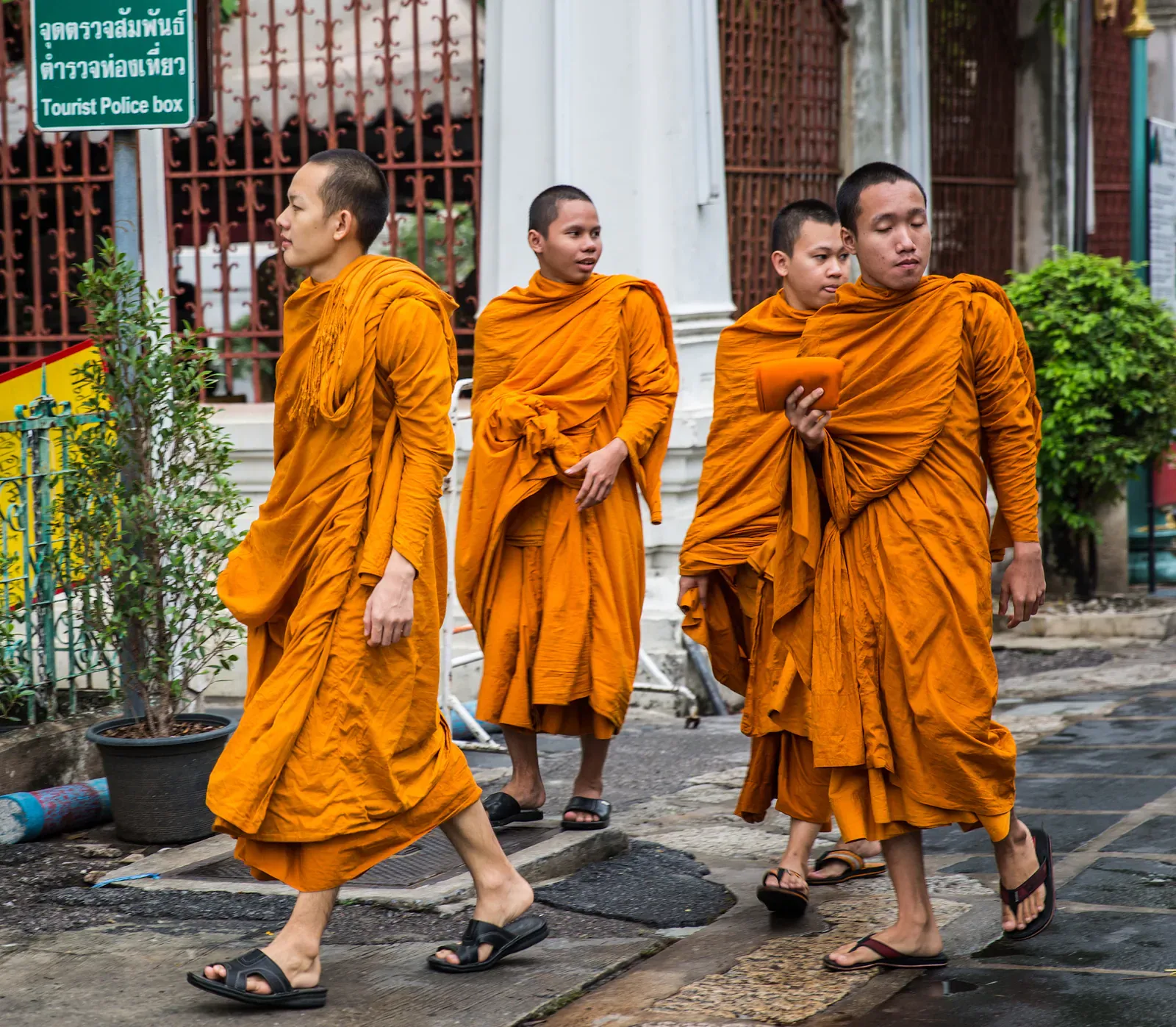
Thai Buddhism is Theravada, and Bangkok has thousands of temples (wat) ranging from small neighbourhood sites to major national landmarks. For a foreigner, there’s an important distinction between a tourist-facing visit (walking through a well-known temple complex, observing dress rules, taking photographs where permitted) and joining a practising community, which is a different relationship entirely.
A number of Bangkok temples and meditation centres offer instruction in English specifically for foreigners, ranging from single introductory sessions to multi-day residential retreats. These are usually structured around basic sitting and walking meditation instruction, sometimes with a short talk on Buddhist principles, and welcome complete beginners. Dress modestly (shoulders and knees covered, no restrictive rule beyond that), remove shoes before entering main halls, and follow the seating and posture cues of people already there rather than guessing.
Monastic ordination (becoming a monk, even temporarily, which Thai men often do for a short period as a rite of passage) is a genuine option for foreign men who want to go further, and some monasteries have a track record of accepting them, but it is a serious commitment involving vows, a shaved head, and a structured daily routine, not a novelty experience. Anyone considering it should approach it as they would any major life commitment, through direct, careful enquiry with a specific monastery rather than assuming any temple will accommodate a short-term arrangement.
Meditation retreats aimed at foreigners range from free (supported by donation, following the traditional Buddhist practice of dana) to structured programmes with a modest indicative fee, roughly ฿500-3,000 (US$15-90) per day for 2026 depending on the centre and whether accommodation and food are included: treat any specific figure as needing confirmation with the centre itself, since practices differ widely and many operate on a donation-only basis as a matter of principle. Turning up in the wrong spirit is the more common mistake than turning up with the wrong amount of money: these are practice spaces first, and centres that cater well to foreigners are used to beginners but still expect quiet, punctuality, and a genuine willingness to follow instruction rather than treating the session as a cultural performance to watch.
For someone who wants ongoing practice rather than a single retreat, some temples run regular sitting groups open to lay practitioners, foreign and Thai, on a weekly or monthly rhythm, a much lower-commitment way to build a relationship with a teacher and a community than a residential retreat, and often the more sustainable route for someone settling into Bangkok for the long term rather than passing through.
Christian communities
Bangkok’s Catholic presence traces back centuries, formalised today under the Archdiocese of Bangkok. Assumption Cathedral, the archdiocese’s principal church in the Bang Rak riverside area, is one of the city’s most recognisable religious landmarks and has hosted both papal visits to Thailand. Nearby, Holy Rosary Church on the eastern bank of the Chao Phraya is another historic riverside Catholic church, built originally to serve Portuguese and later Vietnamese Catholic communities in the area, recognisable by its gothic spire. Catholic parishes across the city hold Masses in Thai, English, and other languages depending on the congregation, and English-language Masses are a long-standing fixture at several central parishes.
Anglican and other mainline Protestant congregations have a long history in Bangkok as well, generally holding services in English and drawing a mixed international congregation. Alongside these, a number of large international and evangelical churches have grown substantially in recent decades, often meeting in modern auditorium-style venues rather than traditional church buildings, with contemporary worship styles and a strong small-group and community-programme culture aimed at newcomers. Orthodox Christian communities, smaller in number, also maintain a presence in the city.
For any Christian service as a visitor: modest dress is appreciated though rarely strictly enforced outside the most formal settings, arriving a little early is normal practice, and most congregations are used to visitors and will make introductions easy without being pushy about it.
Beyond the service itself, many of Bangkok’s larger international and evangelical churches run an active weekday programme (small groups meeting in homes or coworking-style venues, newcomer lunches, young-professionals gatherings, family and children’s ministry) that often ends up mattering more to a new arrival’s social life than the Sunday service does. Someone weighing which congregation to settle into is often better served by asking about this weekday layer directly than by judging a church purely on its Sunday format, since a smaller, quieter service can still sit on top of a very active community underneath it.
Denominational differences are worth knowing before you turn up somewhere expecting a specific style: a traditional Catholic Mass or Anglican liturgy follows a fixed structure that repeats week to week, while the newer international and evangelical churches tend toward a more contemporary, less liturgical format with contemporary music and a longer sermon. Neither is more or less legitimate; they simply suit different expectations, and it’s entirely normal to visit two or three different congregations before settling on one.
Muslim communities
Thailand’s Muslim population and Bangkok’s Muslim community specifically have deep historical roots, going back centuries through Cham, Malay, Persian, Indian, and other Muslim traders and settlers. Bangkok has a very large number of registered mosques spread across the city, with historically significant Muslim neighbourhoods and communities concentrated in areas including Bang Rak, Thonburi, Ratchathewi, and around Ramkhamhaeng, where Muslim communities with roots in Thailand’s south established themselves from early in the twentieth century. For visitors, see mosques and halal food by area.
Some of the city’s mosques are architecturally and historically notable: one of Bangkok’s oldest mosques sits in the Thonburi area, reflecting Egyptian and Javanese-influenced architecture, while another well-known mosque near the river in the Bang Rak area was built by Indonesian-Arab traders and is known for its calligraphy. Each mosque tends to reflect the specific heritage of the community that built it: Cham, Malay, Indian, or Turkish influence is visible across different mosques in different neighbourhoods.
Friday prayer (Jummah) is the main communal gathering, and visitors are generally welcome at most mosques outside prayer times for a respectful look, though direct participation in prayer is for practising Muslims. Women should bring a headscarf and wear loose, covering clothing; men should wear long trousers; everyone removes shoes before entering the prayer hall. Halal food is easy to find across Bangkok, particularly clustered around the Muslim neighbourhoods mentioned above, and Ramadan brings a visible shift in daily rhythm in those areas: evening markets selling food for breaking the fast, extended prayers, and a noticeably different pace after sunset.
For a Muslim newcomer moving to Bangkok, the practical questions tend to matter as much as the spiritual ones: which neighbourhoods make halal food and a nearby mosque part of daily life without much effort, where children can get after-school Islamic studies classes, and which communities have an active network for newly arrived families rather than just a prayer hall. The neighbourhoods with the deepest historical Muslim presence tend to answer all three well, since a long-established community usually comes with the halal restaurants, the madrasah-style classes, and the informal support network already built in. Newer arrivals sometimes find it easier to start by simply asking at a local halal restaurant or market stall in one of these areas, which tend to be well connected to the mosque and community nearby.
Hindu communities
Bangkok’s Hindu community, historically linked to Tamil and North Indian trading families who settled in the city generations ago, maintains several temples, the best known of which is a prominent Hindu temple in the Silom area dedicated to a form of the Goddess and popularly known by a colloquial Thai name. It draws not only Hindu worshippers but also many Thai Buddhists, who visit and make offerings there as part of a broader, syncretic Thai devotional practice that isn’t unusual around the city’s Hindu and Chinese shrines.
Visitors are generally welcome to observe respectfully; remove shoes before entering, dress modestly, and follow the lead of worshippers regarding where to stand and photograph. Major Hindu festivals draw large, colourful gatherings and are one of the more visible expressions of the community’s continued presence in the city, and are usually the easiest single occasion for a curious newcomer to see the community at its most active and welcoming.
Beyond the well-known Silom temple, smaller Hindu shrines and community associations exist elsewhere in the city, often organised around specific regional or linguistic groups within the broader Indian-Thai community. For someone wanting more than an observational visit (a genuine connection to the community), asking at the temple itself about associated cultural or social associations is usually more productive than searching online, since much of this community’s social organisation runs informally rather than through a public web presence.
Sikh community
Bangkok’s Sikh community centres on a well-established gurdwara in the Phahurat area, known locally as Bangkok’s Little India, a multi-storey building with a distinctive dome that serves as both a place of worship and a community hub for the city’s Sikh and broader Indian population. The langar tradition (a free communal meal, open to anyone regardless of faith or background, prepared and served as an act of equality and service) is a central practice at the gurdwara and one of the more welcoming entry points for a curious visitor.
Anyone visiting should cover their head (a scarf is usually available at the entrance for those without one), remove shoes, and dress modestly. Sitting on the floor to eat alongside everyone else during langar is the expected practice, not an optional extra, and it’s a genuinely accessible way for a newcomer of any background to experience the community directly, and it functions as a form of community volunteering in its own right for those who help prepare and serve it regularly.
The gurdwara in Phahurat sits inside one of Bangkok’s most concentrated small ethnic-commercial districts, with Sikh, Hindu, and broader South Asian-owned textile and fabric shops filling the surrounding streets, and the two (the place of worship and the trading community around it) have grown up together over generations. A visit tends to work well as part of a wider walk through the area rather than a single-purpose trip, and the langar meal is as much a chance to talk with long-settled community members as it is a religious observance.
Jewish community
Bangkok’s Jewish community is small relative to the city’s size but well established, with more than one synagogue serving different traditions within the community, including at least one long-standing Ashkenazi congregation and a separate Sephardic congregation, alongside an active Chabad presence that serves both the resident community and visiting Jewish travellers. Kosher food is available in Bangkok on a limited but real basis, through a small number of dedicated kosher restaurants and community kitchens tied to the synagogues.
Visitors wanting to attend services are generally welcome but should contact the specific synagogue or community organisation in advance, since access and security arrangements vary and change, rather than simply arriving unannounced.
Baháʼí and other communities
Bangkok also has a small Baháʼí community, consistent with the Baháʼí Faith’s presence across Thailand more broadly, organised around local gatherings rather than a single large temple. Other smaller religious communities (including various Chinese folk religion practitioners, whose shrines and temples are common across the city, often blending Buddhist and Taoist elements) add to the texture of religious life here without fitting neatly into any single category above.
Finding current service times
Service times, retreat schedules, and event calendars change, and this guide deliberately does not state any of them, because a stale time printed here would send someone to a locked door. The reliable approach: check a specific congregation’s own current channels close to when you plan to attend, ask a member of the community you’ve connected with through a social route such as a meetup or volunteering group, or simply visit during clearly active daylight hours to ask in person, which works for most communities described here.
Religious schooling and children’s classes
Several of Bangkok’s international schools have a religious affiliation (Catholic, other Christian denominations) and some faith communities separately run supplementary weekend or after-school religious education classes for children: Sunday school-style Christian classes, Islamic studies classes, and similar programmes tied to specific mosques, churches, or temples. Relocating families with school-age children should ask directly at both the schools they’re considering and any congregation they plan to join, since availability and format vary by community and change year to year.
Weddings, funerals, and civil versus religious status
In Thailand, a religious wedding ceremony (Buddhist, Christian, Muslim, or otherwise) is not by itself sufficient for legal marriage recognition; civil registration is a separate administrative step handled through the relevant district office, and most binational or foreign couples need to handle both processes deliberately rather than assuming a religious ceremony covers it. The same separation broadly applies to death and inheritance matters, where religious funeral rites and legal death registration and estate matters run on separate tracks. Couples and families should treat the religious and civil sides as two separate to-do lists, not one.
Funeral customs also vary meaningfully by community and matter practically, not just spiritually, for a family arranging one quickly. Thai Buddhist funerals typically run over several days with merit-making ceremonies at a temple; Muslim burial in Thailand generally follows Islamic practice of burial as soon as reasonably possible, coordinated through the mosque community; Christian, Hindu, Sikh, and Jewish communities each have their own established local practices and community networks that a family can lean on for guidance in what is usually an unfamiliar and stressful process for a foreign resident. Congregational and community leaders across all of these traditions are generally the fastest, most reliable source of practical guidance in the moment, well ahead of anything a general guide can offer.
Interfaith and mixed-faith families
Bangkok’s international community includes a meaningful number of interfaith couples and families, and several congregations across the traditions above have direct experience supporting mixed-faith households, whether that means accommodating a spouse of a different faith at family events, advising on how to raise children across two traditions, or simply being a welcoming, low-judgment community for a family that doesn’t fit one box neatly. Asking a congregation directly about its experience with interfaith families, before committing to it as your community, is a reasonable and common question.
The Erawan Shrine and its neighbours
The Erawan Shrine, at the Ratchaprasong intersection, is one of Bangkok’s most visible religious sites and a good example of the city’s syncretic devotional life: it is dedicated to the Hindu god Brahma but is overwhelmingly visited by Thai Buddhists as well as Hindu worshippers, alongside a steady stream of curious visitors. Worshippers bring flower garlands, incense, and sometimes commission traditional Thai dancers performing on the spot as a form of thanksgiving when a wish is believed to have been granted.
A handful of similar shrines sit nearby along the same stretch of central Bangkok, each associated with different deities and popular for different kinds of requests (business success, relationships, general fortune). Visitors are welcome to walk through and observe; if you want to make an offering yourself, small garlands and incense are sold right at the shrine, and the respectful approach is simply to watch what other worshippers do and follow the same basic sequence (light incense, place the garland, a brief moment of quiet respect) rather than treating it as a photo opportunity alone.
Common questions
Are there English-language church services in Bangkok?
Yes. Catholic parishes, Anglican and other mainline Protestant congregations, and a number of large international and evangelical churches all hold English-language services, and Bangkok’s Christian community more broadly has held services in multiple languages for a very long time.
Can non-Muslims visit mosques in Bangkok?
Generally yes, outside of prayer times and with modest dress: women should bring a headscarf and loose clothing, men long trousers, and everyone removes shoes before entering the prayer hall. Friday prayer itself is for practising Muslims, but a respectful outside-hours visit is normally welcome.
Is there a Jewish community and kosher food in Bangkok?
Yes, a small but well-established Jewish community maintains more than one synagogue across different traditions and a Chabad presence, and a limited number of kosher restaurants and community kitchens operate in the city.
What should I wear to visit a Bangkok temple or shrine?
Modest dress covering shoulders and knees, and shoes off before entering any main hall or prayer area. This applies broadly across Buddhist temples, Hindu temples, and the gurdwara, with mosques adding a headscarf requirement for women.
How do I find out current service or prayer times?
Check the specific congregation’s own current channels close to your visit rather than relying on any general guide, since schedules change; asking a community member you’ve met through a local meetup or volunteering group is often the fastest reliable route.
Does a Buddhist or Christian wedding count as legal marriage in Thailand?
Not on its own. Religious ceremonies across all traditions here are separate from civil marriage registration, which happens through a district office, so couples generally need to complete both the religious ceremony they want and the civil registration for legal recognition.
Written by
Mike Brochlowski
Founder and editor, travel photographer and designer
I'm Mike Brochlowski, a travel photographer and designer, and I currently live on Koh Samui, Thailand. I built BangkokWiki to put practical, checked information about Bangkok in one place. Every page is researched from official and primary sources, and the text names them. Where a page shows a checked date, that is when its facts were last confirmed. I also run samui69.com, a non-commercial guide to Koh Samui. If you spot an error or something out of date, tell me through the contact page and I will check it and correct the page.
Read all articles
Visas and paperwork
Staying in Thailand longer?
Visas, extensions, documents and banking for longer stays. Rules and fees change often and offices apply them differently, so check the official source before you act.

Places to stay
Find a hotel
Explore the other desks
More from Living
- 12 min read
 12 min read
Volunteering in Bangkok: A Practical, Ethical Guide
 9 min read
Renting Near an International School in Bangkok

Newsletter
You're subscribed as