Transport
Bangkok Traffic Peak Hours: Rush Hour, Rain, Festivals
Why Bangkok traffic is worst at different times for different reasons: daily rush hour, rainy-season flooding, and scheduled festival road closures explained.
On this page
Bangkok traffic peak hours run roughly 7:30 to 9:30 in the morning and 17:00 to 19:30 in the evening, and that daily rush hour is only one of three separate reasons the city’s traffic gets a bad reputation. The other two, seasonal flooding and scheduled festival closures, follow completely different calendars, and most “Bangkok traffic is bad” guides blur all three into one vague warning. They’re not the same problem, and they don’t call for the same fix.
Here’s each one on its own terms, with the numbers and dates that actually back it up.
Cause one: the daily rush hour that repeats every weekday
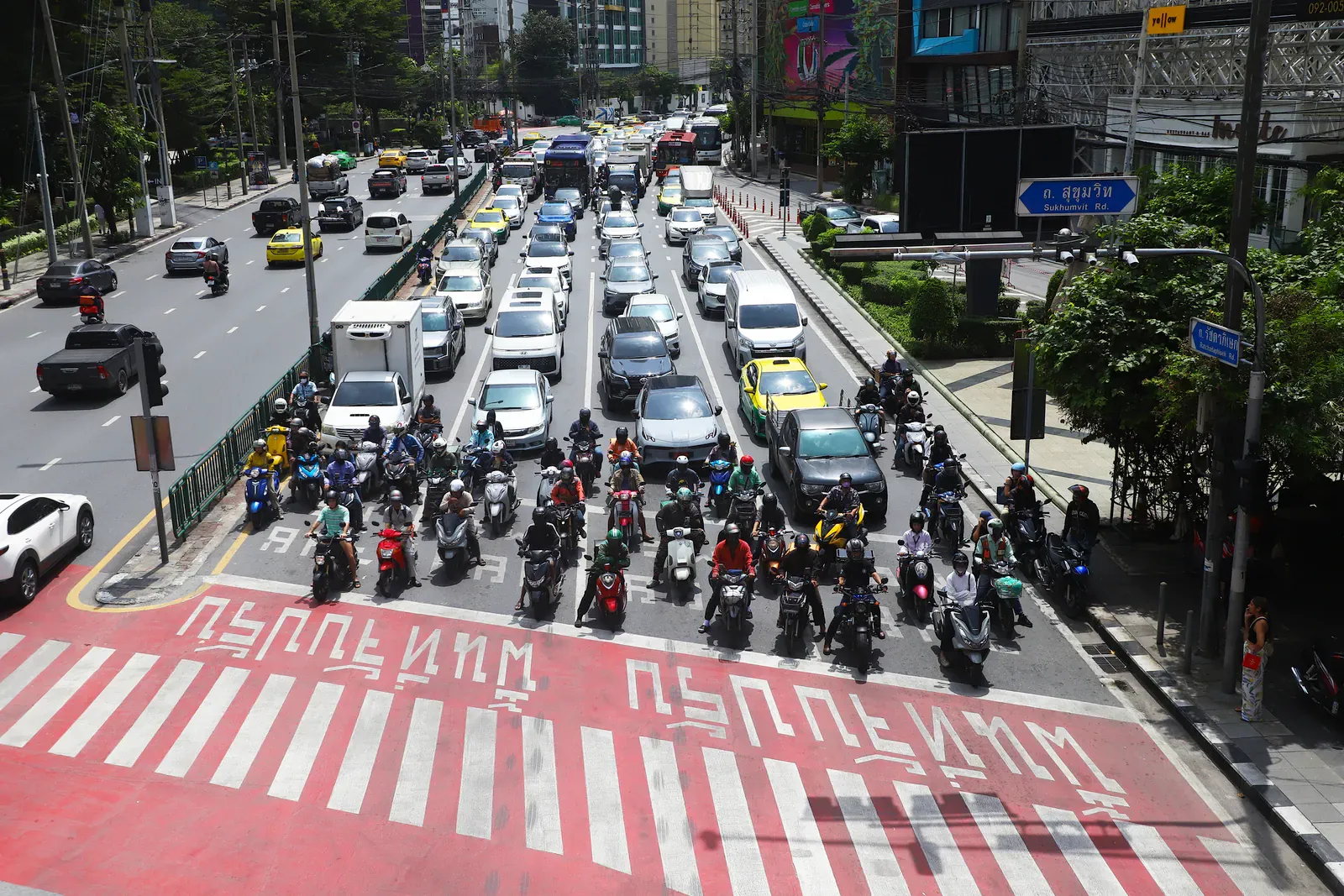
This is the predictable one. Morning rush builds from around 6:30, peaks between 7:30 and 9:30, and eases off by mid-morning. Evening rush starts around 16:00 to 16:30 and typically runs past 19:00, sometimes stretching to 20:00 or later on a Friday. Between roughly 9:00 and 16:00, the same roads run noticeably clearer.
According to the TomTom Traffic Index (data checked September 2026), a 10 km trip across Bangkok averages about 23 minutes overall, but stretches to roughly 26 minutes during the morning peak and around 31 minutes during the evening peak. TomTom’s figures also put Bangkok drivers’ annual time lost in rush-hour traffic at about 115 hours in 2025, roughly five hours more than the year before, with citywide congestion averaging 67.9 percent across the year, the worst of any Thai city.
- Off-peak (9:00-16:00)
- 20 min
- Daily average
- 23 min
- Morning peak (7:30-9:30)
- 26 min
- Evening peak (17:00-19:30)
- 31 min
Source: TomTom Traffic Index, checked September 2026
“Bangkok drivers lost about 115 hours in rush-hour traffic in 2025,” TomTom Traffic Index, 2026 data summary
Why the evening peak is worse than the morning
Evening rush stacks two things the morning doesn’t: everyone leaving offices within roughly the same two-hour window, and a full day of accumulated road use, deliveries, and minor incidents that morning traffic hasn’t yet hit. The gap shows up directly in the travel-time numbers above, a five-minute difference on the same 10 km stretch. If your schedule has any flexibility, shifting a return trip even 30 to 45 minutes later, once the first wave has cleared, tends to help more than shifting a morning departure earlier.
Why Bangkok’s road network amplifies the daily jam
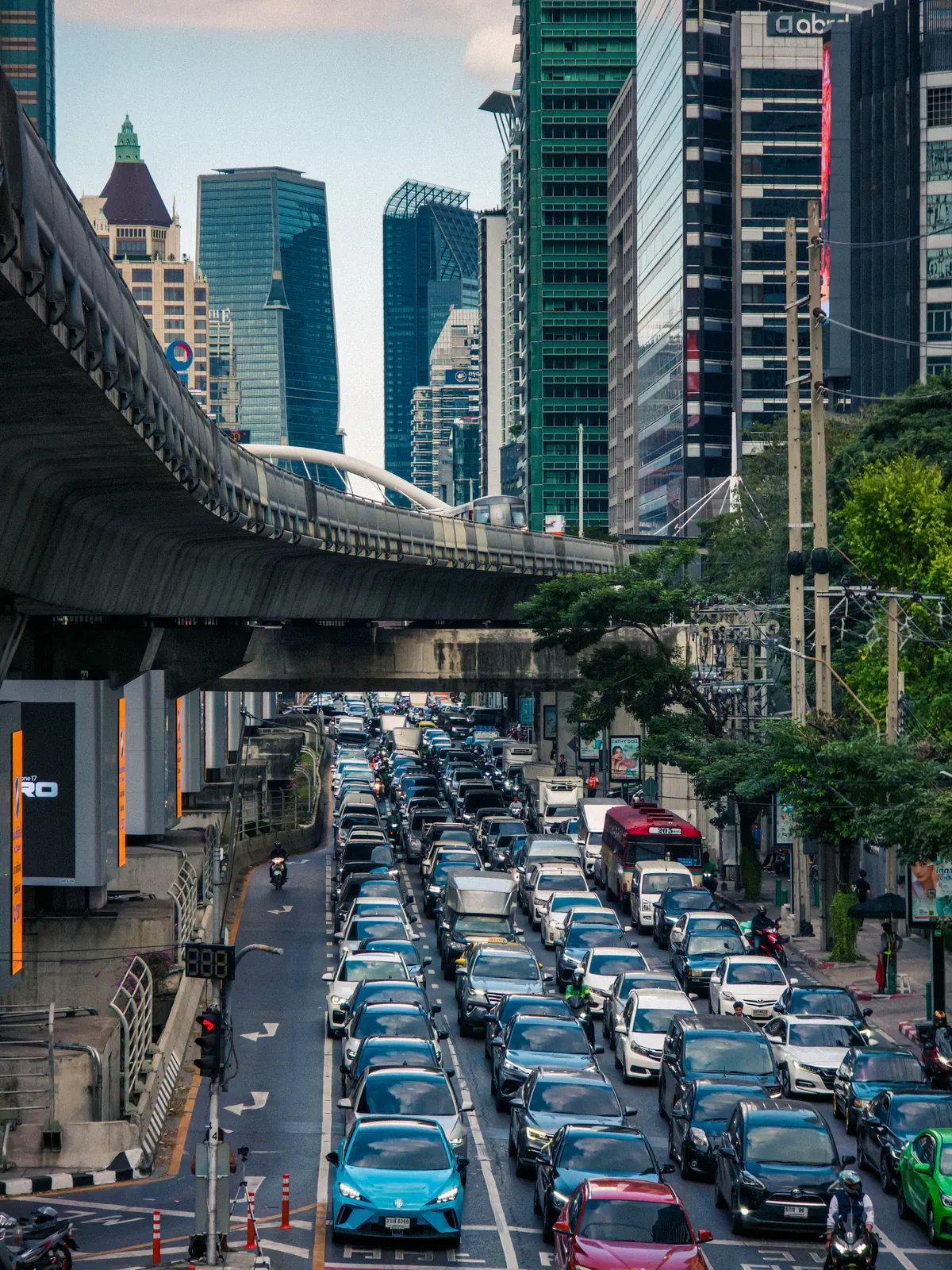
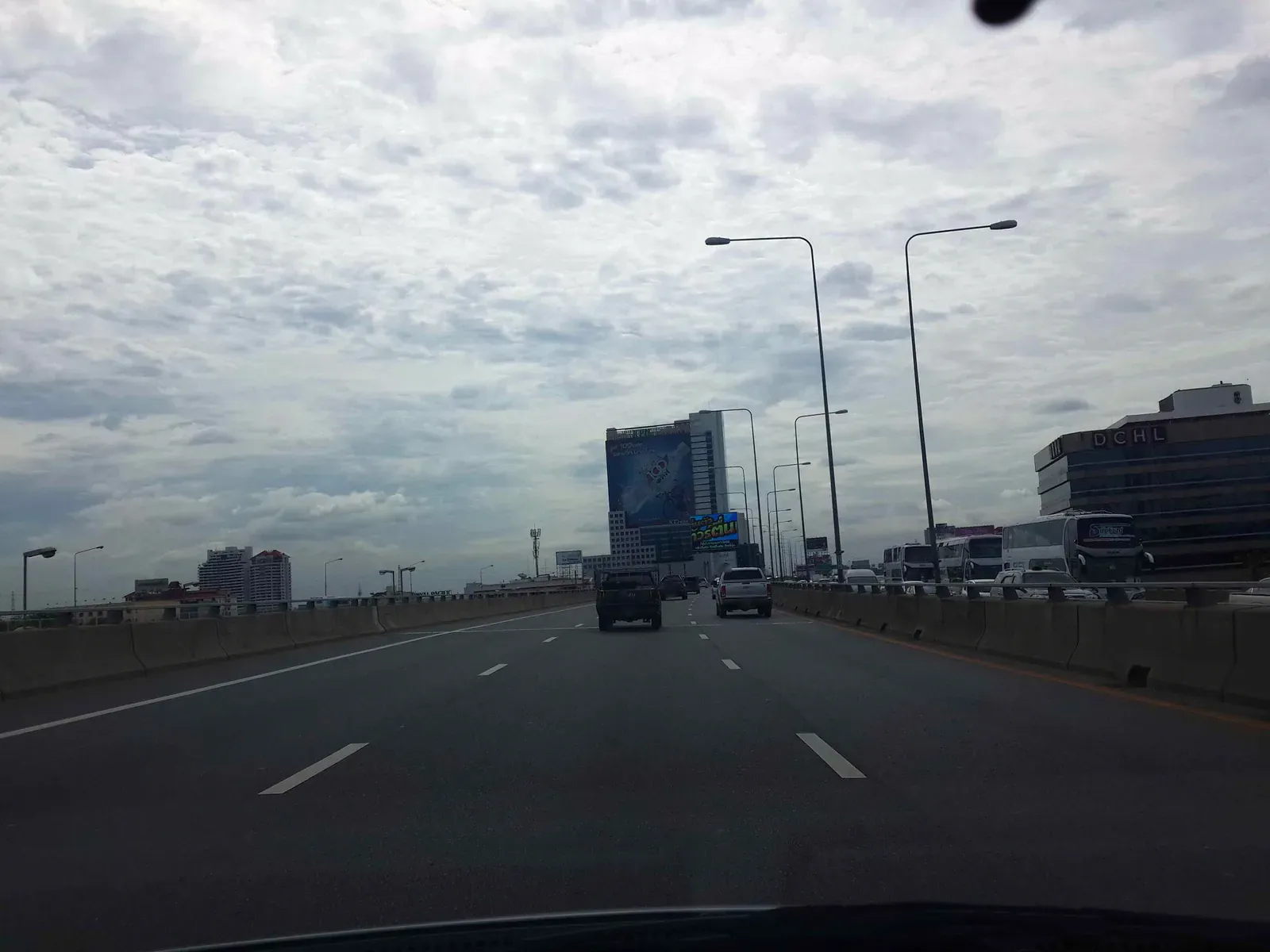
Rush hour hits Bangkok harder than a similarly sized city with a grid layout, for structural reasons that don’t change day to day. The Chao Phraya river runs through the city with a limited number of bridges, so cross-river trips funnel through a handful of choke points regardless of how light traffic is elsewhere. Much of the road network is built around long one-way systems in the older districts, meaning a short straight-line distance can require a long loop to a main road and back. And the city’s soi (side-street) layout means many addresses only connect to the main road network at one or two points, so a jam on that single access road can strand an entire neighbourhood’s traffic with no alternate route.
None of that is unique to rush hour, but it’s why the same daily peak that might add ten minutes to a trip in a well-gridded city can add thirty in Bangkok: there’s simply less room for traffic to reroute around a slow patch. It’s also why the rail network, unaffected by any of these road-layout constraints, holds such a consistent time advantage over a car or taxi on a route that runs parallel to a BTS or MRT line during peak hours.
Cause two: rainy-season flooding, unpredictable rather than daily
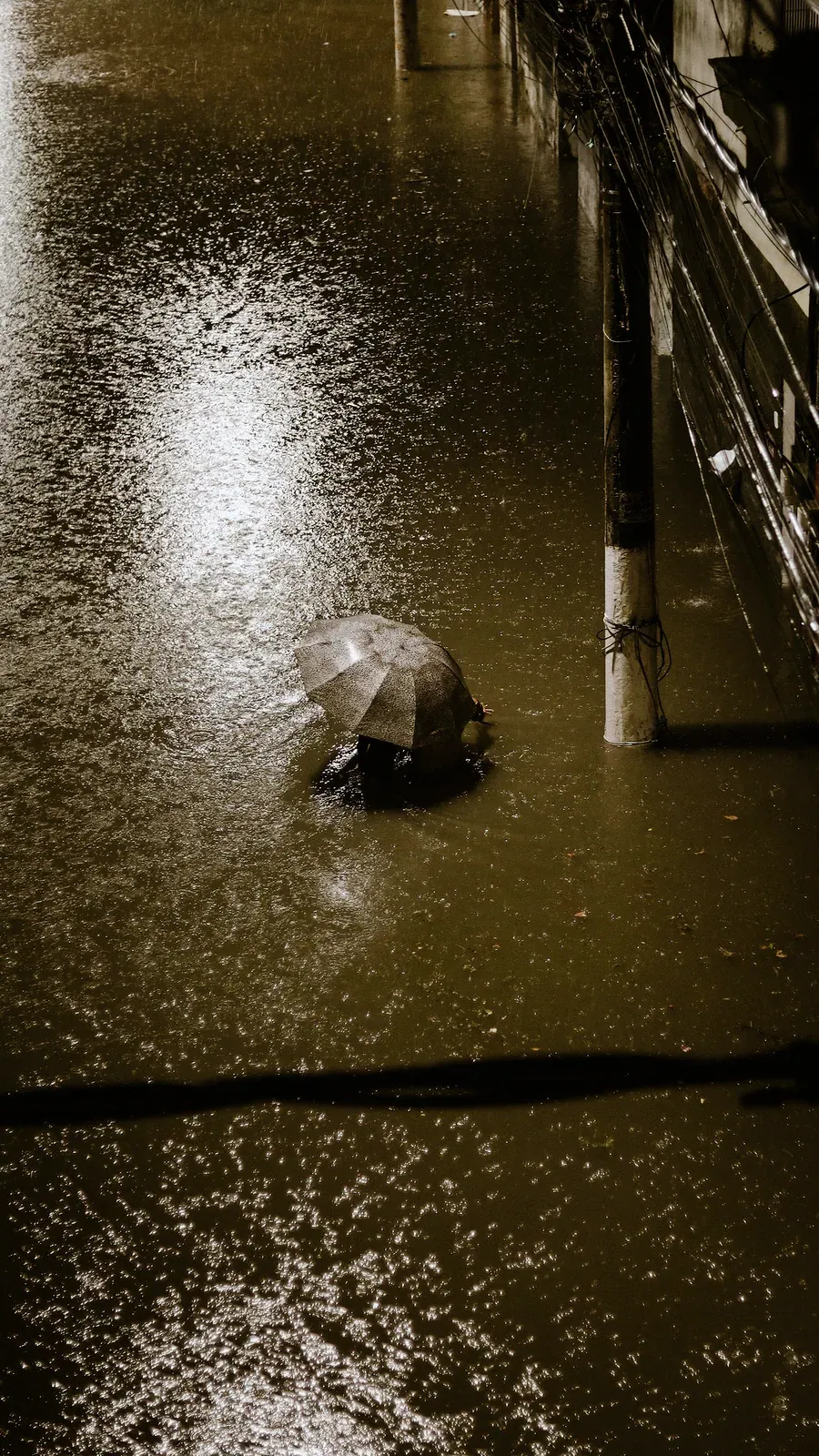
Unlike rush hour, this cause doesn’t follow a clock. Bangkok’s rainy season runs roughly May through October, and heavy downpours, particularly anything exceeding 100mm in a short window, can flood low-lying streets, underpasses, and even parts of the rail network within the hour. It happens on some days and not others, which is exactly why it catches newcomers off guard more than the predictable rush hour does.
A clear, dated example: on the evening of 5 to 6 September 2025, the Thailand Cultural Centre MRT station on the Blue Line flooded at concourse level, with water entering through a construction vent connected to an adjacent building project during rain exceeding 100mm on Ratchadaphisek Road. Commuters had to wade through standing water to reach ticket machines. The platform level stayed dry and trains kept running, but the concourse flooding, and the traffic chaos on the surface streets above it that same evening, was widely reported by Bangkok Post and Nation Thailand at the time.
The Samsen Road collapse: a different kind of disruption
Worth separating out on its own, because it’s often lumped in with routine flooding when it wasn’t one. On the morning of 24 September 2025, at around 7:13am, a sinkhole roughly 30 metres wide and 50 metres deep opened on Samsen Road in the Dusit district, next to Vajira Hospital, swallowing several vehicles including a police tow truck. No casualties were reported, but nearby buildings were evacuated and the hospital briefly suspended new admissions while the site was stabilised with sandbags and crushed stone.
The stated cause was a burst underground water main combined with erosion from an unfinished section of the MRT Purple Line tunnel nearby, with floodwater weakening the road structure until it gave way. It happened during the rainy season and floodwater played a role, but it wasn’t ordinary street flooding. It’s a reminder that Bangkok’s ageing underground infrastructure and its active construction projects can occasionally produce sudden, localised road closures that have nothing to do with the daily commute pattern at all.
Cause three: festival road closures, scheduled well in advance
This is the one cause you can actually plan around perfectly, because the dates are published. Songkran, Thailand’s water festival, closes specific roads to normal traffic for days at a time every April. For 2026, Khao San Road ran a full closure from 13 to 15 April, noon to midnight each day, with a one-way pedestrian system (entry via Chakraphong Road, exit via Tanao Road). Silom Road, between the Sala Daeng and Nararam intersections, closed from 12 to 14 April, 10:00 to 21:00, functioning as a water-play walking street.
Free shuttle buses ran a Lan Khon Mueang to Khao San to Sanam Luang loop every 20 minutes during the closure window, tracked in real time through the ViaBus app, so getting near the festival zone without a car was genuinely workable. Big concerts and matches also add road load; see stadiums and arenas for events for venues and rail routes.
The three causes side by side
| Cause | Frequency | Predictability | Typical effect |
|---|---|---|---|
| Daily rush hour | Every weekday | High, same windows daily | 10 km trip takes 26-31 min instead of 20-23 |
| Rainy-season flooding | Some days, May-October | Low, depends on rainfall intensity | Localised street or station flooding, sudden delays |
| Festival road closures | A few days per year | High, dates published in advance | Specific named roads fully closed for hours or days |
How to actually plan around each one
- Daily rush hour: travel between 9:00 and 16:00 when possible, or shift an evening trip 30 to 45 minutes past the worst of the 17:00-19:30 window.
- Rainy season: check the sky and a weather radar before committing to a road trip during heavy rain, and have a rail-based backup route in mind since flooding tends to hit street level and underpasses harder than elevated platforms.
- Festival dates: look up the specific road closures for your travel dates a few days ahead, not the morning of, since full lists (like Khao San Road’s and Silom Road’s Songkran closures) are published in advance.
- Any day: build slack into a schedule that matters (a flight, a visa appointment) rather than timing it to the minute against any of these three causes.
- Cross-river trips: budget extra time regardless of hour, since a limited number of bridges means any slowdown near a crossing affects a wider area than a similar jam elsewhere in the city.
- After a heavy downpour: wait 20 to 30 minutes before setting out on foot or by road if the rain was intense; Bangkok’s street-level drainage generally clears standing water fairly quickly once the rain itself stops, but the surge of vehicles all leaving at once right after a storm often creates its own secondary jam.
For a wider comparison of getting around at all, the best transport apps in Bangkok covers which app actually tracks live conditions, and what transport actually costs in Bangkok prices out rail-heavy versus road-heavy routines side by side.
Does the rain make the BTS and MRT unreliable too?
Mostly not, and that’s the practical upside of all three causes above. Elevated BTS platforms sit above street-level flooding entirely, and MRT’s underground stations are built for exactly this climate; the September 2025 Thailand Cultural Centre incident affected a concourse-level access point tied to nearby construction, not the platform or train service itself, which kept running throughout. During Bangkok’s daily rush hour, rail also holds a real edge, since trains run on a fixed schedule immune to road congestion, while a car or bus on the same corridor sits in exactly the traffic described above. Where rail genuinely doesn’t reach, Bangkok’s bus system and the last mile in Bangkok cover the road-based options for that final stretch, and if you’re weighing whether to walk that stretch instead, see is Bangkok walkable.
Common questions
What time is Bangkok traffic at its worst?
The evening window, roughly 17:00 to 19:30, is generally worse than the morning window of 7:30 to 9:30, based on TomTom Traffic Index travel-time data: a 10 km trip that takes about 26 minutes in the morning peak stretches to about 31 minutes in the evening peak.
Does rainy season make Bangkok traffic worse every day?
No. Heavy rain and localised flooding happen on some days between roughly May and October, not continuously, which is what makes this cause harder to plan around than the fixed daily rush-hour windows.
Do roads close for Songkran every year?
Yes, specific streets close for Thailand’s water festival every April, though exact dates and hours shift year to year. For 2026, Khao San Road closed 13 to 15 April and Silom Road closed 12 to 14 April, both published in advance by local authorities.
Are the BTS and MRT affected by Bangkok’s traffic causes?
Rush-hour road congestion doesn’t affect rail schedules at all, since trains run on fixed tracks. Rainy-season flooding can occasionally affect a station’s street-level access point, as it did at Thailand Cultural Centre in September 2025, but platform and train operations are built to stay clear of it.
Is there a single worst day of the year for Bangkok traffic?
Not one fixed date. The worst individual days tend to be a heavy-rain evening that coincides with rush hour, or the lead-up to a major festival closure as people travel before roads shut, rather than any single predictable calendar date.
Last verified: September 2026.
Written by
Mike Brochlowski
Founder and editor, travel photographer and designer
I'm Mike Brochlowski, a travel photographer and designer, and I currently live on Koh Samui, Thailand. I built BangkokWiki to put practical, checked information about Bangkok in one place. Every page is researched from official and primary sources, and the text names them. Where a page shows a checked date, that is when its facts were last confirmed. I also run samui69.com, a non-commercial guide to Koh Samui. If you spot an error or something out of date, tell me through the contact page and I will check it and correct the page.
Read all articles
Where to stay
Pick the area before the hotel
Traffic and heat make Bangkok distances feel longer than they look on a map, so the area shapes a trip more than the hotel does. Our guides match areas to trip types and explain the trade-offs.

Places to stay
Find a hotel
Explore the other desks
More from Transport
- 9 min read
 5 min read
How to Use Grab in Bangkok: The Pin-to-Pickup Walkthrough
 10 min read
Bangkok Don Mueang: Terminals, Lounges and Getting Out

Newsletter
You're subscribed as