Travel
Bangkok Air Quality and PM2.5: What to Know
How Bangkok's PM2.5 season works, why AQI apps disagree, and the practical steps residents use to protect their lungs through burning season.
At a glance
- Reading time
- 13 min read
- Chapters
- 13
- Published
- Sep 20, 2026
On this page
Bangkok’s air quality problem is not the haze you can see, it is the particulate you cannot. PM2.5 is small enough to reach deep into the lungs and bloodstream, and it spikes hardest during the very months the city looks its most inviting: cool, dry, blue-skied. This guide explains how the PM2.5 calendar works, why two apps on your phone can show different numbers for the same afternoon, and what actually reduces your exposure indoors and out.
What PM2.5 is, and why it matters more than visible haze
PM2.5 refers to particulate matter 2.5 microns or smaller, roughly thirty times finer than a human hair. At that size the particles bypass the nose and throat’s natural filtering and settle in the lower respiratory tract, with some fraction crossing into the bloodstream. Larger dust and soot particles cause visible haze and irritate eyes and throat, but the body clears most of them at the surface. PM2.5 does the opposite: a day can look reasonably clear while the PM2.5 reading is elevated, because the particles are too fine to scatter enough light to be obvious to the eye. This is why relying on “does it look smoggy today” is a poor way to judge Bangkok’s air. The number matters more than the view.
Sources in Bangkok are layered. Year-round, traffic exhaust, construction dust and industrial emissions provide a baseline. On top of that, a seasonal spike arrives from regional agricultural burning: sugarcane, rice stubble and maize fields cleared by fire across upcountry Thailand and neighbouring countries, plus forest fires in the hills to the north. Neither source alone would be as bad as the two combined with the season’s weather pattern, which is the next piece of the puzzle.
The Bangkok air quality calendar
Thailand’s cool-dry season, roughly November through February, gives way to what residents call burning season from around mid-January through April. It is usually not noticeable in the city until mid-February, builds into an unpleasant stretch by mid-March, and typically fades by late April or early May. March tends to be the worst single month. The driver is agricultural field clearing that runs from December into April across the region, combined with forest fires that tend to peak in February and March.
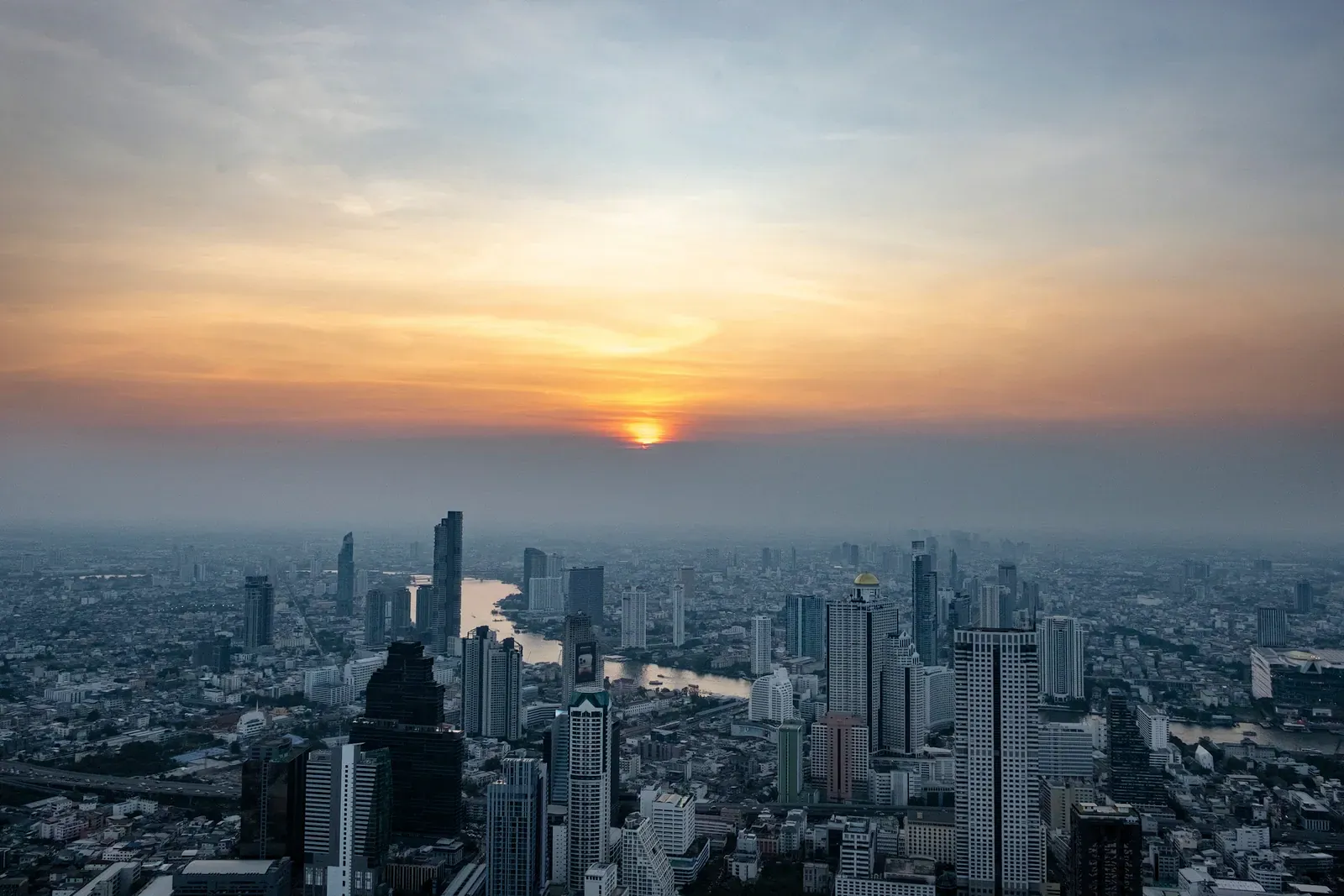
The cruel twist is meteorological. The same still, stable, high-pressure air that makes December and January feel like the most pleasant, most photogenic months to visit also traps pollution close to the ground through temperature inversions: a warm layer sits over cooler air near the surface and stops it rising and dispersing. So the coolest, driest, most tourist-friendly weeks often carry the worst air, while the hot, humid months that visitors try to avoid are frequently cleaner. Anyone planning a trip or a relocation date around comfort alone, without checking this pattern, is optimising for the wrong variable, worth reading alongside a broader seasonal comparison of when to visit.
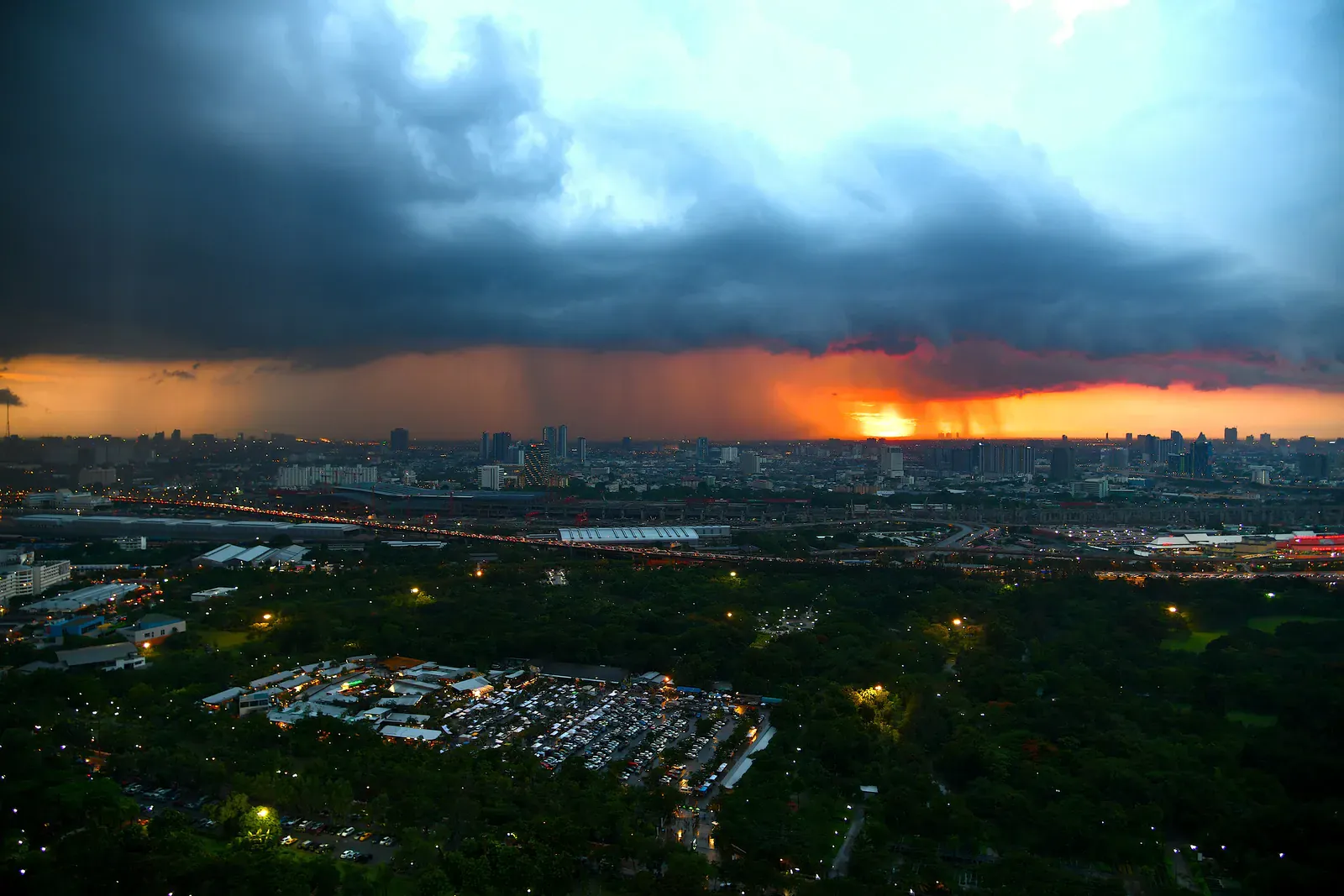
Relief comes with the monsoon. From around mid-May to October, rain scrubs particulates out of the air efficiently, and PM2.5 readings are typically at their best of the year even though humidity and downpours are at their peak. It is a genuine trade-off between air you can breathe easily and streets that occasionally flood, and the monsoon rainfall and flooding patterns are the other half of that seasonal picture, and they explain why long-stay residents often treat the wet season as the lesser inconvenience. For heat and humidity through the year, see our Bangkok weather and climate guide.
Why your AQI app disagrees with your neighbour’s
A common source of confusion: two air quality apps on two phones in the same room, at the same hour, showing different numbers or different colour bands. There are a few real reasons for this, none of which mean one app is simply “wrong.”
Different scales. Thailand’s Pollution Control Department (PCD) publishes its own national AQI, built by converting several pollutants into individual sub-indices against Thai breakpoints, then reporting the worst-performing pollutant’s sub-index as the headline number. During burning season that pollutant is almost always PM2.5. Many international aggregator apps instead calculate and display the US EPA AQI, which uses a different formula and a different numeric range. A “100” on one scale is not the same air as a “100” on the other. Neither is fraudulent; they are different rulers measuring the same thing.
Different stations, different air. A monitor bolted to a signpost on a busy arterial road will read differently from one on a rooftop away from traffic, even a few hundred metres apart. Roadside stations capture exhaust and dust close to source; ambient background stations capture the more general neighbourhood picture. Low-cost consumer sensor networks, often small units on private balconies or rooftops shared into crowdsourced maps, add useful hyperlocal detail but are generally less rigorously calibrated than reference-grade government equipment, so treat them as a rough local indicator rather than a precise reading.
Instant versus averaged. Some apps show a live hourly value that can swing sharply with wind and traffic; others show a rolling 24-hour average, which is the timeframe most health guidance on PM2.5 is actually built around. A single bad hour during evening rush pushes an hourly reading up without necessarily meaning the whole day was hazardous, and a calm morning reading doesn’t guarantee the whole day stays that way either. When a number looks alarming or reassuringly low, check whether it’s an instant snapshot or an average before reacting.
The practical takeaway: pick one or two sources you trust, understand which scale and averaging window they use, and track the trend over a few days rather than fixating on a single figure at a single hour.
Where residents actually check the numbers
Three broad categories cover most of what long-term residents use, and it’s worth knowing what each is good for rather than treating any single one as definitive.
- Official government monitoring. The Pollution Control Department runs the reference-grade network across greater Bangkok and reports the Thai national AQI. This is the most rigorously calibrated source and the one referenced in any official health advisory or school closure decision.
- International aggregator apps and sites. These pull from a mix of government stations and other feeds, often defaulting to the US EPA scale, and are convenient for a quick daily glance or for comparing Bangkok to other cities.
- Low-cost sensor networks. Crowdsourced maps of consumer-grade sensors give hyperlocal, near-real-time colour on your specific soi or building, useful for deciding whether to open a window right now, less useful as a precise health metric given the lighter calibration standard.
Using one from each category (a government reading for the general trend, an aggregator for convenience, a local sensor for your specific street) gives a fuller picture than any single app.
Reading an AQI band without over-trusting the number
Air quality indices worldwide are built around a similar idea even though the exact cutoffs differ by standard: a colour-coded band moving from good air through several stages of increasing concern. Treat the band names below as the general pattern you’ll see reported, not as fixed numeric thresholds: the actual breakpoints depend on which scale (Thai PCD or US EPA) the app you’re using has adopted.
| Band | What it generally means | What to do |
|---|---|---|
| Good | Air poses little or no health risk | Normal outdoor activity, including exercise |
| Moderate | Acceptable, but some pollutants may be a concern for a small number of unusually sensitive people | Most people carry on as normal; unusually sensitive individuals watch for symptoms |
| Unhealthy for Sensitive Groups | General public unlikely to be affected; children, older adults, pregnant women and those with heart or lung conditions may notice effects | Sensitive groups reduce prolonged or heavy outdoor exertion |
| Unhealthy | Everyone may begin to notice effects; sensitive groups more seriously | Limit prolonged outdoor exertion generally; sensitive groups stay indoors where practical |
| Very Unhealthy | Increased risk of effects for the general population | Avoid outdoor exertion; sensitive groups avoid outdoor activity entirely |
| Hazardous | Serious risk for the entire population | Stay indoors with air filtration where possible; treat as an emergency-level health warning |
During peak burning season weeks, Bangkok readings can sit anywhere from Moderate through Unhealthy on a given day, occasionally worse; outside that window, Good and Moderate are typical, especially through the monsoon.
Indoor air: what a purifier can and cannot do
An air purifier with a genuine HEPA filter is the single most effective tool against PM2.5 indoors, but only within limits worth understanding before buying one.
Sizing matters more than the brand name. Every purifier has a rated coverage area and a clean air delivery rate; a unit undersized for the room will run flat out and still underperform. As a rule of thumb, size for the room’s square metreage with the unit running on a lower, sustainable speed rather than buying the smallest model and running it on maximum continuously. Indicative 2026 pricing: a compact HEPA unit for a bedroom runs roughly ฿3,000-7,000 (about US$85-200); a larger unit for an open living area or condo studio runs roughly ฿8,000-20,000 (about US$230-570); genuinely large-room or whole-floor units go higher.
Filters degrade, and heat and humidity accelerate that. A HEPA filter loaded with Bangkok’s dust and haze clogs faster than the same filter in a drier, cleaner climate. Replace on the manufacturer’s schedule or sooner if airflow noticeably drops, and budget for filter replacement as an ongoing cost, not a one-off purchase.
A purifier cannot fix a leaky room. Running a purifier with windows open, or in a unit with poor door seals and gaps around aircon piping, means outdoor air keeps diluting the work the machine is doing. During burning season weeks, keep windows shut and rely on air conditioning for cooling rather than natural ventilation: the opposite habit from the cooler, cleaner months when opening up is fine. This is one of the few times of year where the “always run the aircon” habit that visitors sometimes resent is doing real protective work, not just comfort.
A purifier does not replace ventilation for other pollutants. It targets particulates, not CO2 buildup or humidity; in a small sealed room it helps to still crack a door to another ventilated space periodically outside the worst hours, or run an air exchange system if the building has one.
Masks: which types actually filter PM2.5
Cloth and surgical masks give minimal PM2.5 protection because they are not designed to seal against the face or filter particles that small. For meaningful filtration, look for:
- N95 or KN95-rated masks, which filter roughly 95% of particles at the 0.3 micron test size when properly fitted: fit matters as much as the rating, since gaps at the nose or cheeks let unfiltered air in.
- Local Thai-market equivalents, often sold as N95 or FFP2 standard in pharmacies and convenience stores during burning season; check the packaging for the filtration standard rather than assuming a mask is adequate because it’s marketed as an “anti-pollution mask.”
- A snug fit over nose and mouth, checked by exhaling and feeling for air escaping around the edges rather than through the mask itself.
Masks are most worth wearing for time spent outdoors on Unhealthy or worse days: waiting for transport at street level, walking any distance rather than using the BTS or MRT, or exercising outside. For brief transitions (a few minutes crossing a soi to a taxi), the benefit is smaller, though still nonzero on the worst days.
Exercise timing: when outdoor training does more harm than good
Exercise increases breathing rate and depth, which increases the volume of polluted air pulled into the lungs. On a day reported as Unhealthy or worse, an hour of outdoor running likely does more respiratory harm than the cardiovascular benefit it provides, particularly for anyone already sensitive. The practical adjustments long-stay residents and Muay Thai trainees use:
- Check the day’s band before an outdoor run, not after.
- Shift outdoor training to early morning if the local reading is genuinely better then (it varies by location and inversion pattern, so check rather than assume), or move it indoors on bad days.
- Favour indoor gyms, air-conditioned fitness studios, or a covered space with filtration over an open-air track or park during Unhealthy stretches.
- Where a route allows it, using the BTS or MRT plus the elevated skywalk network to reach an indoor venue keeps exposure lower than walking street level the whole way, especially near traffic corridors.
- For Muay Thai gyms with open-air rings, ask during burning season whether sessions move indoors or adjust timing; a serious gym training for the local climate will already have a policy.
Skipping a single outdoor session on a bad-air day is a reasonable trade; training through a Very Unhealthy day for the sake of consistency is not.
Children, older adults, and existing conditions
Children breathe a higher volume of air relative to body size than adults and have developing lungs, which puts them in the more sensitive category on the AQI table above. Many international schools in Bangkok monitor local readings and move outdoor recess, sports and PE indoors once thresholds are crossed; if a school does not appear to have a clear policy, it is a reasonable question to raise directly with them.
Older adults, and anyone with an existing heart or lung condition (asthma, COPD, cardiovascular disease) are named specifically in the Unhealthy for Sensitive Groups band because particulate exposure can aggravate these conditions. This is general guidance, not medical advice: anyone managing a specific respiratory or cardiac condition should discuss a personal air-quality plan, including whether medication timing or an action plan needs adjusting during burning season, with their own clinician rather than relying on a generic guide. The same caution applies to pregnant visitors and residents, who fall into the same sensitive category on most scales.
Choosing a home with air quality in mind
For anyone relocating or renewing a lease, a few factors affect year-round exposure more than most people expect when they first view a condo:
- Floor level. Units well above street level generally see lower particulate concentration than ground-floor or low-rise units close to traffic, since pollution concentrates near its source before dispersing upward and outward.
- Road proximity. A unit facing a quiet soi rather than a main arterial road avoids the exhaust plume that roadside monitoring consistently shows as elevated compared to background readings a short distance away.
- Construction next door. An active building site adjacent to or opposite a unit adds a local, sustained dust source independent of the seasonal pattern; ask about any planned construction before signing, not just what exists today.
- Building ventilation and sealing. Older buildings with gaps around windows and aircon sleeves let more outdoor air in regardless of season; newer or better-maintained buildings seal more effectively, which matters most during burning season weeks.
What employers, schools and landlords may or may not provide
Provision varies widely and should not be assumed. Some international employers and co-working spaces install purifiers as standard; many smaller offices and most residential landlords do not, treating it as a tenant responsibility. Some schools issue clear indoor-recess policies tied to published AQI bands; others leave the decision to individual teachers. Before relying on a workplace, school or rental to have this covered, ask directly rather than assuming, it is a reasonable question for a lease negotiation or a school enrolment conversation, and landlords are sometimes willing to provide or subsidise a purifier as a lease incentive if asked.
The escape-months pattern
A recognisable pattern among longer-term residents, particularly those with young children or an existing respiratory condition, is timing travel or a temporary relocation to coincide with the worst weeks of burning season, roughly February through April. Some leave Thailand entirely for a few weeks; others travel south to areas less affected, or simply plan more indoor time and fewer outdoor commitments during that window. This is not a universal necessity (many residents manage the season with an indoor purifier setup and a mask for outdoor days), but it is common enough that anyone planning a Bangkok relocation should factor the possibility into a first-year budget and calendar, alongside the seasonal comfort trade-offs covered in the month-by-month visiting guide.
Common questions
When is Bangkok’s air quality actually at its worst?
Typically March, within a broader window running from around mid-January through April. It usually isn’t noticeable until mid-February, worsens through March, and fades by late April or early May, driven by regional agricultural burning combined with the cool season’s still air trapping pollution near ground level.
Why do two AQI apps show different numbers for the same day?
They often use different underlying standards (Thailand’s own PCD scale versus the US EPA scale used by many international apps), plus different monitoring station locations and different reporting windows (an instant hourly reading versus a 24-hour average). Different numbers don’t mean one app is wrong.
Does an air purifier actually work against Bangkok’s PM2.5?
Yes, a genuine HEPA purifier sized correctly for the room is effective, provided windows stay shut and the filter is replaced on schedule. It cannot compensate for open windows, a poorly sealed room, or a badly undersized unit running on the wrong speed for the space.
What kind of mask actually filters PM2.5?
A properly fitted N95, KN95 or FFP2-standard mask filters particulate effectively; ordinary cloth or surgical masks do not seal or filter finely enough to make a meaningful difference against PM2.5 specifically.
Should I cancel outdoor exercise during burning season?
Not entirely, but shift it. Check the day’s AQI band before training outdoors, move sessions indoors on Unhealthy or worse days, and treat skipping one outdoor run as a reasonable trade rather than a failure of discipline.
Is Bangkok’s air quality bad all year, or just seasonally?
Seasonally, mainly. The monsoon months from roughly mid-May to October generally bring the cleanest air of the year because rain scrubs particulates out of the atmosphere, even though it’s the wettest and most humid stretch. The dry season, especially the burning-season months, is when PM2.5 becomes a genuine daily consideration.
Written by
Mike Brochlowski
Founder and editor, travel photographer and designer
I'm Mike Brochlowski, a travel photographer and designer, and I currently live on Koh Samui, Thailand. I built BangkokWiki to put practical, checked information about Bangkok in one place. Every page is researched from official and primary sources, and the text names them. Where a page shows a checked date, that is when its facts were last confirmed. I also run samui69.com, a non-commercial guide to Koh Samui. If you spot an error or something out of date, tell me through the contact page and I will check it and correct the page.
Read all articles
Where to stay
Pick the area before the hotel
Traffic and heat make Bangkok distances feel longer than they look on a map, so the area shapes a trip more than the hotel does. Our guides match areas to trip types and explain the trade-offs.

Places to stay
Find a hotel
Explore the other desks
More from Travel
- 14 min read
 15 min read
Bangkok Rainy Season and Flooding Explained
 11 min read
How to Plan a Bangkok Itinerary: Group by Area, Not Day

Newsletter
You're subscribed as