Living
Learn Thai in Bangkok: Language Schools and Visas
How to learn Thai in Bangkok: course formats, realistic timelines, costs, and how the ED visa through a language school actually works.
On this page
Learning Thai in Bangkok means choosing between intensive schools, part-time courses, university programmes, private tutors and self-study: each with a different pace, price and payoff. It also means understanding the ED visa route attached to language study, which is a legitimate long-stay option for a genuine student and a real source of risk for anyone treating it as paperwork. This guide covers both: how to actually learn the language, and how to do it without walking into a visa problem.
What you’re taking on
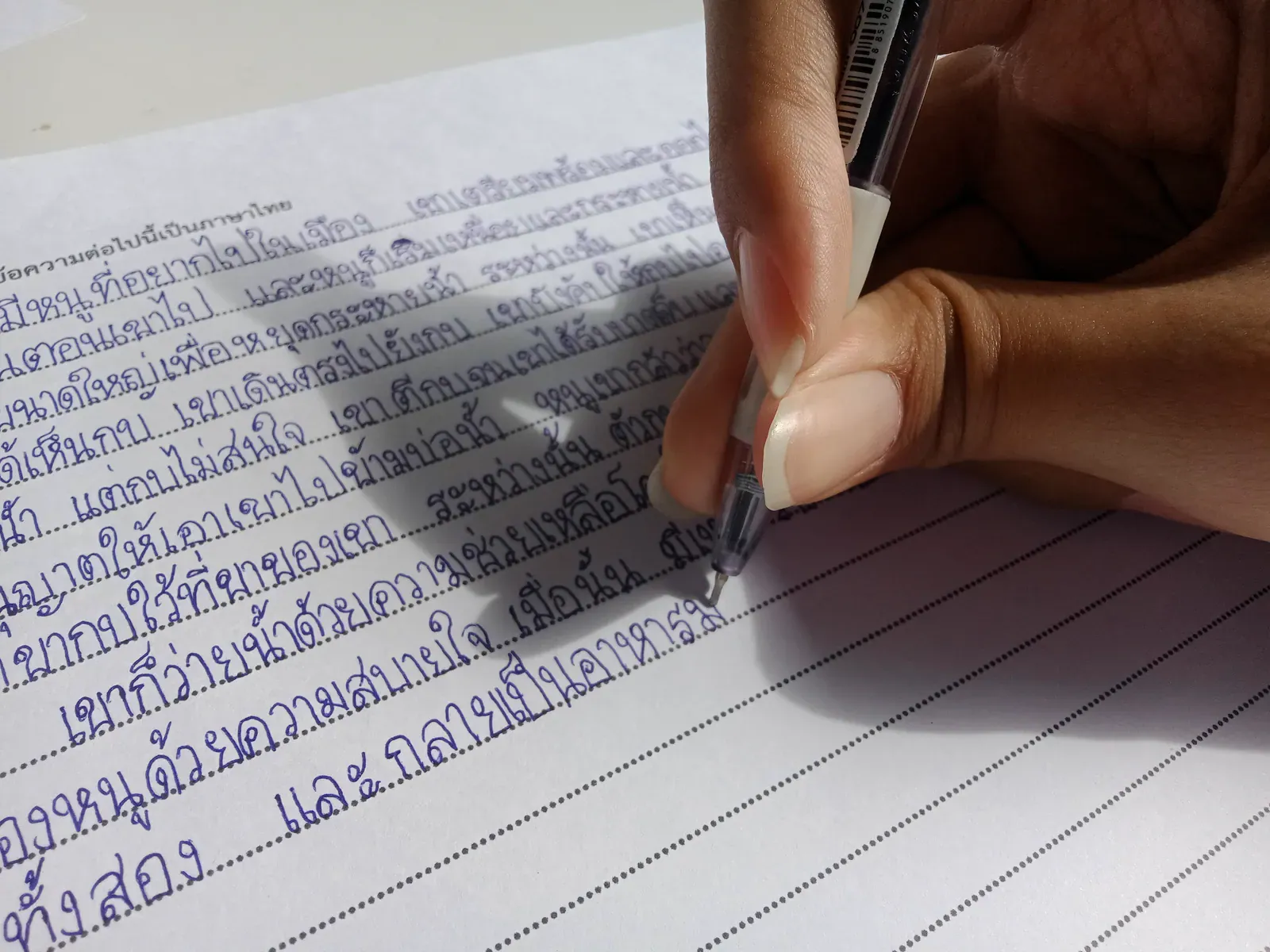
Thai is tonal: five tones in the central dialect, where the same syllable said with a different pitch contour is a different word entirely. It has its own script, written without spaces between words, which most learners find harder to read fluently than to speak. There’s no verb conjugation, no noun gender, no plurals to memorise, which makes the grammar genuinely easier than many European languages once you’re past the alphabet.
Two things textbooks handle badly. First, the gap between spoken and written Thai: everyday speech drops words, contracts phrases and uses particles that formal written Thai doesn’t, so a learner who studies only from a textbook can read a menu and still struggle to follow a market conversation. Second, politeness registers: the words you use, and even the final particle you add to a sentence, change depending on who you’re speaking to and your own gender. Getting this wrong isn’t usually offensive, but it marks you immediately as a beginner, and un-learning an overly formal or overly casual habit later is harder than learning the right register from the start. For a short list of survival words before you enrol, see useful Thai phrases for Bangkok.
The study options
Intensive full-time courses
Full-time courses at dedicated language schools typically run daily classes over a fixed term, often the format used to support an ED visa (see below). Pace is fast (expect several hours of class a day plus homework) and this suits people with no other commitments who want visible progress within a few months. Class sizes vary a lot by school, from small groups of four to eight up to larger lecture-style classes; ask before enrolling, since a “small class” school and a “high enrolment” school can differ enormously in how much speaking practice you actually get.
Part-time evening and weekend courses
Aimed at people working or studying something else during the day, part-time courses spread the same broad content over a longer calendar period at a slower weekly pace. Progress is real but slower, and momentum is easier to lose if you skip weeks: the learners who succeed with this format tend to be the ones who also practise outside class.
University language programmes
Several universities run Thai-language programmes for international students, sometimes as a standalone course and sometimes bundled with a wider Thai-studies or exchange programme. These often carry more academic structure (grammar reference, formal assessment, sometimes credit that transfers to a home-university degree) than a private language school, at the cost of being less flexible on scheduling. For other languages, see foreign language courses in Bangkok.
Private tutors
One-to-one tutoring is the fastest way to correct specific problems (tone production, a stubborn reading habit, business vocabulary for a specific job) because the entire session is built around you. It costs more per hour than group classes but often less overall if you need only a few sessions a week rather than a full course. Quality varies enormously since there’s no licensing requirement for private tutoring, so ask for a trial session and check reviews or referrals before committing to a block of lessons.
Online and app-based study
Apps and online courses are useful for vocabulary building, script recognition drills and flexible-schedule review, and they’re the cheapest option by far. They rarely replace in-person speaking practice (tone production especially needs a human ear correcting you in real time) so most successful learners treat apps as a supplement to classes or tutoring rather than a replacement for either.
Language exchange
Informal language exchange, trading English (or another language) conversation time for Thai practice, costs nothing but structure. It’s genuinely useful for conversational fluency and cultural context once you have basic vocabulary and grammar in place, but it’s a poor starting point for absolute beginners who need structured tone and script instruction first.
| Format | Pace | Typical cost structure | Class size | Best for |
|---|---|---|---|---|
| Intensive full-time | Fast, daily | Term-based fee, higher overall cost | Small to large, varies by school | Fast progress, ED visa route |
| Part-time evening/weekend | Slow, steady | Per-term or per-block fee | Small to medium | Working learners |
| University programme | Moderate | Per-semester, academic fee scale | Medium | Academic structure, credit |
| Private tutor | Flexible | Per-hour, higher per-hour cost | One-to-one | Targeted correction, busy schedules |
| Online/apps | Self-paced | Low, often subscription | N/A | Vocabulary, review, supplement |
| Language exchange | Flexible | Free | One-to-one or small group | Conversation practice, post-beginner |
The ED visa through a language school
A language-school ED visa is a legitimate route to a longer stay in Thailand for someone genuinely studying: sponsored by the school, tied to enrolment, and subject to attendance and reporting requirements much like the university-based ED route covered in the studying in Bangkok guide. It is not, however, a uniform product: schools differ enormously in how seriously they actually teach, and that difference matters more here than almost anywhere else in the decision. Related guides: ED visa guide.
In structural terms: the school reports your enrolment to the relevant authorities, an initial stay period is followed by extensions tied to continued study, and attendance is checked, increasingly through a centralised reporting system shared between schools and Immigration rather than left to each school’s own paperwork. A student who is not genuinely attending is at risk of the visa being flagged or cancelled regardless of how the paperwork looks on paper.
This is where the grey market shows up. Some operations sell the visa route rather than the education behind it: minimal real class time, loose or fabricated attendance records, a fee structure built around “visa service” rather than teaching. Thai authorities have tightened enforcement against this pattern in recent years, including centralised cross-checking of attendance and periodic reviews that have led to bulk visa cancellations at schools found to be non-compliant. The risk sits with the student, not just the school: a visa obtained through fraudulent enrolment can be cancelled, and consequences can extend to fines, detention, or bans on re-entry: far more serious than losing a term’s tuition.
Practical implications: choose a school on the basis of its actual teaching (curriculum, qualified teachers, verifiable class schedule), not on how easy it makes the visa paperwork sound. A school that markets itself primarily on visa convenience rather than teaching quality is a signal to look elsewhere. Ask direct questions about attendance-tracking, hours of instruction per week, and what happens if you miss classes, and be suspicious of any answer that treats attendance as a formality.
Disclaimer: current visa durations, fees and attendance thresholds are not stated here as fact because they change and are enforced differently by school, nationality and policy period. Confirm current requirements with the Immigration Bureau, the Ministry of Education, and the specific school before enrolling or applying.
The learning craft
Script first or speech first
Two honest schools of thought. Script-first learners argue that Thai’s spelling, while irregular, encodes tone information the ear alone won’t reliably catch early on, so learning to read supports correct tone production faster than pure listening does. Speech-first learners argue that focusing on the script too early slows down conversational progress and that tones are better learned by ear and repetition, with reading added once basic speech is comfortable. Neither is wrong; the better fit depends on whether you learn faster visually or aurally, and many successful learners end up doing both in parallel within the first few months rather than picking one and delaying the other.
Tones and how adults actually learn them
Adult learners rarely get tones right by explanation alone: hearing a tone described (rising, falling, high, low, mid) helps intellectually, but production improves mainly through repeated listen-and-repeat drills with correction from a native speaker, ideally in the first weeks before habits set in. Recording yourself and comparing against a native speaker’s pronunciation is a genuinely useful, low-cost supplement most learners skip.
Transliteration systems and why they disagree
Because Thai script doesn’t map cleanly onto the Latin alphabet, several competing transliteration (romanisation) systems exist, and they disagree on how to render the same sounds: one reason two textbooks can spell the same word two different ways. This is normal, not a sign either source is wrong, but it’s a good argument for moving to the Thai script itself as soon as you can rather than relying on transliteration long-term, since transliteration inconsistency compounds confusion rather than resolving it.
What “conversational” means at three months and at a year
At three months of serious study, a realistic expectation is functional survival Thai: transport, food ordering, shopping, basic small talk, understanding simple questions directed at you. At a year of consistent study, most learners reach genuine conversational fluency for daily life (following normal-speed conversation on familiar topics, handling most day-to-day situations without falling back to English) though reading fluency and vocabulary breadth for unfamiliar topics usually lag behind spoken ability at that stage. These are broad patterns, not guarantees; intensity of study and amount of real-life practice outside class explain most of the variation between learners.
The plateau most learners hit
Most learners plateau somewhere around six months to a year, once basic conversational needs are met and the easy wins (numbers, common phrases, transport vocabulary) are behind them. Progress from “getting by” to genuine fluency slows because the remaining gains (nuanced vocabulary, regional accents, reading speed, formal register) need more exposure and less pure classroom drilling. Pushing through usually means deliberately adding harder input: Thai-language media, conversations with non-English-speaking Thai friends, or a higher-level course rather than repeating the same conversational-level material.
Choosing a school
- Ask for a trial lesson. A single trial class reveals more about teaching quality, pace and class atmosphere than any brochure.
- Check teacher training and continuity. Ask whether teachers hold a recognised teaching qualification and whether you’ll have the same teacher throughout the course or a rotating roster.
- Look at the curriculum, not just the hours. A structured syllabus with clear progression beats a vague “conversational Thai” course description.
- Ask about class composition. A class mixing complete beginners with people who’ve studied a year elsewhere will move at the wrong pace for someone.
- Separate the visa conversation from the teaching conversation. If a school’s answers to visa questions are more confident and detailed than its answers about curriculum and teachers, that’s worth noting.
Costs by format
All figures are broad, indicative 2026 bands; confirm current pricing directly with any school before enrolling.
| Format | Indicative monthly cost (THB) | Approx. USD |
|---|---|---|
| Intensive full-time course | 6,000-15,000 | 170-430 |
| Part-time evening/weekend course | 2,500-7,000 | 70-200 |
| University language programme | 8,000-20,000 (per semester equivalent varies) | 230-570 |
| Private tutor (per hour) | 300-1,000 | 9-29 |
| Apps and online subscriptions | 0-1,000 | 0-29 |
| Language exchange | Free | Free |
Common mistakes beginners make
Learning only transliteration and never moving to the script. It feels faster at first, but transliteration inconsistency between sources eventually slows you down more than the upfront effort of learning to read would have.
Skipping tone practice because grammar feels more productive. Grammar is genuinely easier in Thai than in many languages, which tempts learners to spend disproportionate time there while under-practising tones: the part that actually determines whether people understand you.
Choosing a school purely on price or location. A cheap, convenient school with weak teaching wastes more time than a slightly pricier one with a real curriculum, because re-learning bad habits (wrong tones, wrong register) costs more time later than getting it right the first time.
Treating the ED visa as the primary goal. Students who enrol mainly for the visa and treat classes as a formality tend to make the least language progress and carry the most visa risk: the two problems reinforce each other.
Avoiding speaking until you feel “ready.” Confidence in Thai comes from making mistakes in front of native speakers early, not from private study alone. Learners who start speaking in week one, badly, generally overtake learners who wait for a comfortable fluency threshold that never quite arrives.
Studying while working remotely
Remote workers who want structured Thai lessons alongside a day job usually fit best with part-time evening courses, private tutoring scheduled around work hours, or a hybrid of short in-person sessions plus app-based review. Anyone on a visa category tied to remote work for a foreign employer should keep language study and visa status separate in their own head: enrolling in a course doesn’t change your visa basis, and studying Thai part-time alongside remote work is a different situation from enrolling full-time on an ED visa, with different obligations attached to each. If a change of visa category is being considered specifically to support full-time language study, that decision needs its own separate check with a Royal Thai Embassy or the Immigration Bureau, not an assumption based on the course alone.
Vocabulary that pays off first
Certain vocabulary earns its keep faster than a generic phrasebook order suggests, because it’s used constantly in daily Bangkok life:
- Transport: station names, “turn left/right,” “straight ahead,” numbers for fares and platforms, and the words for BTS, MRT and motorbike taxi.
- Food: spice-level words, “no coriander,” common dish names, and numbers for ordering multiples: street food and food courts run almost entirely in Thai even in international areas.
- Markets: bargaining phrases, numbers, and polite refusal phrases that let you decline without offence.
- Rental: basic terms for deposit, contract length, and utilities, which come up early if you’re renting a room yourself (covered in full in the student budget and areas guide).
- Health: symptoms, body parts, and pharmacy vocabulary, useful even at a private hospital where not all staff speak English fluently.
Learning this set early, even before broader conversational grammar is solid, pays off faster than following a textbook’s chapter order strictly.
Common questions
How long does it take to become conversational in Thai?
Roughly three months of serious study gets most learners to functional survival Thai for transport, food and shopping. A year of consistent study typically reaches genuine daily-life conversational fluency, though reading speed and vocabulary for unfamiliar topics usually lag behind. Intensity and real-life practice explain most of the difference between learners.
Is the ED visa through a language school a reliable long-term stay option?
It can be, for someone genuinely studying at a school that takes teaching seriously, but it is not a paperwork shortcut. Attendance is checked, increasingly through centralised reporting, and a visa obtained through minimal or fabricated attendance carries real risk of cancellation and other consequences. Confirm current rules with the Immigration Bureau and Ministry of Education before relying on it.
Should I learn to read Thai script before speaking?
There’s a genuine argument either way. Script-first helps with tone accuracy since spelling encodes tone information; speech-first can move conversational progress faster early on. Many successful learners do both in parallel within the first few months rather than delaying one for the other.
What’s the cheapest way to learn Thai in Bangkok?
Language exchange and self-study apps cost nothing or close to it, but they work best as a supplement to structured lessons rather than a replacement, particularly for tone production, which needs a human ear correcting you. A mix of low-cost self-study plus periodic private tutoring is often the most cost-effective combination for someone on a tight budget.
How do I avoid a “visa school” that doesn’t really teach?
Judge the school on its teaching, not its visa pitch: ask for a trial lesson, check teacher qualifications and continuity, and be wary of any school more confident about visa paperwork than curriculum. A legitimate school will answer curriculum and teaching questions as readily as visa questions.
Can I study Thai part-time while working remotely on another visa?
Generally yes, and this is a common pattern among remote workers, but studying part-time doesn’t change your underlying visa basis. Keep the two separate: your visa status depends on the category you actually hold, not on which courses you’re taking, and any change of category needs its own check with a Royal Thai Embassy or the Immigration Bureau.
Written by
Mike Brochlowski
Founder and editor, travel photographer and designer
I'm Mike Brochlowski, a travel photographer and designer, and I currently live on Koh Samui, Thailand. I built BangkokWiki to put practical, checked information about Bangkok in one place. Every page is researched from official and primary sources, and the text names them. Where a page shows a checked date, that is when its facts were last confirmed. I also run samui69.com, a non-commercial guide to Koh Samui. If you spot an error or something out of date, tell me through the contact page and I will check it and correct the page.
Read all articles
Visas and paperwork
Staying in Thailand longer?
Visas, extensions, documents and banking for longer stays. Rules and fees change often and offices apply them differently, so check the official source before you act.

Places to stay
Find a hotel
Explore the other desks
More from Living
- 12 min read
 13 min read
Studying in Bangkok: A Guide for International Students
 10 min read
The Real Cost of Retirement in Bangkok

Newsletter
You're subscribed as