Living
Studying in Bangkok: A Guide for International Students
How international programmes, accreditation, the ED visa and work rules actually work for students choosing Bangkok for a degree or exchange.

On this page
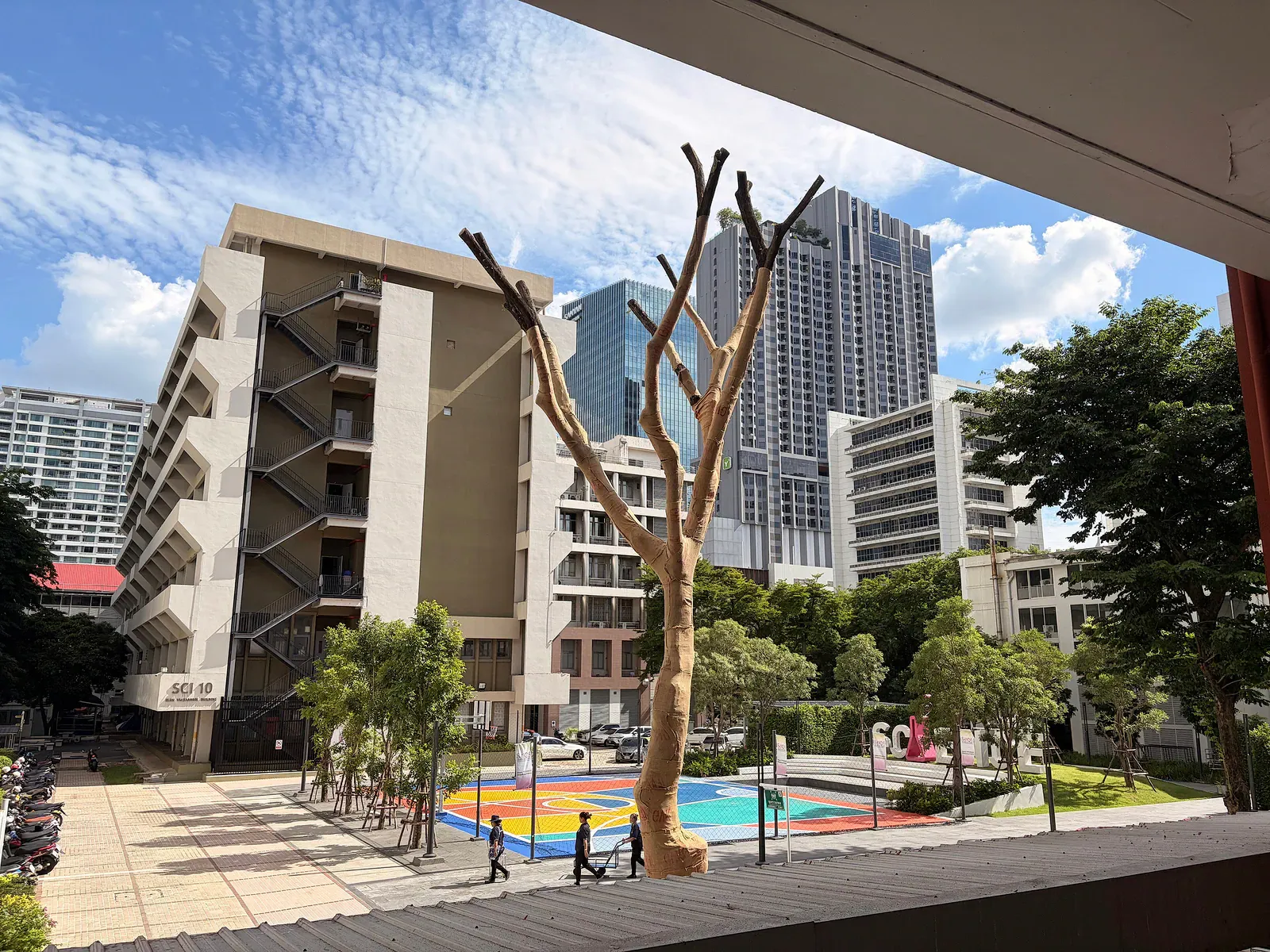
Bangkok has become one of Southeast Asia’s busiest hubs for international higher education, with English-taught programmes at public and private universities, branch campuses of foreign institutions, and a dense network of language schools underneath all of it. Choosing to study here means weighing accreditation and teaching culture against cost and visa mechanics, not just picking a familiar name. This guide lays out the landscape, the decisions that matter before you apply, and the practical rules (visas, work, healthcare, cost) that determine whether a year here goes smoothly.
The landscape: where international students actually study
Thailand’s higher-education sector for international students sits across four overlapping groups, and most applicants end up choosing between them rather than picking a single “best” option.
Public research universities run the largest international programmes, usually as English-taught tracks inside a much bigger Thai-medium institution. These sit within Thailand’s national accreditation system and often carry the strongest domestic reputation, particularly in business, engineering, medicine and social sciences. See universities in Bangkok for international students and the Chulalongkorn University guide for individual schools.
International branch campuses of foreign universities operate under partnership or franchise arrangements with a Thai host institution. Degrees may be issued by the foreign parent, the Thai partner, or jointly, and the answer changes what “accredited” means for that specific programme: never assume, always ask the admissions office directly which body issues the parchment.
Private Thai universities with international faculties and a strong international intake sit alongside the public sector, often smaller, sometimes newer, and frequently more flexible on entry requirements and scheduling. Quality varies more here than in the public sector, so due diligence matters more too.
Specialist institutions cover everything from art and design schools to hospitality, aviation and culinary programmes, plus language schools that sit outside the university system entirely (covered in full in the Thai language schools guide). These suit a narrower set of goals than a general degree.
None of these groups is inherently better. A public university’s international programme might have more rigorous entry standards and lower fees; a private university might offer faster progression and closer staff contact; a branch campus might carry more weight with an employer back home. The right fit depends on what you need the qualification to do for you afterward.
What an “international programme” actually means
In Thailand, an international programme is usually not a separate international university: it is an English-taught track embedded inside a Thai institution. That has practical consequences worth understanding before you enrol.
Classes are taught in English, but the student body is typically mixed: Thai students who tested into the English track alongside international students from a wide range of countries. Administrative staff, some support services, and campus-wide announcements may still default to Thai, so day-to-day life involves more translation and self-advocacy than a fully international campus would.
Fee structures for international programmes run separately from the domestic Thai-medium track, generally higher, and set by the faculty rather than the university as a whole. Facilities (libraries, labs, sports centres) are usually shared across both tracks, which is a genuine advantage: you get access to a full university’s infrastructure, not a scaled-down international wing.
The practical upshot: an international programme gives you an English-taught education with real interaction with Thai peers, inside an institution built primarily for Thai students. That is different from, and often more immersive than, a standalone international university, and it suits people who want the degree and the cultural exposure together.
The decision layer: what to check before you apply
Accreditation and recognition at home
This is the single most consequential check and the one applicants skip most often. A programme can be legitimately accredited within Thailand’s own system and still be poorly recognised by a specific employer, licensing body or graduate school in your home country: recognition is assessed case by case, not by a blanket rule. Before committing:
- Confirm the Thai accrediting body for the specific programme (not just the university’s general reputation).
- If a foreign institution is involved, confirm which body actually issues the degree and whether that body is separately accredited in its home country.
- Contact the licensing board, employer or graduate admissions office in your home country directly and ask whether they recognise degrees from that specific programme: general reputation is not the same as a formal recognition answer.
- Keep every accreditation document, syllabus and transcript from year one, because you may need to produce them years later for a licensing or credential-recognition application.
Teaching style and assessment culture
Thai higher education, even in English-taught tracks, often carries a stronger emphasis on structured coursework, group assignments and continuous assessment than the exam-heavy, seminar-debate model common in UK or US universities. Some programmes, particularly ones built with foreign partners, lean closer to a Western seminar style. Ask about the balance of coursework versus final exams, how much class participation is graded, and whether the programme uses group projects heavily: this affects both your workload rhythm and how comfortable you’ll be if you’re used to a different academic culture.
Class sizes and contact hours
International programmes range from small cohorts of a few dozen to lecture halls of several hundred, and this varies enormously by faculty within the same university. Smaller cohorts generally mean more staff contact and easier access to academic advising; larger ones mean more peer diversity and sometimes better resources. Ask for actual cohort sizes for the specific programme, not university-wide averages.
English proficiency requirements
Entry requirements typically ask for an IELTS, TOEFL or equivalent score, though the required band varies by faculty and programme level: postgraduate programmes generally set a higher bar than undergraduate ones. Some universities offer conditional admission with an English foundation year for applicants below the threshold. Confirm the exact requirement and any foundation-year option directly with the admissions office, since general guides (including this one) cannot state a single number that applies across a market this varied.
The academic calendar
Most Thai universities run two main semesters, roughly August to December and January to May, with an optional short summer term. This is offset from the UK’s autumn-to-summer year and only loosely aligned with the US calendar, which matters for anyone doing an exchange or planning to transfer credits: check semester start and end dates against your home institution’s calendar early, since gaps and overlaps affect visa timing and flight bookings.
Exchange and study-abroad: the low-commitment way in
For students who want to experience studying in Bangkok without committing to a full degree, an exchange semester or a short study-abroad programme through a home university’s partnership is the lowest-friction route in. Exchange students typically pay tuition to their home institution rather than the Thai host, take a lighter administrative load since the exchange office at the home university often manages paperwork, and get first-hand exposure to the teaching style and campus culture before deciding whether a full degree here makes sense.
Exchange places are usually more limited than direct-enrolment ones and are allocated through the home university’s international office, so timelines run further ahead than a direct application, often a full year before departure. If your university does not already have a partnership with a Bangkok institution, some programmes accept direct-enrolment exchange or visiting-student applications instead, worth asking about even without an existing agreement.
The ED visa: how student status keeps you in the country
Studying full time in Thailand as a non-Thai national generally requires the Non-Immigrant “ED” category: a study-based permission to remain, sponsored by the enrolling institution rather than granted independently. In structural terms, the arrangement works like this:
- The institution acts as your sponsor, confirming enrolment to the Immigration Bureau and, for many programme types, to the Ministry of Higher Education, Science, Research and Innovation.
- Initial entry is followed by a period of stay tied to enrolment, with renewal contingent on continued registration and attendance rather than granted automatically.
- Institutions are expected to report attendance, and Immigration has moved toward centralised, cross-checked reporting between schools and universities: a student who stops attending without formally withdrawing risks the visa being flagged or cancelled, sometimes with consequences that outlast the individual case.
- Reporting obligations continue through your enrolment: periodic address reporting and re-entry permit requirements apply to ED-visa holders as they do to other long-stay categories.
None of the specific durations, fees or attendance thresholds are stated here as current facts, because they change and are enforced differently by institution type, nationality and current policy. Confirm exact requirements directly with your institution’s international office, a Royal Thai Embassy or consulate before applying, and with the Thai Immigration Bureau for anything relating to extensions or reporting once you are in the country.
Disclaimer: this section is general information, not immigration advice. Visa rules change, and enforcement has tightened in recent years. Verify current requirements with your institution, a Royal Thai Embassy, and the Immigration Bureau before relying on anything above.
Work rules: the question students get most wrong
Being enrolled as a student in Thailand does not, on its own, give you the right to work. This is worth stating without hedging: paid work by a foreign student (on campus, off campus, remote for a foreign employer while physically in Thailand, or informal freelance work) is tightly restricted under Thai law, and undertaking it without proper authorisation is treated as unauthorised work regardless of how casual or short-term it seems.
Where work is genuinely permitted, it typically requires a separate work permit issued by the Department of Employment, and in most cases the underlying visa category must also support employment: an ED visa on its own generally does not. The narrowest and most commonly cited exception is a curriculum-mandated internship, arranged and pre-approved through the institution as a required or credit-bearing part of your programme; even then, formal permission is usually needed rather than assumed, and requirements have been tightened as part of wider immigration enforcement (see the internships section further down).
Do not treat casual tutoring, content creation for pay, gig-platform work, or “just helping out” at a friend’s business as low-risk. Enforcement has increased, and the consequences of unauthorised work (for the student and sometimes for whoever facilitated it) can include visa cancellation, fines, detention and re-entry bans. If you need income while studying, the Department of Employment is the authority to check with before doing anything that could count as work, and your institution’s international office should be your first call if you are unsure whether an activity crosses the line.
Where to live near campus
Most students choose between three options: on-campus or affiliated dormitories, older apartment buildings within walking distance of campus, and shared condo units slightly further out and reached by rail or a short ride. Dormitories are cheapest and simplest for a first year, with meals and security handled centrally, but often carry curfews and less privacy. Older apartment blocks near campus gates are the traditional off-campus option, priced well below newer condos, with the fan-versus-air-conditioning choice doing most of the work on monthly cost. Shared condos cost more but offer better amenities and, often, direct rail access. Full budget breakdowns and area-by-area comparisons are in the student budget and areas guide; the short version is that proximity to campus and access to a rail line both save time and money, and it is rarely possible to maximise both at once.
Health cover and insurance
Most institutions require proof of health insurance as a condition of enrolment and visa sponsorship, and some require enrolment in a specific institution-arranged policy rather than accepting any external provider: check this before buying a policy independently. Public hospitals are markedly cheaper than private ones and generally adequate for routine care, though language can be a barrier without a Thai-speaking companion; private hospitals cost more but offer English-speaking staff and shorter waits, which matters for anything urgent. Whatever policy you hold, confirm it covers outpatient visits, hospitalisation, and repatriation, and check whether it satisfies your specific visa or institutional requirement: a policy that covers you adequately for health reasons does not always satisfy the paperwork requirement, and the two need to be checked separately.
What a year actually costs
Costs vary hugely by institution type, programme level and lifestyle. The table below gives indicative 2026 bands; always confirm current tuition and fees directly with the institution, since faculty-level pricing changes yearly.
| Item | Indicative annual range (THB) | Approx. USD |
|---|---|---|
| Public university international programme, tuition | 60,000-250,000 | 1,700-7,100 |
| Private university international programme, tuition | 150,000-450,000+ | 4,300-12,900+ |
| Branch campus / dual-degree programme, tuition | 200,000-600,000+ | 5,700-17,100+ |
| Accommodation (dorm to shared condo) | 36,000-150,000 | 1,000-4,300 |
| Living costs (food, transport, phone, essentials) | 84,000-150,000 | 2,400-4,300 |
| Health insurance | 8,000-30,000 | 230-860 |
These are broad bands, not quotes, and postgraduate and specialist programmes (medicine, aviation, some MBAs) run well above the upper figures. See the student budget guide for a full month-by-month breakdown of living costs, area by area.
Student life, societies and internships and what is actually permitted
Campus life in Bangkok’s international programmes tends to be more organised around clubs and faculty societies than around a large, unified student union culture, though larger public universities do run substantial student-government and events infrastructures. International-student associations are common and often the fastest way to find housing leads, secondhand textbooks and orientation advice from people who’ve just been through it. Sports facilities, especially at the larger public universities, are usually open to all enrolled students regardless of programme.
Internships and what is actually permitted
Internships arranged as a required or credit-bearing part of a degree programme are the main legitimate route to gaining local work experience as a student, and they generally need to be arranged through the institution with formal notification to the relevant authorities rather than set up independently with an employer. An internship that is not part of your curriculum, or one you arrange privately outside the institution’s process, risks being treated as unauthorised work: the distinction is about process and documentation, not about how the placement feels. Always start with your faculty’s internship or careers office, confirm what paperwork is required before you start, and never begin an unpaid or paid placement on the assumption that it will be sorted out afterward.
After graduation
Graduating ends your student status, and with it the basis for your ED visa: there is a limited grace period to depart, change status, or apply for a different visa category, and the specifics depend on current immigration rules at the time you graduate, not on anything fixed at enrolment. Graduates who want to stay and work need to secure a job offer that supports a change to an employment-based visa category and a separate work permit through the Department of Employment; a degree alone does not create a right to remain or to work. See non-teaching jobs for foreigners in Bangkok for which sectors actually sponsor a work permit and realistic salary bands. Some universities run graduate-transition support through their international offices, which is worth using early rather than waiting until final exams are over. Anyone planning to stay long-term should start that conversation with the international office and, separately, with the Immigration Bureau, well before graduation rather than after.
Common questions
Will a degree from a Bangkok international programme be recognised in my home country?
It depends on the specific programme, not the university’s general reputation. Confirm the accrediting body for that programme and check directly with the relevant licensing board, employer or graduate school in your home country: general recognition of “the university” is not the same as recognition of a specific international-track degree.
Can I work part-time while studying on an ED visa?
Generally no. Student status does not confer a right to work, and paid work (including part-time, remote or informal work) usually requires a separate work permit and a visa category that supports employment, which an ED visa typically does not provide. The narrow exception is a curriculum-mandated, institution-approved internship.
How long does an ED visa last and what does renewal involve?
The structure is an initial entry followed by extensions tied to continued enrolment and attendance, with periodic reporting obligations throughout. Exact durations, fees and attendance thresholds change and are enforced differently by institution and policy period, so confirm current requirements with your institution, a Royal Thai Embassy, or the Immigration Bureau rather than relying on a fixed figure.
Is a private university or a public university international programme better for me?
Neither is universally better. Public programmes often carry stronger domestic recognition and lower fees; private universities can offer smaller cohorts and more flexible scheduling. Weigh accreditation, class size, teaching style and cost against your specific goals rather than reputation alone.
What happens if I stop attending classes?
Institutions are required to report attendance, and Immigration has moved to centralised cross-checking between schools and universities. Falling below required attendance without formally withdrawing risks your ED visa being flagged or cancelled, with consequences that can include fines, detention or re-entry bans in serious cases.
Is an exchange semester a good way to test studying in Bangkok before committing to a full degree?
Yes, generally. Exchange places usually keep you enrolled and paying tuition at your home institution, carry a lighter administrative load, and let you experience the teaching style and campus culture directly. Places are limited and allocated well in advance, so start the conversation with your home university’s international office early.
Written by
Mike Brochlowski
Founder and editor, travel photographer and designer
I'm Mike Brochlowski, a travel photographer and designer, and I currently live on Koh Samui, Thailand. I built BangkokWiki to put practical, checked information about Bangkok in one place. Every page is researched from official and primary sources, and the text names them. Where a page shows a checked date, that is when its facts were last confirmed. I also run samui69.com, a non-commercial guide to Koh Samui. If you spot an error or something out of date, tell me through the contact page and I will check it and correct the page.
Read all articles
Visas and paperwork
Staying in Thailand longer?
Visas, extensions, documents and banking for longer stays. Rules and fees change often and offices apply them differently, so check the official source before you act.

Places to stay
Find a hotel
Explore the other desks
More from Living
- 12 min read
 12 min read
Learn Thai in Bangkok: Language Schools and Visas
 9 min read
Renting Near an International School in Bangkok

Newsletter
You're subscribed as