Things to do
Cycling in Bangkok: Best Routes to Ride
Where to cycle in Bangkok for sport, from Bang Krachao to the airport's Sky Lane, plus bikes, gear, transit rules and the club scene, honestly assessed.
At a glance
- Reading time
- 12 min read
- Chapters
- 12
- Published
- Sep 20, 2026
On this page
Cycling in Bangkok splits cleanly into two very different activities. As transport, it’s genuinely difficult: heavy traffic, no continuous network of protected lanes, and a climate that punishes exposed riding for much of the year. As sport, it’s better than its reputation suggests, once you know the handful of places locals and long-stay residents actually go. This guide is honest about the first and detailed about the second.
Cycling as transport: the honest version
Riding a bike as a daily commute in central Bangkok is hard, and it’s worth saying so plainly rather than pretending otherwise. The city’s road network was built around cars and motorbikes, painted bike lanes exist in patches rather than as a connected system, and where they do exist they’re routinely blocked by parked vehicles, street vendors or simply end without warning at a busy junction. Traffic density on arterial roads makes riding alongside trucks and buses genuinely stressful for anyone without experience riding in dense Asian city traffic, and the heat turns even a short commute into a sweat-soaked one without a shower waiting at the other end. Add the burning-season months (roughly January to April) when air quality regularly makes sustained outdoor exertion inadvisable, and daily transport cycling in the city centre is a minority pursuit chosen by the committed rather than a default option most residents reach for.
None of that applies to cycling as sport and recreation, which is where the rest of this guide focuses, because away from the main arterial roads, Bangkok and its edges have a genuinely good set of places to ride.
Where people actually ride
Bang Krachao: the city’s cycling heart
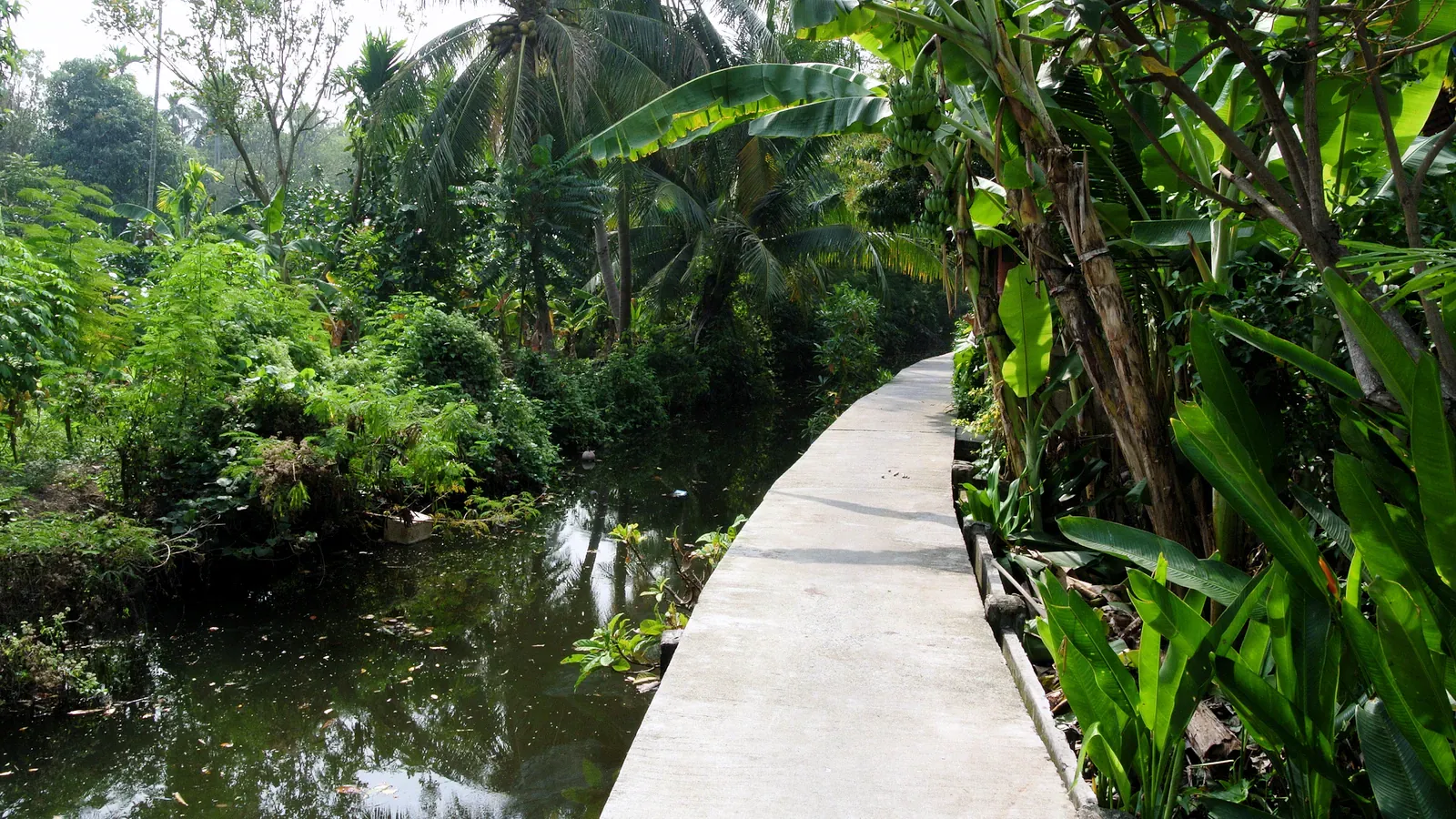
Bang Krachao sits inside a bend of the Chao Phraya river just south of the main city, close enough to reach in minutes by boat yet largely free of the traffic that defines the rest of Bangkok. Its interior is a network of raised concrete paths threading through mangrove remnants, small orchards and quiet residential lanes, built originally as flood-resilient walkways and now doubling as the closest thing the city has to a purpose-made cycling park. A full loop of the main paths takes roughly one to two hours at an easy pace, longer if you detour onto the smaller side lanes, and the flat, largely shaded, low-traffic character makes it approachable for a beginner while still rewarding a serious rider who wants distance on a weekend morning. Go early (from soon after sunrise until around 9 or 10am), both to beat the heat and because Bang Krachao gets genuinely busy with cyclists, joggers and day-trippers by mid-morning on weekends. Access is by a short river crossing, and bike hire is available on the island itself for anyone who doesn’t want to bring their own across.
Rot Fai Park and the other park loops
Vachirabenchatat Park (commonly known as Rot Fai Park) offers a dedicated cycling and skating loop within a large, flat green space in the north of the city, popular with families and casual riders as well as anyone doing repeat laps for fitness. Several of Bangkok’s other large parks maintain similar internal loop paths, generally shorter and busier with pedestrians than Rot Fai’s dedicated circuit, useful for an easy recovery spin or an early lap before work rather than a serious training ride. These loops share a common profile: flat, paved, no traffic to speak of, and busiest in the two or three hours around dawn and again in the early evening once the heat breaks. For another park to ride in, see our Benjakitti Park guide.
The airport’s Sky Lane
One of Bangkok’s more unexpected cycling facilities sits around the perimeter of Suvarnabhumi Airport: a purpose-built loop of over twenty kilometres, separated entirely from airport traffic, with distinct lanes for casual and faster riders, rest stops at regular intervals, and lighting that makes early or late riding practical. It’s a genuine curiosity worth explaining to anyone who hasn’t heard of it (a major international airport with a public recreational cycling track wrapped around its edge is not something most cities can claim), and it draws a dedicated following of road cyclists doing repeat laps for distance training, alongside more casual family riders on the wider, easier sections. Basic safety rules apply (helmet required, no barefoot or sandal riding), and reaching it generally means driving or arranging transport out to the airport perimeter with your bike, since it sits well outside the reach of the rail network’s cycling provisions.
Early-morning old-town rides
Before the city’s traffic wakes properly, the old town around Rattanakosin Island and the surrounding historic districts turn into a genuinely pleasant place to ride: narrow lanes, temple grounds, and riverside stretches that are simply impossible to enjoy by bike once daytime traffic and tour groups fill them. This window is short (realistically before about 7am) but rewarding for anyone who wants to see the old city’s canals, temple compounds and market streets from a bike saddle rather than stuck in a tuk-tuk. Surfaces vary from smooth road to older, uneven lanes, so this is a ride for a hybrid or city bike rather than a road bike with narrow tyres.
Riverside and canal-side stretches
Sections of riverside promenade and canal-side path, particularly around the newer public riverfront developments, offer short, pleasant, mostly flat stretches of paved path good for an easy ride rather than a serious training loop. These tend to be shared with pedestrians and joggers, so they suit an unhurried pace and a social ride rather than intervals, and they’re a good option for anyone staying centrally who wants a short outdoor ride without travelling out to Bang Krachao or a park.
Road rides beyond the city edge
Once you’re willing to transport a bike out past the city’s built-up core, the flatter agricultural land and quieter provincial roads to the west, north and south of Bangkok open up genuine road-cycling territory: long, largely flat routes past rice paddies, orchards and small towns, with far lower traffic density than anything inside the city. This is where Bangkok’s more serious road cycling clubs head on weekend mornings, typically driving a support vehicle or motorbike-taxi with bikes racked to a starting point, then riding routes of 40-100km or more before traffic and heat build. Joining an established weekend group, at least for the first few outings, is the sensible way in: route knowledge, traffic-aware group riding discipline and a shared support vehicle all matter more out here than in a city park loop.
Buying, renting and hiring a bike
Three options cover most needs. Hiring by the hour or day suits a one-off ride at Bang Krachao, a park, or the Sky Lane, with hire points at or near each of these locations and no need to own or transport a bike at all. Renting for a longer period (weeks to months) suits someone testing whether cycling will stick before committing to a purchase, or a temporary resident who doesn’t want to sell a bike before leaving. Buying makes sense once you’re riding regularly: the local market covers everything from budget city and hybrid bikes to serious road and mountain bikes at prices comparable to or better than many Western markets for equivalent specifications, sold through both dedicated bike shops and a large secondhand market among the expat and local cycling community. A reasonable hybrid or city bike starts in the low tens of thousands of baht; a decent entry-level road or mountain bike from a known brand typically runs ฿15,000-40,000 ($430-1,140), with serious road bikes going well beyond that. If you would rather ride with a guide, see our Bangkok bike tours compared. For a ride outside the city, see our Muang Boran (Ancient Siam) guide.
Bike shops, servicing and costs
Bike shops in Bangkok range from small neighbourhood repair stalls to full-service shops carrying major international brands, and it’s worth treating them as a category rather than expecting one shop to cover every need: a basic puncture repair or chain fix is available almost anywhere, while a proper bike fit, suspension service or high-end component work needs a specialist shop. As broad, indicative 2026 price bands: a basic tune-up or safety check runs roughly ฿200-500 ($6-14), a full service with parts replacement ฿800-2,000 ($23-57) depending on what needs replacing, and a puncture repair or tube swap is often a small flat fee, sometimes done while you wait. Serious riders investing in a road or mountain bike should budget for a proper fit and periodic servicing as part of the ownership cost, not just the purchase price.
Taking a bike on the rail network and boats
The BTS Skytrain and MRT generally restrict full-size bicycles during peak commuting hours and sometimes require the bike to be foldable or bagged outside those windows too. Policies have shifted over time and vary by line, so checking current rules before planning a rail-and-ride trip is worth doing rather than assuming. Folding bikes have a much easier time on both systems and are the practical choice for anyone who wants to combine rail travel with cycling regularly. River and canal boats are generally more accommodating of bikes than the rail network, particularly outside the busiest commuting hours, making a boat-plus-bike combination (crossing to Bang Krachao, for instance) one of the more reliable ways to combine transit and cycling in the city.
Storing a bike, theft and locking
Condo buildings vary enormously in how they handle bike storage: some provide a dedicated bike room or racks, others expect residents to store bikes in their unit or squeeze them into a parking space, and it’s worth checking a building’s policy before assuming storage is included. Bike theft is a real risk in Bangkok as in any large city, and a decent U-lock or heavy chain, used to secure the frame (not just a wheel) to a fixed object, is standard practice rather than overcaution; leaving any bike, especially a higher-value one, unlocked or minimally secured in a public space is asking for it to disappear. Indoor, monitored storage is worth prioritising for anything beyond a basic city bike.
Lights, punctures and the debris problem
Dawn riding, which is when most serious cycling in Bangkok happens, means riding in low light for at least part of most sessions: a decent front light and rear light are not optional extras but basic visibility equipment, particularly on any stretch shared with vehicle traffic. Road surfaces outside the dedicated cycling paths carry a real debris problem: glass, loose gravel, potholes and uneven repairs are common enough on ordinary streets that punctures are a routine part of city riding rather than a rare event, which is another reason the dedicated paths (Bang Krachao, park loops, the Sky Lane) are so much more pleasant than street riding. Carrying a spare tube and a basic repair kit, or at minimum knowing the location of the nearest bike shop on a given route, is sensible for anything beyond a short park loop.
Heat, hydration and the club and group-ride culture
Bangkok’s heat and humidity make hydration planning essential for anything beyond a short ride: start well hydrated rather than trying to catch up mid-ride, carry more water than feels necessary, and treat dizziness, nausea, unusual fatigue or a stopped-sweating episode as a signal to stop, not push through; heat exhaustion is a real risk on longer rides, particularly during the hottest months (roughly March to May), and anyone with a heart condition or other relevant health issue should check with a doctor before committing to serious outdoor training in this climate. Riding at dawn, before the heat and traffic both build, is less a preference than the practical default for anyone doing distance here.
Cycling clubs and informal group-ride communities are genuinely active in Bangkok, organised mainly through messaging apps and social media, covering everything from casual Sunday Bang Krachao loops to serious weekend road rides out past the city edge. Joining one is by far the fastest way into the sport here: beyond the social element, an established group brings route knowledge, safety-conscious group riding discipline in traffic, and often a shared support vehicle for longer road rides, all of which are harder and riskier to arrange solo.
Cycling with children
Bang Krachao’s flat, largely car-free paths and the park loops (particularly Rot Fai Park) are the two most family-friendly settings in the city, wide enough and calm enough for children riding their own bikes or being towed in a child seat or trailer, with none of the traffic exposure of street riding. The Sky Lane’s wider casual lanes are also usable with children, though the distance from the city centre makes it more of a planned outing than a casual one. Street cycling with children anywhere in central Bangkok is not recommended given the traffic conditions described earlier in this guide. Stick to the dedicated paths and parks for family rides.
E-bikes and the delivery-rider ecosystem
Electric bikes and e-scooters have grown quickly in Bangkok, driven substantially by the city’s large food-delivery workforce, who ride adapted electric bikes and mopeds through traffic all day as their primary income source: a visible and significant presence on Bangkok’s roads that any cyclist shares space with. For recreational riders, e-bikes offer a genuine way to extend range and manage the heat and humidity that make unassisted long rides hard here, and rental and purchase options have expanded accordingly. Regulatory treatment of e-bikes sits somewhere between a bicycle and a motorised vehicle depending on power output and design, and rules continue to evolve, so checking current classification before buying one for road use is worth doing rather than assuming a bicycle’s rules apply automatically.
Routes at a glance
| Route | Surface & traffic | Approx. loop time | Best hour |
|---|---|---|---|
| Bang Krachao | Raised paved paths, minimal traffic | 1-2 hours | Early morning, before crowds |
| Rot Fai Park & other park loops | Paved, dedicated loop, pedestrian-shared | 20-45 minutes per lap | Dawn or early evening |
| Suvarnabhumi Sky Lane | Purpose-built lanes, no vehicle traffic | 1-2+ hours for the full loop | Early morning or lit evening hours |
| Old-town early-morning ride | Mixed road and lane surfaces, light traffic pre-7am | 1-1.5 hours | Before roughly 7am |
| Riverside and canal-side paths | Paved, pedestrian-shared, flat | 30-60 minutes | Early morning or evening |
| Road rides beyond the city | Rural roads, low traffic, long flat stretches | Half-day (40-100km+) | Weekend early morning, with a group |
Common questions
Is it safe to cycle in Bangkok traffic?
Riding on ordinary city streets carries real risk given heavy, mixed traffic and inconsistent bike-lane infrastructure, and it’s not recommended for casual or inexperienced riders. The dedicated paths and parks covered in this guide (Bang Krachao, park loops, the Sky Lane) give the traffic-free riding experience most people are actually looking for.
How do I get to Bang Krachao with a bike?
Bang Krachao is reached by a short river crossing near the city’s southern riverside districts; boats generally accommodate bikes outside the busiest commuting hours, and bike hire is also available on the island itself if you’d rather not bring your own across.
Can I take my bike on the BTS or MRT?
Policies vary by line and time of day, with restrictions common during peak commuting hours and sometimes a requirement that a bike be foldable or bagged outside those windows: check current rules before planning a trip, since they have changed over time. Folding bikes generally have an easier time than full-size bikes.
What does servicing a bike cost in Bangkok?
As a broad, indicative 2026 range, a basic tune-up runs roughly ฿200-500 ($6-14) and a full service with parts ฿800-2,000 ($23-57), with puncture repairs often available for a small flat fee. Costs rise with higher-end components and specialist work.
Is cycling outdoors safe during burning season?
Sustained outdoor exertion on high-PM2.5 days during burning season (roughly January to April, worst in February and March) carries real respiratory load, and it’s sensible to shorten or skip hard outdoor rides on the worst days, checking a real-time air quality reading rather than judging by eye.
How do I find a cycling club or group ride in Bangkok?
Most clubs and informal groups organise through messaging apps and social media rather than a central directory, covering everything from easy Bang Krachao loops to serious weekend road rides beyond the city. Joining one is the fastest way into the sport here, particularly for road riding out past the city edge, where group safety and route knowledge matter most.
Written by
Mike Brochlowski
Founder and editor, travel photographer and designer
I'm Mike Brochlowski, a travel photographer and designer, and I currently live on Koh Samui, Thailand. I built BangkokWiki to put practical, checked information about Bangkok in one place. Every page is researched from official and primary sources, and the text names them. Where a page shows a checked date, that is when its facts were last confirmed. I also run samui69.com, a non-commercial guide to Koh Samui. If you spot an error or something out of date, tell me through the contact page and I will check it and correct the page.
Read all articles
Where to stay
Pick the area before the hotel
Traffic and heat make Bangkok distances feel longer than they look on a map, so the area shapes a trip more than the hotel does. Our guides match areas to trip types and explain the trade-offs.

Places to stay
Find a hotel
More from Things to do
- 13 min read
 9 min read
Bangkok Must-Do Experiences, Scored by Time, Cost, Crowd
 5 min read
How to Choose a Thai Cooking Class in Bangkok

Newsletter
You're subscribed as