Things to do
Padel and Tennis in Bangkok: Racket Sports Guide
How to play padel, tennis, badminton, pickleball, squash and table tennis in Bangkok: booking, prices, courts, coaching and how newcomers find a game.
At a glance
- Reading time
- 13 min read
- Chapters
- 13
- Published
- Sep 20, 2026
On this page
Bangkok’s racket-sports scene has changed shape fast: padel went from a curiosity to a rooftop fixture in a few years, tennis has quietly built a dawn-and-floodlight culture around the heat, and badminton remains the sport most residents actually grew up playing. Between them sits a newer pickleball wave, a genuinely scarce squash scene, and table tennis as the low-key option nobody plans a session around but everybody enjoys. This guide covers each sport on its own terms, then the shared practical layer: heat, air quality, injuries, leagues and where to live if a racket matters to your routine.
Padel: the sport that ate Bangkok’s rooftops
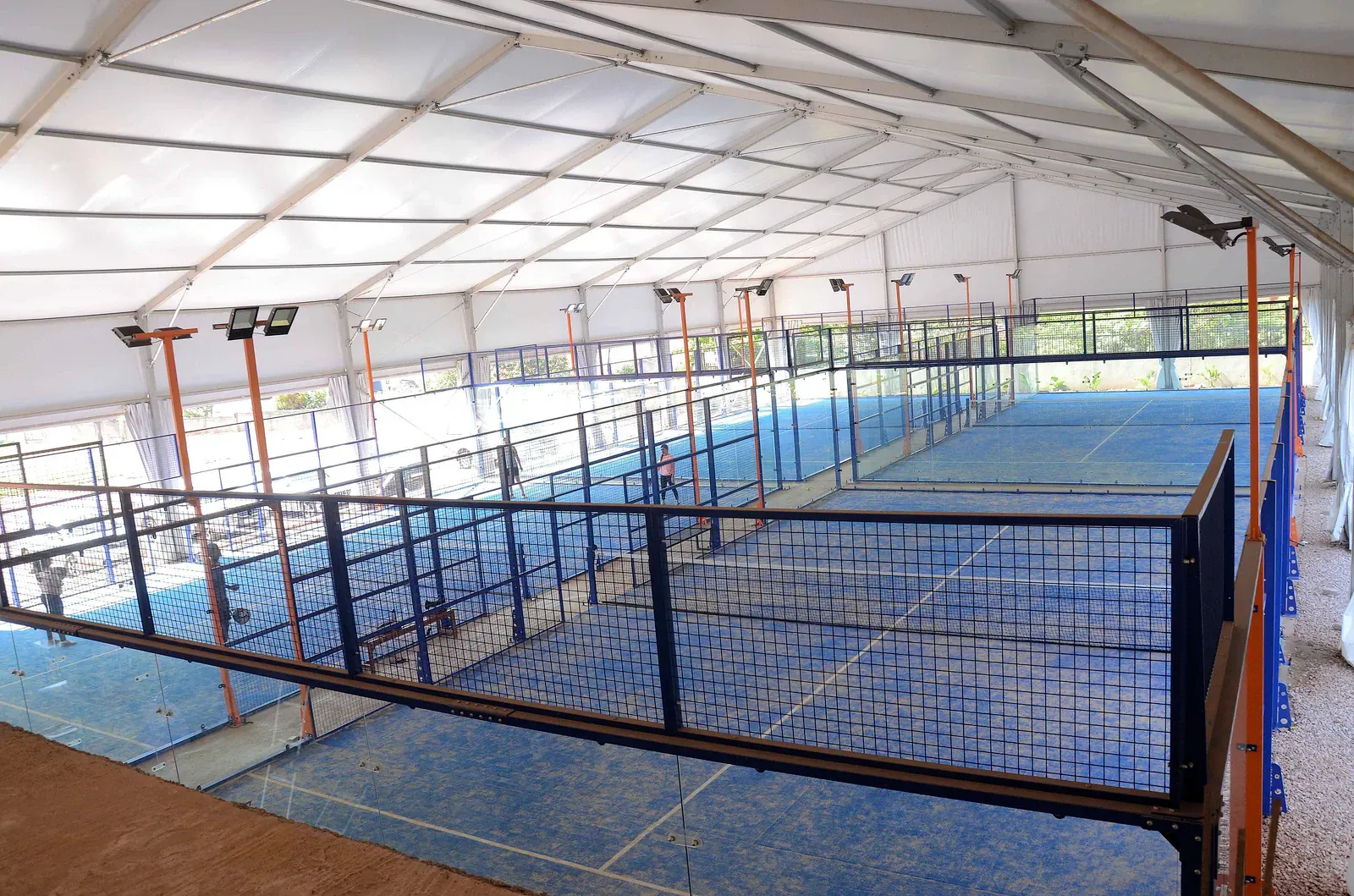
Padel arrived in Thailand later than in Spain or the Gulf, then made up the gap quickly. Courts have opened on hotel rooftops, inside converted warehouses, next to malls and on spare land behind office towers, and the city now has roughly a hundred courts across dozens of venues: a number that keeps moving because new courts open most months. The sport suits Bangkok’s climate better than almost any other racket game precisely because so many courts are covered: a roofed, walled court means play continues through a downpour and out of direct sun, which matters for eight months of the year here.
For a newcomer, padel is the easiest racket sport to pick up in a single session. The court is roughly a third the size of a tennis court, enclosed by glass and mesh walls that the ball can bounce off and stay in play, and doubles is the only format anyone plays. Games are shorter, rallies are more forgiving of a mis-hit, and the underarm serve removes the single biggest technical barrier tennis puts in front of beginners. Most people who try an introductory hour end up able to sustain a rally by the end of it.
How booking and court-sharing work. Almost nobody in Bangkok owns a court booking outright without splitting it: padel is priced and played as a whole court for four, so groups of four book a fixed slot (usually 60 or 90 minutes) and split the cost evenly. Booking runs almost entirely through apps rather than phone calls or walk-ins: search for a slot by time and area, pay online or at the desk, and the fourth player is often the missing piece rather than the court itself. Peak evening and weekend-morning slots at popular venues fill days ahead; weekday midday slots, when the heat is worst and most players are at work, are the easiest to get on short notice.
The four-player economics. A court typically runs ฿1,000-2,200 ($29-63) an hour depending on venue, time slot and whether it is peak evening or off-peak, which works out to roughly ฿250-550 ($7-16) per person for an hour split four ways: genuinely competitive with a single gym class once split, which is part of why the sport spread so fast among people who’d never played racket sports before. Racket hire is usually available for a modest fee per session for anyone without their own, and balls are typically provided or sold cheaply at the desk.
Finding a game as a newcomer. There is no single directory of players; the culture runs on group chats, club-run social sessions and the same booking apps used to reserve courts, several of which have a “find a fourth” or open-game feature that lets a solo player or pair join a group that’s short. Many venues run a weekly open or social play session aimed explicitly at solo bookers, and these are the fastest way in if you don’t already know three other people who play. Coaching exists but is thinner than in tennis: expect group clinics and occasional private lessons rather than a deep bench of dedicated padel coaches, though this is growing as the sport matures.
Tennis: dawn courts, floodlights and the heat problem
Tennis in Bangkok is older and more institutionally embedded than padel, but it runs on a schedule dictated entirely by the sun. Courts exist in four broad flavours: condo courts (a single court bundled into a residential development’s amenities, often underused and free to residents), private club courts (multiple courts, coaching programmes, membership fees), hotel courts (bookable by guests and sometimes outsiders at a day rate), and public or sports-complex courts run by the city or a stadium authority, which are the cheapest option and the most likely to need booking in person or by phone rather than an app.
The heat problem is the defining fact of tennis here. Bangkok’s midday sun on an exposed hard court routinely pushes surface temperatures well past what’s comfortable for sustained rallying, and heat stress risk climbs fast between roughly 10am and 4pm for most of the year. The result is a city that plays tennis at the edges of the day: dawn sessions starting as early as 6am are common among serious players, and evening floodlit courts fill up from around 6pm once the sun drops, with many public and club courts investing specifically in lighting because the two- or three-hour window after dark is when the largest share of casual play actually happens. Midday tennis outdoors, outside of an air-conditioned indoor facility (rare in Bangkok), is mostly left to those with no other option.
Coaching is the most developed of any racket sport in the city: private clubs and several public facilities run structured junior and adult programmes, and freelance coaches operate across condo and hotel courts on an hourly basis. Surfaces are overwhelmingly hard court (acrylic-coated concrete), with a smaller number of clay courts at some clubs; hard courts play faster and are lower-maintenance in Bangkok’s climate, which is why they dominate.
Court hire runs roughly ฿300-800 ($9-23) an hour for public and condo-adjacent courts, and ฿600-1,500 ($17-43) an hour at private clubs and hotels, with private coaching typically ฿800-2,000 ($23-57) an hour on top. As with padel, finding a partner leans on informal networks (condo WhatsApp groups, club noticeboards and hitting-partner apps) more than any central listing.
Badminton: the genuinely popular local sport
Badminton is not a niche import in Thailand the way padel or pickleball are: it is a mainstream, widely played sport with a deep base of local players and dedicated halls in almost every district of the city. Multi-court indoor halls, air-conditioned and purpose-built, are common enough that finding one within a short ride of most residential areas is rarely a problem, and many operate well into the evening to catch the after-work crowd.
The hall-booking culture runs on a mix of walk-in courts, phone bookings and, increasingly, the same booking-app ecosystem used for padel. Regulars often hold a standing weekly slot at the same hall and the same time, effectively forming an informal club even where no formal membership exists; a newcomer’s easiest way in is to turn up at a hall during a busy evening slot and ask if a group needs a fourth, or to use a sport-booking app’s open-session listings where they exist.
Why it’s the cheapest good workout in the city: court hire runs roughly ฿100-300 ($3-9) an hour for a full court, split between two or four players, which puts a session at a few dollars a head, cheaper than a single gym class and a genuine cardiovascular workout given how much ground a badminton rally covers. Racket hire and shuttlecocks are cheap and widely available at every hall, so there’s no equipment barrier to trying it once.
Halls are indoor and air-conditioned by default, which removes the heat problem entirely and is part of why badminton, alone among the racket sports here, is played at any hour without a weather calculation. Outdoor badminton exists only casually (a shuttlecock is too wind-sensitive for serious outdoor play), so “indoor versus outdoor” isn’t really a live question for this sport the way it is for tennis or padel.
Pickleball: the newest arrival
Pickleball reached Bangkok later than padel and is still building its base, but it is growing quickly among the same crowd that took to padel: expats, condo residents and people looking for a lower-impact racket sport than tennis. Courts are smaller than tennis courts and often laid out as temporary lines on existing badminton or tennis courts rather than purpose-built facilities, though a small but growing number of dedicated pickleball courts and converted padel-adjacent venues have appeared.
The game is easy to pick up for anyone who has played any other racket sport (the underhand serve and smaller court make it approachable within a first session), and its lower physical intensity than tennis or padel has made it popular with older players and those returning from injury. Finding a game currently depends heavily on a handful of active social groups and messaging-app communities rather than an established booking-app ecosystem, though that is changing as more dedicated venues open. Expect to pay roughly ฿200-500 ($6-14) per person for an hour session where courts are shared, similar to a modest badminton or padel split.
Squash: the scarce one
Squash is the racket sport Bangkok has the least of. A small number of clubs, hotels and older sports complexes maintain squash courts, but they are neither evenly distributed across the city nor easy to find casually: this is the one sport on this list where checking a specific facility’s court availability in advance, rather than assuming a walk-up option nearby, is close to essential. Where courts exist they tend to sit inside private club or hotel facilities with membership or day-guest pricing rather than public pay-per-hour halls.
Because the player base is smaller, finding a regular squash partner in Bangkok usually means joining whatever club maintains the courts and using its internal member network or an informal WhatsApp ladder, rather than an app-based open-booking culture. Expect court hire in the ฿300-700 ($9-20) an hour range where public or semi-public access exists, plus a guest fee at private clubs; equipment (racket and ball) is worth bringing your own, since hire options are limited compared with the other sports here.
Table tennis
Table tennis is the low-stakes, low-commitment option: tables turn up in condo function rooms, some coworking spaces, community centres, a handful of dedicated clubs, and occasionally in public parks as fixed outdoor tables. It’s rarely the centrepiece of anyone’s fitness routine, but it’s an easy social activity and a genuinely useful cardio-and-reflex workout in short bursts, and the equipment barrier is close to zero if a venue supplies bats and balls.
Dedicated table-tennis clubs exist for players who want to compete or train seriously, with coaching and league play organised informally; for everyone else, a condo or community table is free to residents and needs no booking at all beyond turning up when it’s free.
Comparing the racket sports at a glance
| Sport | Typical venue | Price band (per person, per hour) | How social | Ease of starting |
|---|---|---|---|---|
| Padel | Rooftop/warehouse courts, booked via app | ฿250-550 ($7-16) | High: doubles-only, open-game culture | Easy: one session to get comfortable |
| Tennis | Condo, club, hotel or public court | ฿300-800 public, ฿600-1,500+ club ($9-43+) | Medium: informal partner networks | Moderate: technical learning curve |
| Badminton | Dedicated indoor halls | ฿25-150 ($1-4) split | High: deep local player base | Very easy: cheap, forgiving, everywhere |
| Pickleball | Converted courts, growing dedicated venues | ฿200-500 ($6-14) | Medium, growing fast | Easy: low physical barrier |
| Squash | Club and hotel courts, scarce | ฿300-700+ ($9-20+) | Low: small, tight player base | Harder: few venues, membership-gated |
| Table tennis | Condo, community, coworking, parks | Often free or nominal | High, casual | Very easy: near-zero barrier |
Heat, hydration and outdoor play
Every outdoor racket sport in this city runs into the same wall: Bangkok’s heat is a genuine physiological risk, not just discomfort. Humidity routinely sits high enough that sweat evaporates poorly, which blunts the body’s main cooling mechanism during exactly the kind of sustained, stop-start exertion that tennis and outdoor padel demand. Hydrate well before a session rather than only during it, take shade breaks between sets, and treat dizziness, nausea, confusion or a stopped-sweating episode as reasons to end a session immediately, not push through: heat exhaustion and heat stroke are real risks during Bangkok’s hottest months (roughly March to May), and anyone with a pre-existing heart or blood-pressure condition should talk to a doctor before committing to regular midday outdoor play.
The burning-season problem for outdoor sport
From roughly January through April, particularly February and March, northern and central Thailand’s agricultural burning season pushes fine-particulate air pollution (PM2.5) in Bangkok to levels that make sustained outdoor exertion genuinely unwise on the worst days. This is the practical argument for indoor sport during those months: badminton halls and covered padel courts keep working through burning season in a way that open tennis courts and outdoor pickleball don’t. Checking a real-time air quality reading before an outdoor session, rather than judging by eye, is worth the ten seconds it takes, and postponing or moving indoors on a red or purple day is not overcaution.
Injuries and physio access
Racket sports are hard on shoulders, knees and ankles: sudden direction changes on a hard court, repetitive overhead motions, and the padel-specific hazard of a low ball chased into a glass wall all show up regularly in Bangkok’s sports-medicine clinics. The city has a well-developed private physiotherapy and sports-medicine sector serving exactly this population, from hospital-based sports clinics to independent physio practices near the same clusters where courts are dense. Anything beyond routine muscle soreness (a joint that doesn’t settle after a few days’ rest, a sharp pain during a specific movement, or swelling) is worth a proper assessment rather than self-diagnosis; this guide is not a substitute for seeing a clinician about a specific injury.
Leagues, socials and how newcomers break in
None of these sports in Bangkok run primarily through formal leagues the way team sports might; the default mode is informal ladders, club social nights and app-organised open sessions. Padel and pickleball both lean hardest on app-based “find a game” features because their communities skew newer and more digitally organised; badminton and table tennis lean on standing weekly slots and word of mouth because their player bases are older and more embedded; tennis sits in between, with clubs running structured social nights alongside informal hitting-partner networks. The practical advice is the same across all of them: show up to an advertised open or social session once, be reliable about turning up to whatever regular slot you’re invited into next, and the network does the rest.
Choosing where to live if a racket sport matters
Court density tracks the same clusters as the rest of the city’s expat and higher-income residential areas: expect the highest concentration of padel and tennis facilities around central Sukhumvit, Sathorn and the newer developments further out along the BTS and MRT extensions, with badminton halls far more evenly spread since the sport has a broader, more local base. If a specific sport is central to your routine, it’s worth checking court density and typical peak-hour availability near a shortlisted neighbourhood before signing a lease, the same way you’d check a gym or a supermarket: a five-minute walk to a badminton hall or a padel venue changes how often you actually play far more than a marginally nicer flat two BTS stops further out. For the broader question of choosing a gym or fitness base to pair with a racket sport, see gyms and fitness in Bangkok; for anyone weighing a racket sport against cycling as their main outdoor activity, cycling in Bangkok covers the routes and the same heat and air-quality caveats from the cyclist’s side. For a different sport, see our golf courses guide.
Common questions
Is padel or tennis easier to learn in Bangkok?
Padel is easier for a true beginner: the smaller court, enclosing walls that keep the ball in play, and underarm serve remove most of tennis’s early technical barriers, and most newcomers can sustain a rally within their first session. Tennis has a steeper learning curve but a much deeper coaching infrastructure if you want to invest in it properly.
What does a padel court cost to book in Bangkok?
As a broad, indicative 2026 range, a full court runs roughly ฿1,000-2,200 ($29-63) an hour, which splits to about ฿250-550 ($7-16) per person across the standard four players. Peak evening and weekend slots at popular venues cost more and book out fastest.
Where can I find badminton courts near me in Bangkok?
Dedicated indoor badminton halls are spread across almost every district, far more evenly than padel or tennis facilities, so proximity to home is rarely a problem. Booking is usually by phone, walk-in or a sports-booking app, and court hire is inexpensive enough that trying a few different halls to find one with a good regular crowd costs little.
Is it safe to play tennis or padel outdoors during burning season?
Outdoor play on high-PM2.5 days during burning season (roughly January to April) carries a real respiratory and cardiovascular load on top of normal exertion, and is worth avoiding or moving indoors when air quality readings are poor. Covered padel courts and indoor badminton halls are the more sensible choice on those days.
How do I find playing partners as a newcomer with no local network?
Booking apps with open-game or “find a fourth” features are the fastest route for padel and increasingly pickleball; badminton and table tennis reward simply turning up to a busy hall or community table and asking to join; tennis and squash lean more on club membership and informal hitting-partner networks. Showing up reliably to one regular slot builds a network faster than searching for one.
Which racket sport gives the best workout for the money in Bangkok?
Badminton, by a clear margin: a full hour of court hire split between players can cost only a few dollars a head, the sport is genuinely aerobic, and halls are air-conditioned and available year-round regardless of heat or air quality outside.
Part of
Written by
Mike Brochlowski
Founder and editor, travel photographer and designer
I'm Mike Brochlowski, a travel photographer and designer, and I currently live on Koh Samui, Thailand. I built BangkokWiki to put practical, checked information about Bangkok in one place. Every page is researched from official and primary sources, and the text names them. Where a page shows a checked date, that is when its facts were last confirmed. I also run samui69.com, a non-commercial guide to Koh Samui. If you spot an error or something out of date, tell me through the contact page and I will check it and correct the page.
Read all articles
Where to stay
Pick the area before the hotel
Traffic and heat make Bangkok distances feel longer than they look on a map, so the area shapes a trip more than the hotel does. Our guides match areas to trip types and explain the trade-offs.

Places to stay
Find a hotel
More from Things to do
- 12 min read
 9 min read
Bangkok Must-Do Experiences, Scored by Time, Cost, Crowd
 5 min read
How to Choose a Thai Cooking Class in Bangkok

Newsletter
You're subscribed as