Things to do
Loy Krathong in Bangkok: Where to Go and What It Means
Loy Krathong in Bangkok explained: the festival's meaning, the best riverside and park spots, and how to float a krathong responsibly.
At a glance
- Reading time
- 12 min read
- Chapters
- 14
- Published
- Sep 20, 2026
On this page
Loy Krathong is Thailand’s festival of floating offerings, held on the full moon of the twelfth lunar month, usually falling in November. Across Bangkok, riverbanks, park lakes and canals fill with small candlelit floats and with people releasing them, in a night that is equal parts spiritual gesture, family outing and citywide spectacle.
What Loy Krathong means
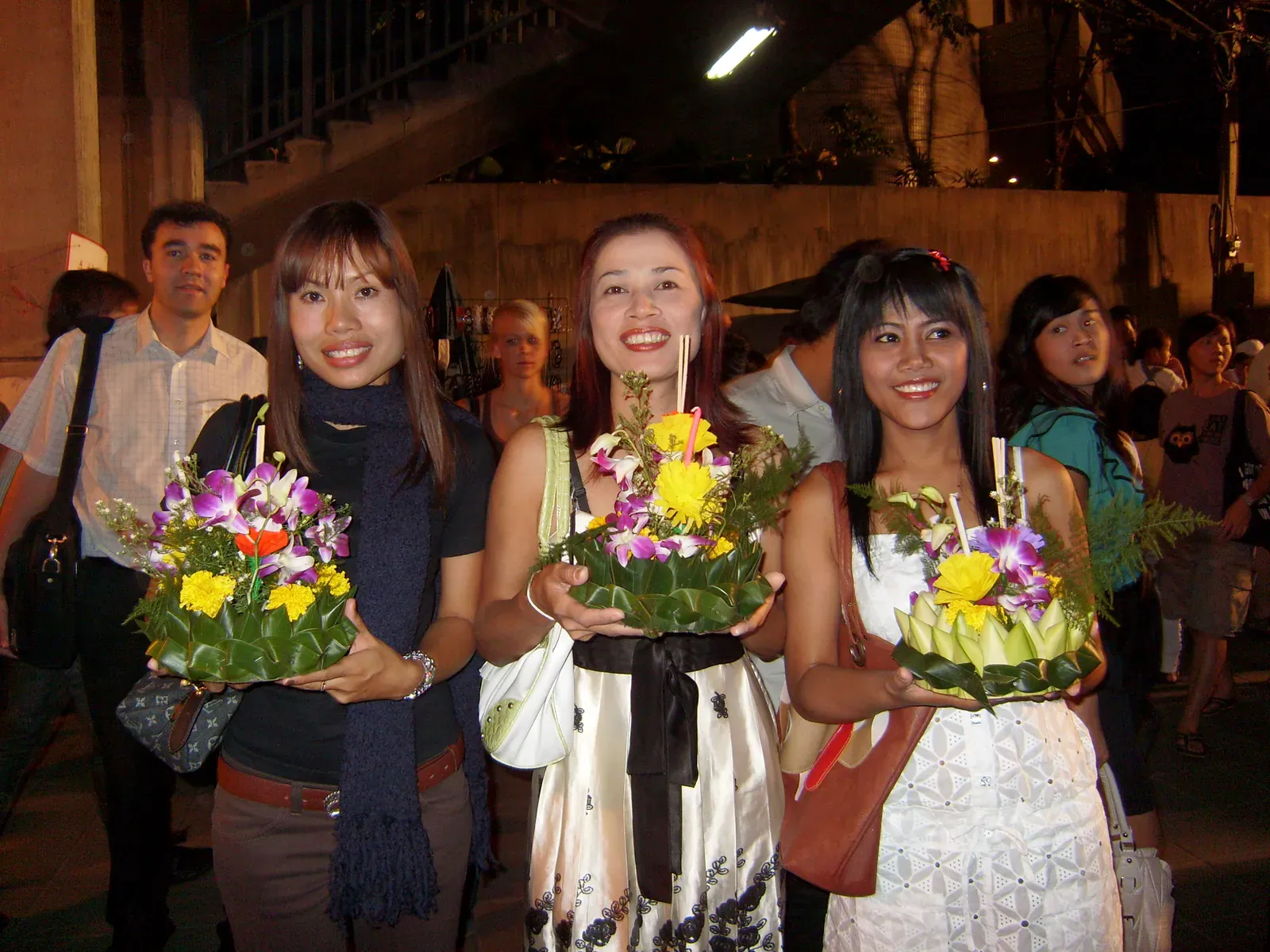
The word “loy” means to float, and a “krathong” is a small vessel, traditionally made from a slice of banana tree trunk, decorated with folded banana leaves, flowers, incense sticks and a candle. The custom is to light the candle and incense, make a wish or a quiet reflection, and set the krathong on moving water, letting it carry away the past year’s misfortune, bad luck or ill will.
The festival carries layered meaning rather than one single origin. A widely told strand is Buddhist: the krathong is released as an act of merit and as a symbolic apology to the water for having used and polluted it throughout the year. An older, animist strand honours Phra Mae Khongkha, a goddess of water, thanking her for the water that sustains rice farming and daily life, and asking forgiveness for the ways rivers and canals are used and misused. Many Thais hold both ideas at once without seeing a contradiction: a Buddhist act of letting go, performed as a gesture of respect to the water itself. Some people also add a small clipping of hair or a fingernail to the krathong before releasing it, a folk practice meant to let go of a specific piece of bad luck along with the wish.
What actually happens in Bangkok on the night
As dusk falls, the riverbanks and piers along the Chao Phraya fill with families and groups carrying krathongs bought earlier in the day or made at home. Vendors set up along the approaches to popular piers selling ready-made krathongs in a wide range of styles and prices. Hotels along the river run their own events, often with dinner, live music and a private stretch of riverbank or a pontoon for guests to release their krathong away from the busiest public crowds. Public parks with lakes, most famously Lumpini Park, become an inland alternative to the river, with the same ritual played out on calmer water and often paired with cultural performances, food stalls and, in some years, fireworks.
By mid-evening, the water in the most popular spots is genuinely crowded: hundreds or thousands of small lit krathongs drifting together, bumping gently against each other, in a sight that is the visual signature of the festival across every photograph taken of it. This crowding is not a flaw in the experience; for most people who go, the crowd, the lights on the water and the shared, slightly noisy atmosphere are the festival, not an obstacle to it.
Where to go and how each spot differs
Bangkok offers several distinct ways to take part, and the right choice depends on what kind of evening is wanted.
| Area | Character | Getting there |
|---|---|---|
| Chao Phraya riverbanks and public piers | The classic version: open riverside space, food stalls, large crowds, and a direct view of the main channel filling with krathongs and passing river traffic. | BTS Saphan Taksin to Sathorn Pier, or any Chao Phraya Express pier along the river |
| ICONSIAM and other riverside developments | A more curated riverside experience, with organised event space, food and retail nearby, and a managed area for releasing krathongs. Expect the largest crowds of any single venue. | BTS Krung Thon Buri or Saphan Taksin, then the connecting shuttle boat or ferry |
| Lumpini Park and other park lakes | A calmer, greener alternative to the river, with a smaller and more contained body of water, often easier for families with small children to navigate. | MRT Lumpini or Silom, or BTS Sala Daeng |
| The old town (Rattanakosin area) | Temples and historic waterfront near the river’s older stretch, offering a quieter, more traditional atmosphere alongside major landmarks. | River boat to Tha Chang or Tha Tien pier |
| Neighbourhood khlongs (canals) | Small, local versions of the festival away from the main crowds, often organised by a community or temple, with a fraction of the visitors. | Varies by neighbourhood; ask locally or check community event listings closer to the date |
Whichever spot is chosen, arriving early secures a workable spot at the water’s edge; the best-known locations fill up well before the peak hour of releasing krathongs after dark.
What a krathong is made of, and why it matters
Material matters more at Loy Krathong than at almost any other Thai festival, because tens of thousands of krathongs go into the water in a single night across the city, and every one of them has to be collected afterward.
- Banana trunk and banana leaf: the traditional base, fully biodegradable and the version cities and environmental campaigns actively encourage.
- Bread: sold as an eco-friendly option because fish and birds eat it, though it also breaks apart and adds to organic waste in already crowded waterways if not eaten quickly.
- Polystyrene (foam): durable, cheap and widely available, but does not biodegrade and is the material most targeted by clean-up campaigns and public appeals to avoid it. Environmental authorities have repeatedly urged Bangkok residents to move away from foam krathongs, and the city removes tens of thousands of them from the water each year.
- Ice: a newer, genuinely biodegradable novelty option that melts away entirely.
Buying a banana-trunk krathong rather than a foam one is the single easiest way for a visitor to reduce their footprint on the night, and stalls near every major venue sell them cheaply, typically in the range of ฿20 to ฿100 (roughly US$0.55-$2.80, indicative for 2026) depending on size and decoration.
How to float a krathong
The ritual itself is simple and does not require any special knowledge to take part respectfully. Light the candle and incense on the krathong, hold it for a quiet moment while thinking of what is being released or wished for, then set it gently on the water and let it drift away without retrieving it. Some people add a small clipping of hair or a fingernail beforehand, as a symbolic way of releasing a specific misfortune along with the general wish; this is optional and not required to take part. Take care with the open flame near paper decorations and near a crowd of people leaning over the water’s edge at the same time; minor burns and dropped, sputtering candles are the most common mishap of the night, simply from the sheer density of people lighting flames in a small space.
The sky lantern question
The image many people associate with Loy Krathong, a sky full of glowing paper lanterns released together, is not a Bangkok event. That mass lantern release is Yi Peng, a separate festival specific to the Lanna culture of northern Thailand and celebrated most famously in Chiang Mai, which happens to fall around the same lunar date as Loy Krathong. In Chiang Mai, the two festivals run together: krathongs on the water and lanterns in the sky on the same nights. In Bangkok, Loy Krathong is the water festival only; there is no equivalent mass sky-lantern release.
This distinction matters beyond disappointment at not seeing lanterns in Bangkok. Releasing sky lanterns near an airport is both illegal and genuinely dangerous, since a floating open flame can drift into an aircraft’s flight path or cause a fire on landing, and Bangkok sits close to two major airports. Anyone hoping to release a sky lantern as part of their Loy Krathong experience should look to organised, permitted events specifically in the north, not attempt it independently in or near Bangkok.
The environmental debate and taking part responsibly
Loy Krathong sits at an uncomfortable intersection of tradition and environmental cost. The ritual’s original spirit, respecting and thanking the water, sits awkwardly against the modern reality of a river and its canals receiving hundreds of thousands of objects in a single night, many made of non-biodegradable material, all of which must be manually collected by city workers in the days after. Bangkok’s municipal authorities run public campaigns most years encouraging biodegradable materials and discouraging foam, and the number of krathongs collected from the river has, according to city figures reported in recent years, trended downward as awareness campaigns and a shrinking appetite for the tradition among younger urban residents both play a role.
A visitor can take part responsibly with a few simple choices: buy a banana-leaf or banana-trunk krathong rather than foam, avoid decorations with glitter, plastic ribbon or metal pins that will not break down, keep the krathong small rather than an elaborate multi-tier version, and consider floating one per group rather than one per person if a family or group of friends is taking part together. None of this diminishes the ritual; a small, simple krathong made from natural materials is, if anything, closer to the tradition’s original form than an elaborate decorated one bought for the photograph.
Photography
Loy Krathong is one of the most photogenic nights in the Bangkok calendar, with hundreds of small candle flames reflected on dark water and lantern-lit riverside crowds. A few practical points help: a tripod or a steady hand matters more than an expensive camera, since most of the light comes from candles rather than any strong ambient light. Wide shots of a crowded pier work well early in the evening before the crowd thickens too much to move; close shots of individual krathongs work better from a private hotel pontoon or a quieter khlong than from the packed public piers, simply because there is more room to get close to the water’s edge. Respect people’s private moments; many visitors are performing a genuine, sometimes emotional personal ritual and are not there to be photographed as scenery.
What a krathong costs and where to buy one
Krathongs are sold everywhere in the run-up to the festival: temporary stalls near every major pier and park entrance, market vendors for weeks beforehand, and even convenience stores and supermarkets in some years. Prices scale with size and decoration rather than material alone, so a simple banana-leaf krathong is not necessarily more expensive than an elaborate foam one; broadly, a basic version runs in the ฿20 to ฿50 range (roughly US$0.55-$1.40, indicative for 2026), while larger, more elaborately decorated versions with layered leaves, flowers and multiple candles can run considerably higher. Buying on the day, close to the venue, is normal practice and does not carry the same last-minute risk as, say, festival tickets; supply generally keeps pace with demand at every major site. Some hotels and venues also offer krathong-making activities as part of an evening event, letting visitors assemble their own from natural materials rather than buying a finished one, which for many visitors is a more memorable way to take part than simply purchasing a float.
Loy Krathong with children
The festival works well for families. The ritual itself, lighting a candle and releasing a small float, is simple enough for most children to understand and enjoy, and the general atmosphere, food stalls, music and lantern-lit water, reads as festive rather than solemn. Park lakes such as Lumpini offer calmer, shallower water’s-edge access than the open river, which matters for supervising small children near candle flames and crowded platforms. Keep a firm hand on younger children in the densest crowds at the main piers, where the combination of low light, open flames and a packed crowd deserves the same care as any other big nighttime event.
Crowds and getting home afterward
The most popular riverside spots and ICONSIAM’s riverside venue draw very large crowds by the peak hour after dark, and moving through them takes patience. River boats and the connecting BTS stations, Saphan Taksin and Krung Thon Buri, get correspondingly busy, with queues for boats and packed platforms in the hour or two after the festival’s peak. Building in extra time to leave, rather than trying to exit at the exact moment everyone else does, makes the night considerably less stressful. Taxis and ride-hailing near the riverside venues face the same congestion as any other major event night in Bangkok, and fares can rise accordingly; walking a few blocks away from the immediate riverside before hailing a ride is often faster than trying from directly outside the venue.
What else is on in November
Loy Krathong does not happen in isolation on the Bangkok events calendar. November sits in the cool season (see Bangkok weather in November), Bangkok’s most comfortable weather stretch, and the city often runs other cultural and seasonal events around the same weeks, from temple fairs to seasonal markets. It is also worth checking Thailand’s wider public holiday calendar for the month, since Loy Krathong itself is not a public holiday (it is a cultural festival rather than a day off work), which means the crowds at the main venues are largely people who have finished a normal working day, concentrating the busiest period into the evening and night hours specifically.
For the structure of Thailand’s actual public holidays and the rules around alcohol sales that sometimes affect festival nights, see Bangkok’s public holiday and alcohol ban guide. For the country’s other major festival built around water, at the opposite end of the calendar, see Songkran in Bangkok. For the other festival dates by month, see the Bangkok festival calendar. The temple fair at Wat Saket is covered in the Wat Saket Golden Mount guide.
When is Loy Krathong, exactly
Loy Krathong has no fixed date on the Western calendar, because it follows the full moon of the twelfth month of the traditional Thai lunar calendar. In practice this places it in November most years, but the exact date shifts annually and must be checked against the current year’s calendar rather than assumed from a previous year’s date. Official tourism and government sources publish the confirmed date each year once it is set.
Common questions
Is Loy Krathong the same as Yi Peng?
No. Loy Krathong is the nationwide festival of floating krathongs on water, celebrated across Thailand including Bangkok. Yi Peng is a separate, northern Lanna festival of releasing sky lanterns, celebrated mainly in Chiang Mai, which happens to fall around the same lunar dates. The two run together in Chiang Mai but Bangkok only has the water festival.
What is the best material for a krathong?
Banana trunk and banana leaf are the traditional, fully biodegradable choice and the one environmental campaigns encourage. Bread and ice are also considered eco-friendly alternatives. Foam krathongs are widely discouraged because they do not biodegrade and add substantially to the clean-up burden on the city’s waterways.
Where is the best place to see Loy Krathong in Bangkok?
The Chao Phraya riverbanks and major piers give the classic experience of a crowded river full of lit krathongs. Riverside developments such as ICONSIAM run large organised events. Lumpini Park and other park lakes offer a calmer, more family-friendly alternative to the open river.
Can I release a sky lantern in Bangkok for Loy Krathong?
No, this should be avoided. The mass sky-lantern release associated with these festivals is a Chiang Mai tradition (Yi Peng), not a Bangkok one. Releasing sky lanterns near Bangkok’s airports is illegal and dangerous, since a drifting flame can interfere with aircraft.
What date is Loy Krathong this year?
The festival follows the lunar calendar and usually falls in November, but the exact date moves each year and must be checked against the current year’s confirmed calendar rather than assumed.
Is Loy Krathong bad for the environment?
It can be, depending on the materials used. Large numbers of krathongs, particularly foam ones, are released into Bangkok’s river and canals in a single night and must be manually collected afterward. Choosing a small, biodegradable krathong made from banana leaf or trunk substantially reduces the impact while keeping the tradition intact.
Written by
Mike Brochlowski
Founder and editor, travel photographer and designer
I'm Mike Brochlowski, a travel photographer and designer, and I currently live on Koh Samui, Thailand. I built BangkokWiki to put practical, checked information about Bangkok in one place. Every page is researched from official and primary sources, and the text names them. Where a page shows a checked date, that is when its facts were last confirmed. I also run samui69.com, a non-commercial guide to Koh Samui. If you spot an error or something out of date, tell me through the contact page and I will check it and correct the page.
Read all articles
Where to stay
Pick the area before the hotel
Traffic and heat make Bangkok distances feel longer than they look on a map, so the area shapes a trip more than the hotel does. Our guides match areas to trip types and explain the trade-offs.

Places to stay
Find a hotel
More from Things to do
- 13 min read
 9 min read
Bangkok Must-Do Experiences, Scored by Time, Cost, Crowd
 5 min read
How to Choose a Thai Cooking Class in Bangkok

Newsletter
You're subscribed as