Things to do
The best parks in Bangkok, and what each one is actually for
A park-by-park guide to Bangkok's green space: Lumphini, Benjakitti, Chatuchak, Bang Krachao and more, with transit, hours and honest verdicts.
At a glance
- Reading time
- 13 min read
- Chapters
- 14
- Published
- Sep 20, 2026
On this page
Bangkok has less green space per resident than almost any comparable Asian capital, so the parks it does have work hard: they are gyms, living rooms, wedding photo studios and the only quiet a lot of people get in a day. This guide goes park by park with a real verdict on each one, then covers the unwritten rules that make a Bangkok park pleasant rather than a mistake: timing, heat, monitor lizards, and the evening ritual that catches every first-time visitor off guard.
Lumphini Park: the central classic
Lumphini is the park most visitors picture when they think of green Bangkok, and it earns the reputation. A roughly 2.5 km perimeter path rings a central lake, with mature rain trees, an amphitheatre, outdoor gyms dotted every few hundred metres, and enough shade to make a slow lap bearable even mid-morning. The lake itself is the park’s signature: paddleboats for hire, monitor lizards the size of small crocodiles cruising the banks or hauled out sunning on the grass, and a resident population of herons and turtles that make it feel wilder than a city park usually does.
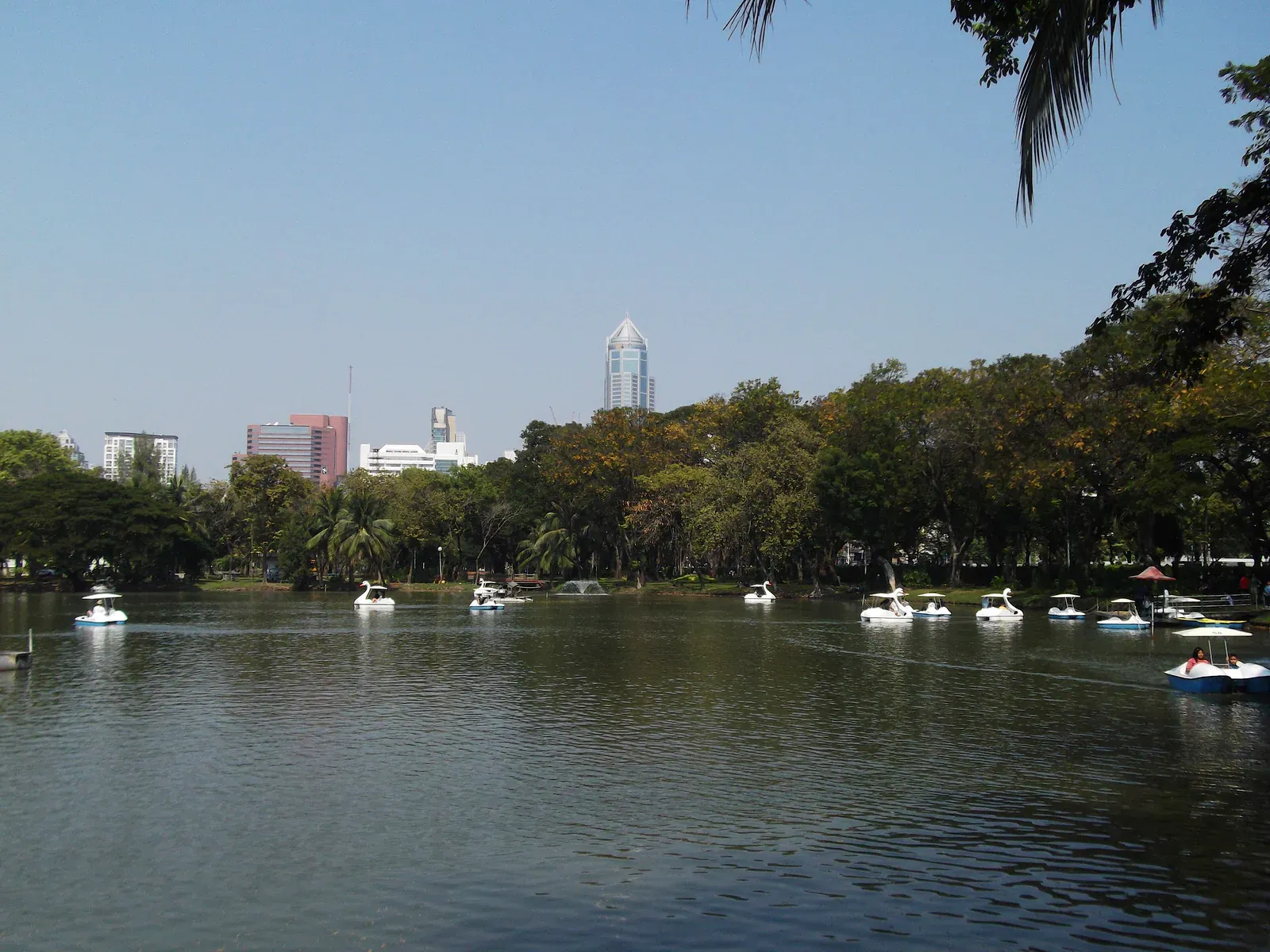
The rhythm here is dawn and dusk. From around sunrise the paths fill with joggers, tai chi groups, and, most distinctively, open-air aerobics classes with a boombox and an instructor on a small platform, a Bangkok institution rather than a novelty. Evenings bring the same crowd back plus office workers decompressing after work, badminton games on the courts, and couples on the benches near the lake. Midday is a different park: hot, quiet, mostly maintenance staff and a few determined joggers.
Getting there: MRT Lumphini or Silom station puts you at the park’s north gate in a couple of minutes; BTS Sala Daeng is a five- to seven-minute walk. Multiple gates ring the park, so pick the one nearest your onward journey rather than always using the same entrance. For hours and the full loop, see our Lumpini Park guide.
Verdict: the best all-rounder in the city and the fairest comparison point for every other park on this list. Toilets and water fountains are dotted around the loop, shade is genuinely good by Bangkok standards, and it is busy enough at the right hours to feel safe and sociable without ever feeling crowded like Chatuchak on a weekend.
Benjakitti Park and its forest extension
Benjakitti used to mean one thing: a lake loop next to the Queen Sirikit National Convention Centre, popular with runners but modest in scale. That changed with the addition of a forest park extension built on former tobacco-factory land next door, a much larger stretch of restored wetland and planted forest threaded by an elevated walkway that runs through the tree canopy and over the water. It roughly doubles the usable green space in this part of town and gives Bangkok something it had very little of: a park that feels like a constructed wilderness rather than a manicured lawn.
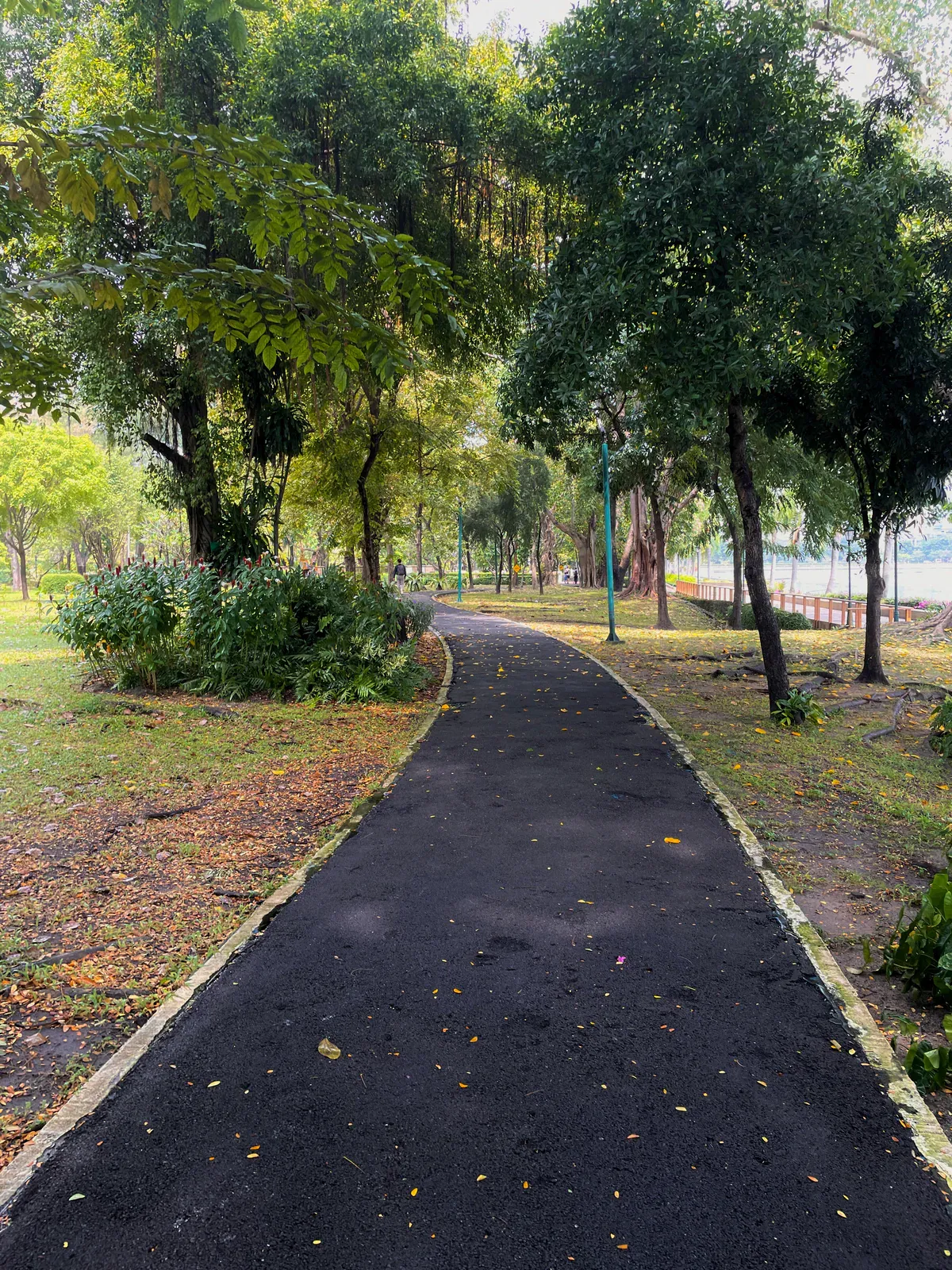
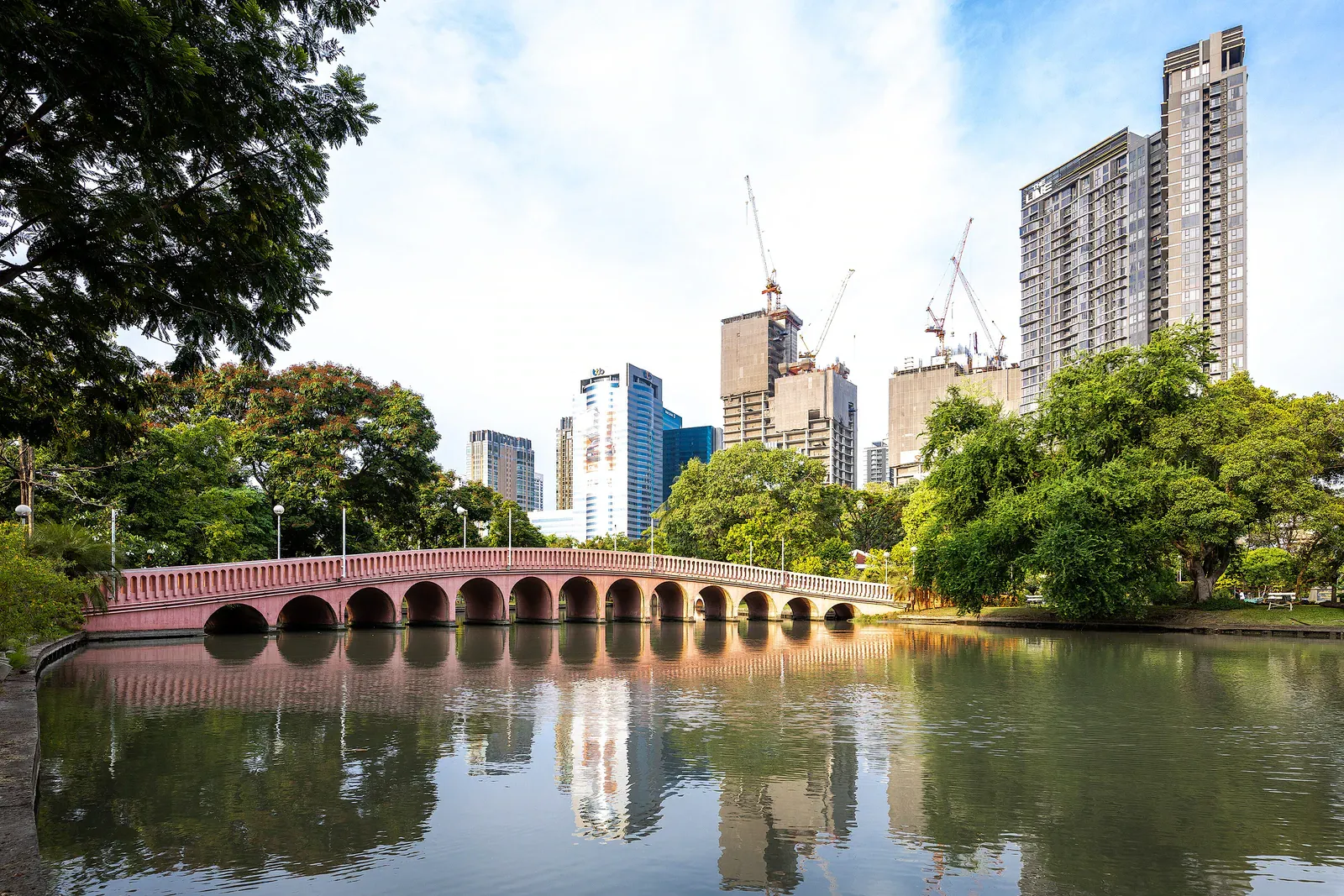
The elevated walkway is the reason to come. Wooden decking lifts you above the wetland, past reflection pools that mirror the surrounding skyline (one of the more photographed views in the city at golden hour), and the planting has matured enough that it genuinely muffles the traffic noise from the expressway nearby. The original lakeside loop is still there and still popular with runners doing repeats before or after work. For the full walk, see our Benjakitti Park guide.
A newer elevated link, sometimes called the Green Bridge, connects Benjakitti toward Lumphini Park for pedestrians and cyclists, so on a good evening it is possible to move between the two green spaces without touching a road: check current signage and access hours on the day, since a bridge like this can close for maintenance.
Getting there: MRT Queen Sirikit National Convention Centre (QSNCC) station opens directly onto the park; it is one of the easiest parks in the city to reach by rail.
Verdict: the most interesting new-build park in Bangkok and worth a special trip for the forest walkway alone. It gets hot with less mature shade than Lumphini in the older section, so time it for morning or late afternoon.
Chatuchak, Rot Fai and the northern green block
Around Mo Chit and Kamphaeng Phet, several parks sit close enough together to function as one large green district: Chatuchak Park proper, Queen Sirikit Park next door (built for the Queen’s 60th birthday, strong on botanical planting), and Rot Fai Park (officially Wachirabenchathat Park), a former railway-land site with the best cycling loop of the three. Rot Fai’s paved perimeter road is wide, largely flat, and popular enough with cyclists that bike hire stalls operate near the entrances on weekends.
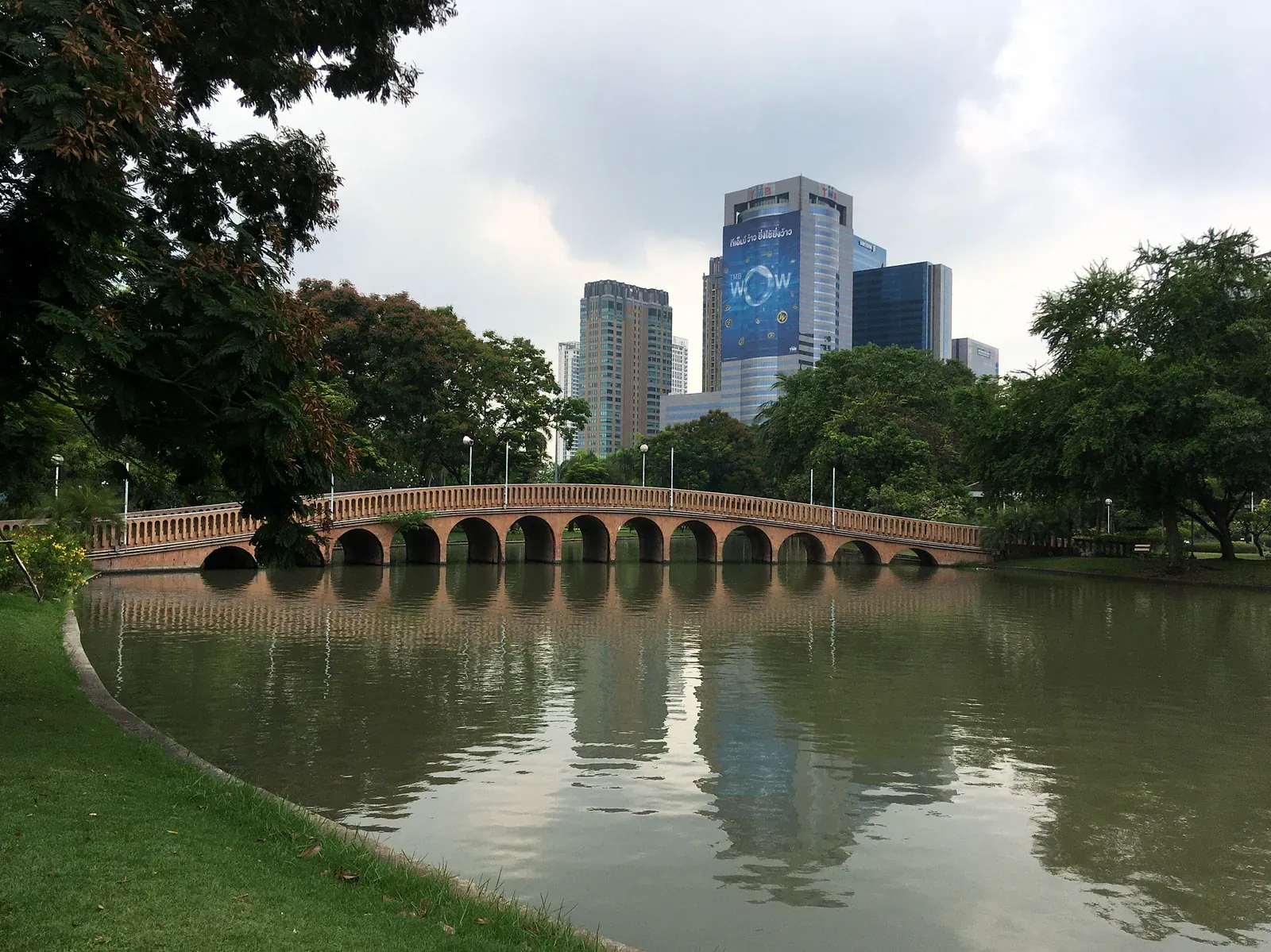
This block sits beside the Chatuchak Weekend Market, so on Saturdays and Sundays the parks absorb market crowds looking for shade and a place to sit down, and the atmosphere is markedly more chaotic than on a weekday. Families use Queen Sirikit Park for its wider lawns and children’s play areas; serious cyclists tend to gravitate to Rot Fai’s loop early, before the heat and the crowds arrive together.
Getting there: BTS Mo Chit or MRT Chatuchak Park for the southern edge of Chatuchak Park; MRT Kamphaeng Phet sits closer to Rot Fai and Queen Sirikit Park’s entrances, a walk of ten to fifteen minutes depending on gate.
Verdict: the best choice for a cycling session or a whole-day family outing with a market visit built in, less good as a quick after-work stop given the distances between gates.
Benjasiri Park: the small Sukhumvit breather
Benjasiri is tiny compared with the parks above (a single loop you can walk in fifteen minutes), but its location is the whole point. It sits directly beside BTS Phrom Phong in the heart of the Sukhumvit condo and office corridor, which makes it the default lunch-break and after-work park for a huge resident and working population that has no other green space within easy reach. Expect a running track ring, a couple of sports courts, playground equipment, and a sculpture garden that makes it feel more curated than most neighbourhood parks.
Getting there: BTS Phrom Phong, exit directly adjacent to the park.
Verdict: not a destination park, but genuinely useful if you live or work nearby and want twenty minutes outside without a taxi ride. Busiest in the early evening as offices empty out.
Santiphap Park and the old-town gardens
Santiphap (“Peace”) Park is a smaller, quieter green space near the government and old-city area, popular with locals rather than tourists and rarely crowded even at peak hours. It lacks the rail access of the parks above (no BTS or MRT station sits close, so a taxi, a Saen Saep canal boat toward the old town, or a longer walk from Phaya Thai is the practical route), which keeps it calm but makes it a deliberate rather than casual visit.
The old-town gardens cluster around Rattanakosin Island near the Grand Palace and Wat Pho: Saranrom Park, a former royal garden with a formal, slightly faded elegance, ponds, and shade trees, sits a short walk from both temples and makes a good decompression stop after the crowds there. It is reachable via MRT Sanam Chai, one of the better-connected stations for this part of the city, or by river boat to Tha Tien pier.
Verdict: Saranrom is worth combining with a Grand Palace or Wat Pho visit rather than visiting alone; Santiphap suits residents more than visitors on a tight itinerary. For another central stop, see our Dusit Park guide.
The riverside parks
Bangkok’s relationship with its river is improving but still patchy: long stretches of the Chao Phraya bank remain private, industrial or simply inaccessible on foot. Where public riverside space exists, it is worth seeking out for the breeze alone, which cuts the heat noticeably compared with inland parks. Santichaiprakan Park, near the Phra Sumen Fort and the Khao San Road area, is small but sits right on the water with river views and food stalls nearby; it connects to the promenade running past Phra Athit. Newer riverside walkway sections have extended some of this connectivity, though coverage is uneven and a route that looks continuous on a map can dead-end at a private pier.
Getting there: river boat to Phra Athit (Banglamphu) pier for Santichaiprakan; there is no nearby BTS or MRT station, so a boat or a longer walk from the old town is the practical option.
Verdict: better for an evening drink and a river breeze than for exercise, given how disconnected the riverside path network still is.
Bang Krachao: the green lung across the water
Bang Krachao deserves its own separate guide (see our full Bang Krachao guide for the detail), but it belongs on any “best parks” list because it is, functionally, the largest and greenest space near central Bangkok. It is a horseshoe-shaped bend of the Chao Phraya opposite the Khlong Toei and Bang Na districts, reached by a short ferry crossing rather than a bridge, and it has stayed largely undeveloped: raised concrete paths through mangrove, orchard smallholdings and a handful of villages, with almost no traffic. Sri Nakhon Khuean Khan Park and Botanical Garden sits at its centre and is the nearest thing it has to a conventional park.
Verdict: the best half-day or full-day green escape near the city, best done by bicycle, and genuinely different in character from every other entry here.
Newer pocket parks on leftover land
A handful of small parks have been built in the last several years on land that had no other obvious use: strips beside expressways, former factory sites, land freed up by infrastructure projects. Chulalongkorn Centenary Park near Samyan is a good example: modern landscape design, a sloped green roof used for water retention during heavy rain, and a location that serves the dense student and office population around Chulalongkorn University and the Samyan area. These pocket parks rarely have the scale for a long run or a picnic spread, but they matter because they put a patch of green within walking distance of people who previously had none.
Getting there: MRT Sam Yan for Chulalongkorn Centenary Park, a short walk from the station exit.
Verdict: worth knowing about if you live or work nearby; not worth a special trip on their own.
If running is the main reason you’re scouting parks, the loop-by-loop detail (including surface, shade and timing for each route) lives in our dedicated running guide.
Comparing the main parks
| Park | Best for | Nearest transit | Walk from station |
|---|---|---|---|
| Lumphini | All-round loop, lake, morning/evening rhythm | MRT Lumphini / Silom | 2-7 min |
| Benjakitti + Forest Park | Elevated walkway, photography, running | MRT QSNCC | Direct |
| Rot Fai / Chatuchak block | Cycling loop, whole-day family outing | BTS Mo Chit / MRT Kamphaeng Phet | 10-15 min |
| Benjasiri | Quick lunch-break green space | BTS Phrom Phong | Direct |
| Saranrom | Quiet stop near the temples | MRT Sanam Chai | 5-10 min |
| Bang Krachao | Full green-lung day, cycling, escape | Ferry from Khlong Toei-area piers | Boat crossing |
The craft of using a Bangkok park
A few things every park in this city has in common, and that catch newcomers out:
- Dawn and dusk are the real hours. Midday heat in the hot season makes anything more than a slow walk unpleasant, and most Bangkok park life (the joggers, the aerobics classes, the badminton games) shifts to before roughly 08:00 and after roughly 17:00 as a result. Treat the middle of the day as a shade-and-water stop, not exercise time.
- Monitor lizards are harmless but enormous. Lumphini and Benjakitti both host large monitor lizard populations, some over a metre and a half long. They are not aggressive toward people and mostly ignore joggers entirely, but give them space, do not feed them, and keep small dogs on a short lead near the water.
- Mosquitoes are a real, manageable problem, worse near standing water and worst at dusk. Repellent is worth applying before you enter rather than after the first bite, particularly in the rainy season.
- The national anthem plays at 08:00 and 18:00 in most public parks, over loudspeakers, and the convention is to stop and stand still until it finishes, a minute or so. Locals do this without fuss; visitors caught mid-jog generally just slow to a stop rather than sprinting past.
- Closing times exist but vary and change, so treat any specific hour you read as a general pattern (roughly dawn to somewhere around 21:00-22:00 for the bigger parks) rather than a fact to plan a tight schedule around. Check signage at the gate on the day.
- Dogs are generally allowed on a lead in the bigger parks, though rules on where they can go (off the main paths, away from playgrounds) are enforced more strictly in some parks than others.
- What is not allowed: alcohol is restricted or banned in most parks, smoking is banned in many, and formal sports pitches or courts are sometimes reservable and sometimes first-come. Signage is usually in Thai and English at the main gates.
For families
Chatuchak’s block of parks and Benjakitti’s forest section have the most space for children to actually run around, with playgrounds, wide lawns and enough distance between path and water that a wandering toddler is not immediately at a canal edge. Lumphini’s lake side needs closer supervision near the monitor lizards and the water, though the animals themselves rarely bother anyone. Benjasiri’s small scale suits a short visit with younger children who tire quickly, rather than a full outing. For a longer family day out, Bang Krachao is worth the ferry crossing: see the family section in the Bang Krachao guide for specifics on cycling with kids. For a swim instead, see our guide to public pools in Bangkok.
For seniors and accessibility
The larger parks (Lumphini, Benjakitti, the Chatuchak block) have paved, largely flat perimeter paths that work well for a slow walk or a wheelchair, with benches spaced frequently enough to break a loop into shorter stretches. Surface quality drops off on some of the smaller connecting paths and around older sections of Saranrom, where paving is uneven in places. Toilets exist in all the major parks but facilities and maintenance standards vary; the bigger, better-funded parks (Lumphini, Benjakitti) are the more reliable choice if that is a concern. Heat is the bigger practical issue than terrain: a mid-morning visit in the hot season is genuinely hard going for anyone with reduced heat tolerance, so aim for the first couple of hours after sunrise or the couple of hours before sunset.
Matching a purpose to a park
| Purpose | First choice | Second choice |
|---|---|---|
| A run | Rot Fai’s loop | Benjakitti (lake loop or forest walkway) |
| A picnic | Queen Sirikit Park | Chulalongkorn Centenary Park |
| A work call outdoors | Benjasiri | Chulalongkorn Centenary Park |
| A child’s afternoon | Chatuchak block | Bang Krachao (with a bicycle) |
| A quiet hour | Saranrom | Santiphap |
Common questions
Which is the best park in Bangkok for a first visit?
Lumphini, for the combination of easy rail access, a proper loop, the lake and monitor lizards, and enough activity at the right hours to feel like a real slice of Bangkok life rather than a tourist stop.
Are Bangkok parks free to enter?
The main public parks covered here (Lumphini, Benjakitti, Chatuchak, Benjasiri, Saranrom, Santiphap) are free. Some smaller attractions inside a park, like paddleboat hire on Lumphini’s lake, charge separately.
Is it safe to visit Bangkok parks alone in the evening?
The bigger parks are busy with joggers, families and exercise groups right up to closing in the evening, which makes them feel safer than an empty park would; use ordinary city sense about quieter corners after dark rather than avoiding parks altogether.
Do Bangkok parks close at night?
Most close for a few hours overnight, generally somewhere in the late evening to early morning window, but the exact hour is not consistent across parks or seasons: check the gate signage rather than assuming a fixed time.
Are the monitor lizards in Lumphini Park dangerous?
No. They are large water monitors that have lived in the park for years, feed themselves from the lake and surrounding grounds, and generally avoid people. Keep a respectful distance, do not feed or corner them, and they cause no trouble.
Which park is best if I don’t have much time?
If you are near Sukhumvit, Benjasiri is a fifteen-minute loop right at BTS Phrom Phong. If you are near Silom or Sathorn, Lumphini’s north gate is a couple of minutes from MRT Lumphini and rewards even a short visit.
Written by
Mike Brochlowski
Founder and editor, travel photographer and designer
I'm Mike Brochlowski, a travel photographer and designer, and I currently live on Koh Samui, Thailand. I built BangkokWiki to put practical, checked information about Bangkok in one place. Every page is researched from official and primary sources, and the text names them. Where a page shows a checked date, that is when its facts were last confirmed. I also run samui69.com, a non-commercial guide to Koh Samui. If you spot an error or something out of date, tell me through the contact page and I will check it and correct the page.
Read all articles
Where to stay
Pick the area before the hotel
Traffic and heat make Bangkok distances feel longer than they look on a map, so the area shapes a trip more than the hotel does. Our guides match areas to trip types and explain the trade-offs.

Places to stay
Find a hotel
More from Things to do
- 13 min read
 10 min read
Chatuchak Weekend Market Guide: How to Navigate It
 10 min read
Floating Markets Near Bangkok Compared

Newsletter
You're subscribed as