Living
Commute Times Across Bangkok: A Data Compilation by Area
Door-to-CBD minutes for eight Bangkok areas, off-peak and rush hour, from BTS/MRT operating data. A sourced guide for choosing where to live by commute.
On this page
Silom is already in the CBD. On Nut is a comfortable half hour away. Nonthaburi, at the far end of a line change, can eat over an hour of a working day round trip. Bangkok’s residential areas span that whole range, and the difference rarely shows up clearly until you’ve already signed a lease. This compiles door-to-CBD minutes for eight named residential areas, off-peak and rush hour, on one chart, built from BTS and MRT operating data rather than agency claims.
For a rent comparison to weigh against these numbers, see Cost of Living by Bangkok Area; for the areas covered in full depth, see the Silom, Nonthaburi, Bang Sue and Victory Monument area guides, and Rama 9 vs Ratchada for that cluster.
The eight areas, side by side
- Silom (already in the CBD)
- 5-8 min
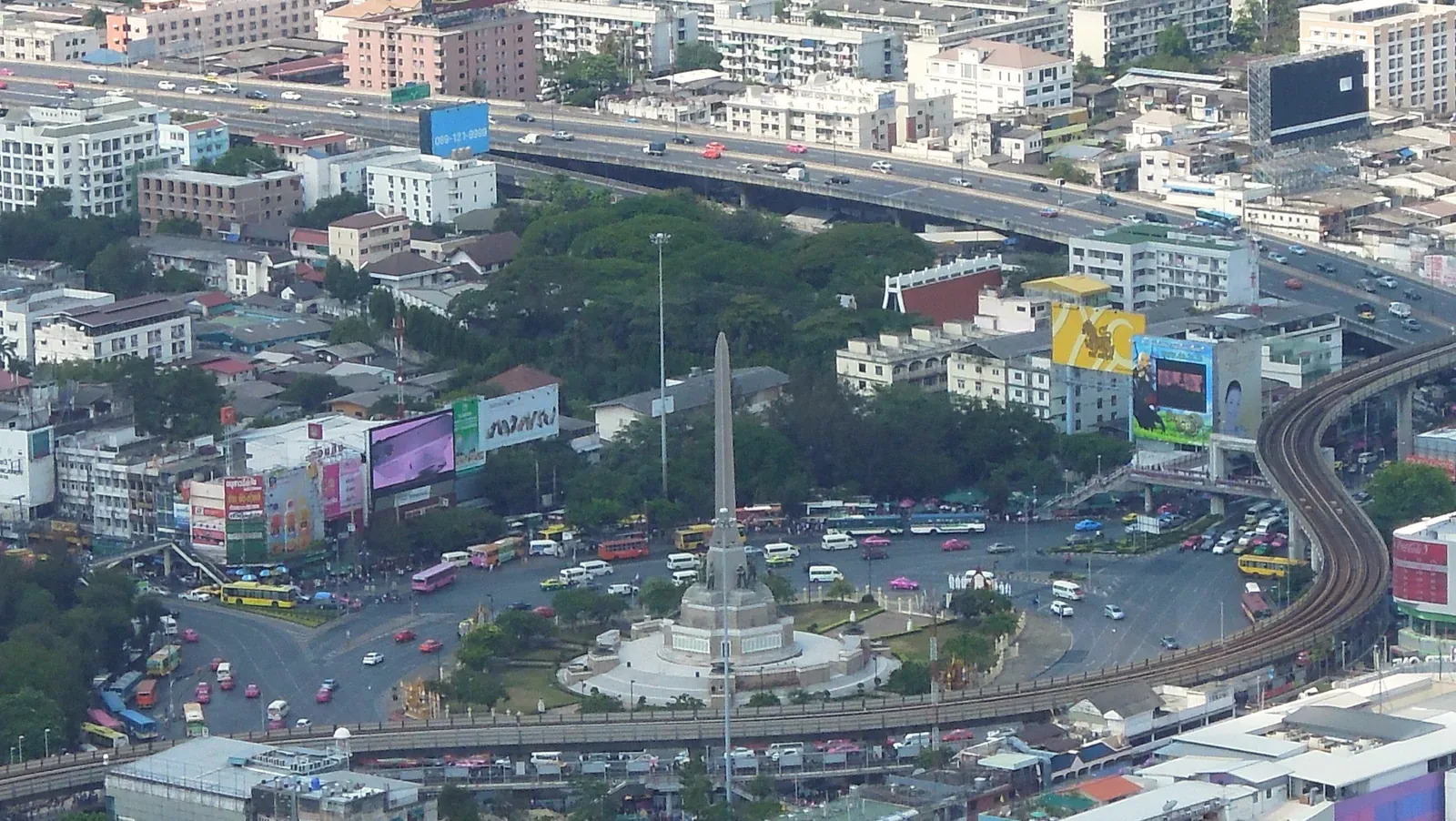
- Victory Monument
- 16-22 min
- Ari
- 20-27 min
- Rama 9
- 20-28 min
- Bang Sue
- 32-42 min
- On Nut
- 30-40 min
- Bang Na
- 38-52 min
- Nonthaburi
- 50-68 min
Source: Editorial estimate from BTS/MRT average operating speed and published station counts; see the methodology callout above. Checked September 2026.
The gap between the fastest and slowest area here is roughly 45 minutes each way at rush hour, close to an hour and a half a day round trip. That’s the real cost a cheaper, further-out address can carry, and it’s worth pricing against the rent saved before committing to a lease.
The full picture: line, interchange, minutes
| Area | Line | Interchange needed | Off-peak | Rush hour |
|---|---|---|---|---|
| Silom | BTS Silom / MRT Blue (Sala Daeng-Si Lom) | None, already there | 5 min | 8 min |
| Victory Monument | BTS Sukhumvit (N3) | None, near CBD | 16 min | 22 min |
| Ari | BTS Sukhumvit (N5) | None, direct | 20 min | 27 min |
| Rama 9 | MRT Blue | One change at Asok or direct to Si Lom | 20 min | 28 min |
| Bang Sue | MRT Blue | None, direct to Si Lom | 32 min | 42 min |
| On Nut | BTS Sukhumvit (E9) | None, direct | 30 min | 40 min |
| Bang Na | BTS Sukhumvit (E13) | None, direct but longer ride | 38 min | 52 min |
| Nonthaburi | MRT Purple + Blue | One change at Tao Poon | 50 min | 68 min |
The fast lane: On Nut, Ari, Victory Monument
These three share a trait that matters more than raw distance: none of them requires a line change to reach the CBD cluster. On Nut (BTS E9) sits further down the Sukhumvit line than Ari or Victory Monument, so its ride is the longest of the three, but it’s still a single, direct BTS run with a sourced 22-minute in-train time to Siam. Ari (BTS N5) and Victory Monument (BTS N3) sit closer to the line’s centre, both a direct ride away with no change.
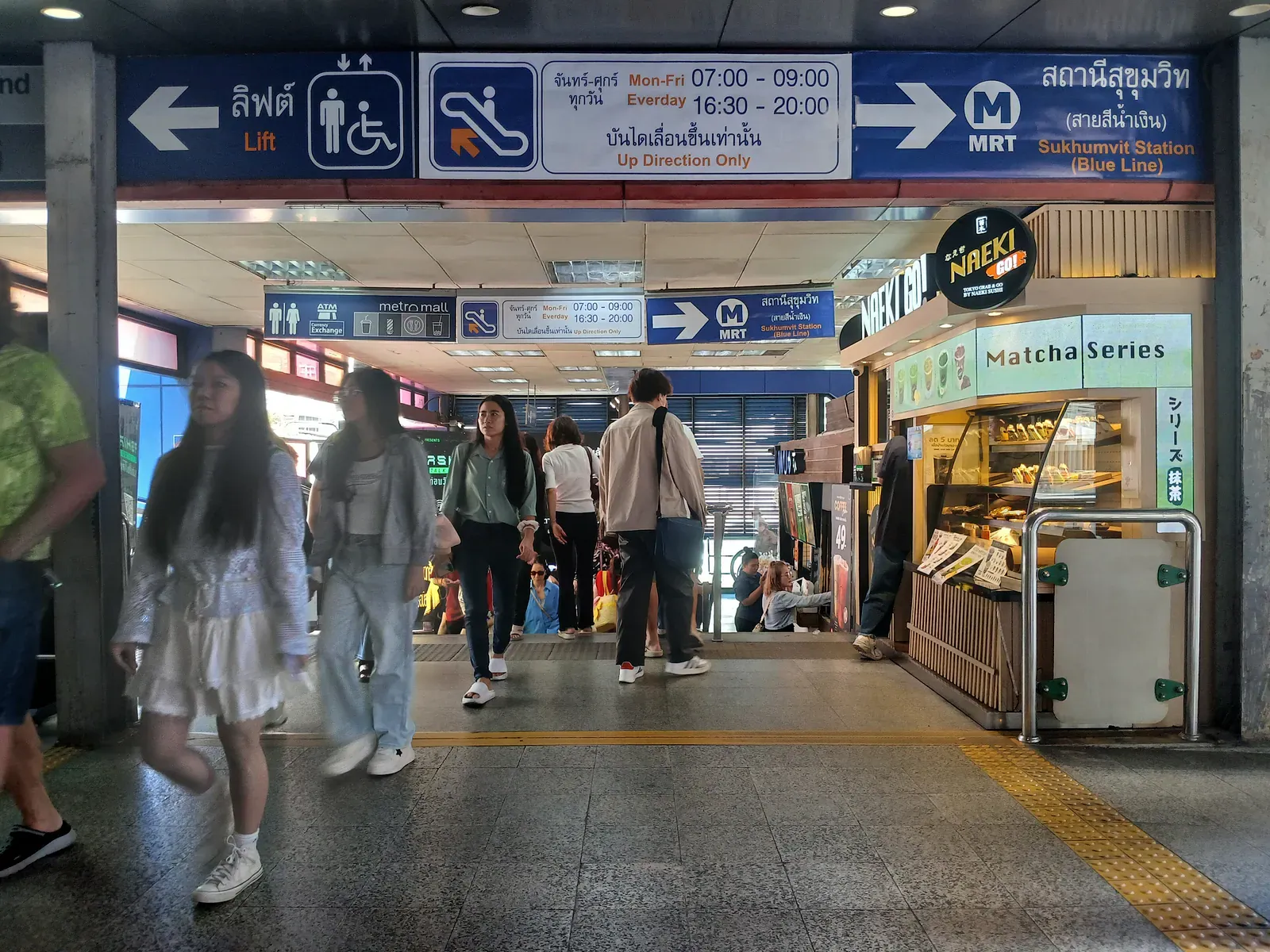
The practical upshot: a resident of any of these three areas experiences rush hour mostly as a more crowded train, not a longer journey. Delay comes from platform queuing and slower boarding, not from the train taking a different route or waiting somewhere it wouldn’t off-peak.
The interchange tax: Rama 9, Bang Sue, Silom
Rama 9 and Bang Sue both sit on the MRT Blue Line, and Blue Line trains reach the Sala Daeng and Si Lom interchange directly without a change. The tax here isn’t a literal line change for most riders, it’s simply more stations to cover before arriving: Bang Sue, further from the centre of the line, adds roughly 12 to 15 minutes over Rama 9’s shorter run. Silom needs no commute calculation at all: it sits inside the reference CBD cluster this whole comparison is measured against.
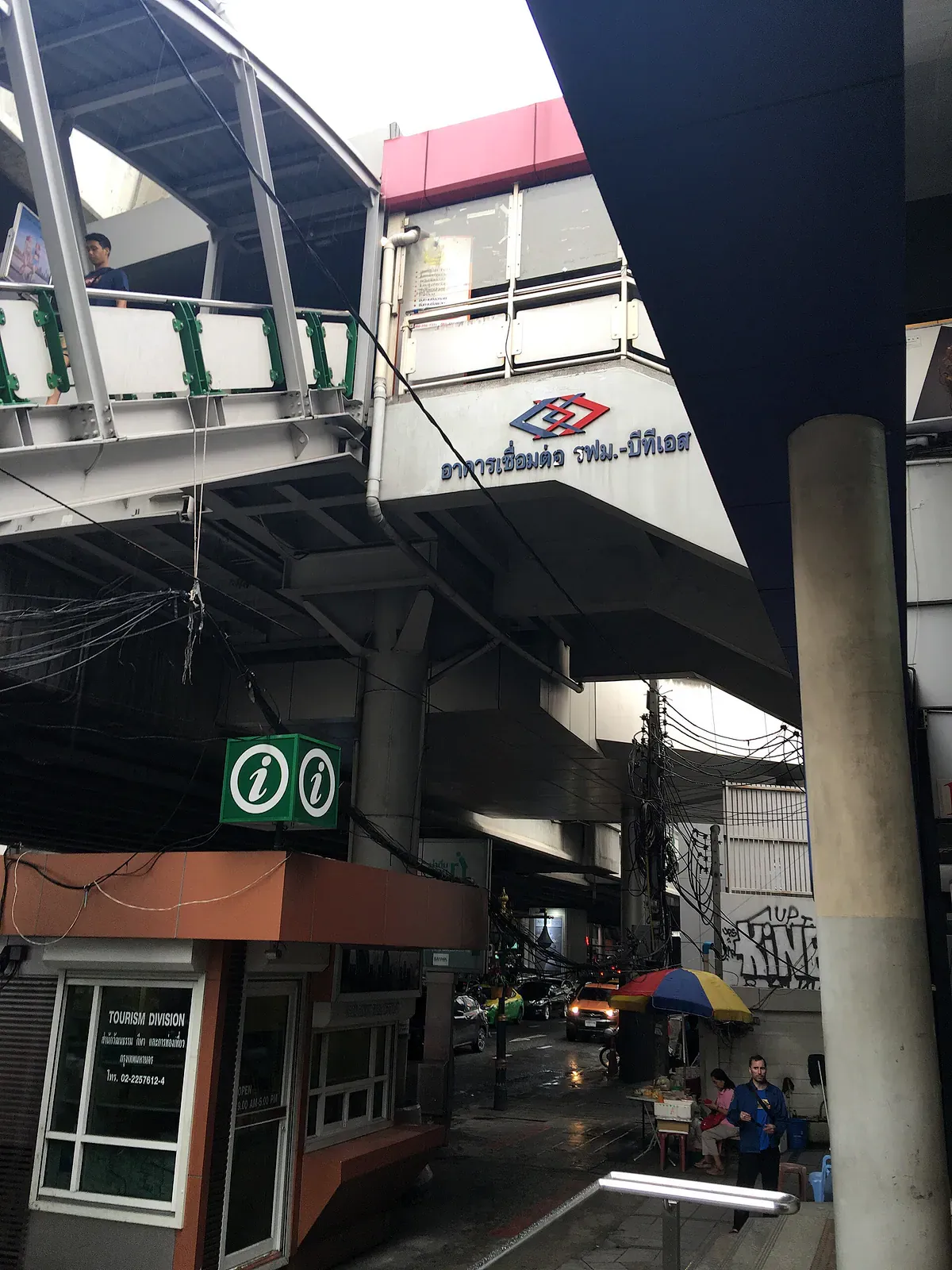
Where an interchange genuinely bites is a Rama 9 resident whose office sits specifically on the Sukhumvit BTS line rather than near an MRT stop: that trip adds a real walkway change at Asok, plus the wait for a second train, typically 5 to 8 minutes beyond the direct-to-Si Lom figure above.
The long haul: Bang Na and Nonthaburi
Bang Na (BTS E13) is the Sukhumvit line’s southern stretch, direct but long: no interchange, just more track to cover than On Nut. Nonthaburi is the outlier on this list for a different reason: it isn’t on a line that reaches the CBD cluster directly at all. A Nonthaburi resident rides the MRT Purple Line to Tao Poon, changes to the Blue Line, and continues to Si Lom or Sala Daeng, a genuine two-leg journey with an interchange penalty baked in on top of real distance.
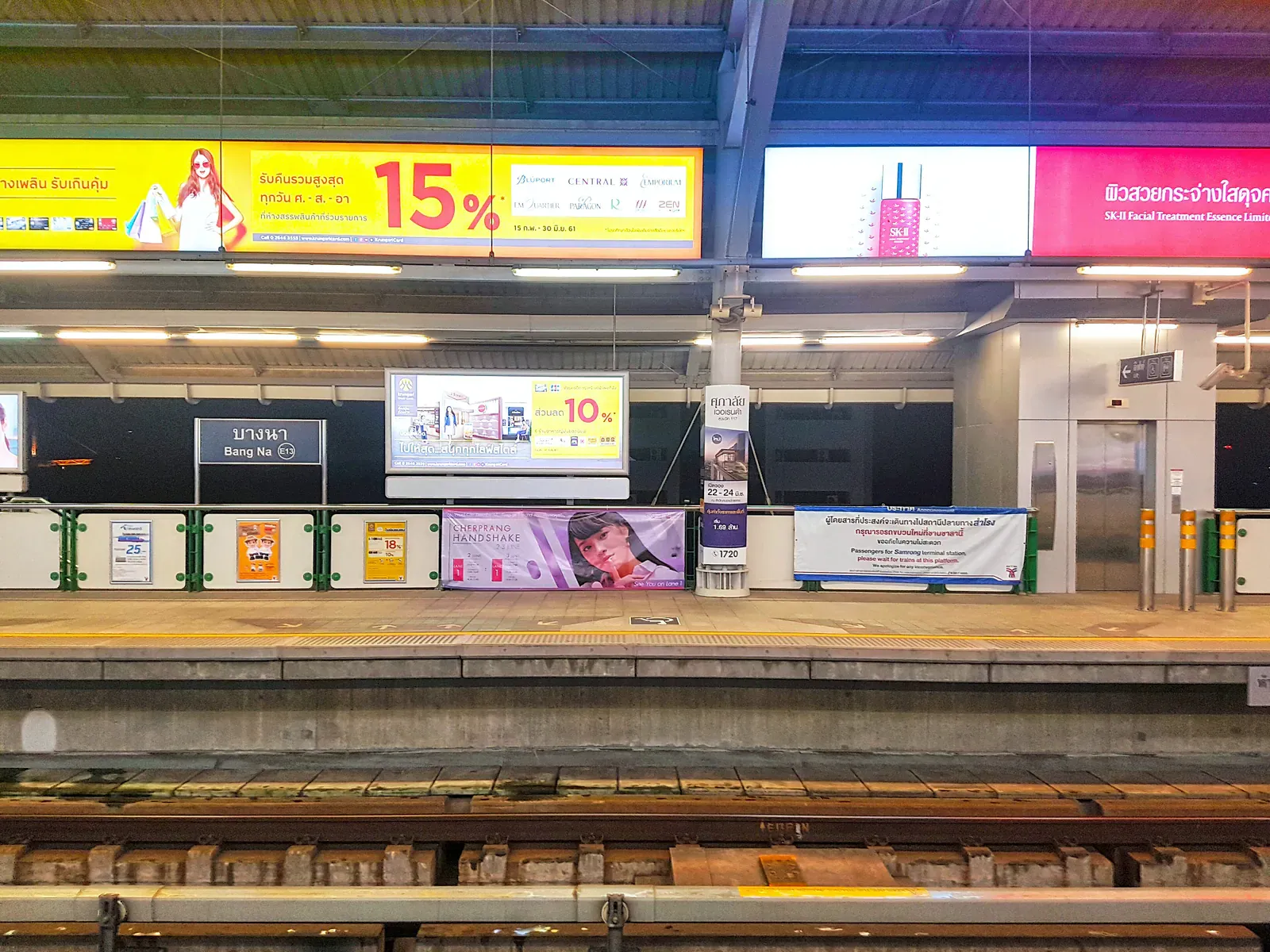
Both areas trade commute time for space, quieter streets and lower rent than the inner ring, a trade-off covered in full in Cost of Living by Bangkok Area. Neither is a poor choice; they’re simply the wrong choice for anyone with a daily CBD office day and no tolerance for a long ride.
Off-peak vs rush hour: why rail resists traffic better than roads
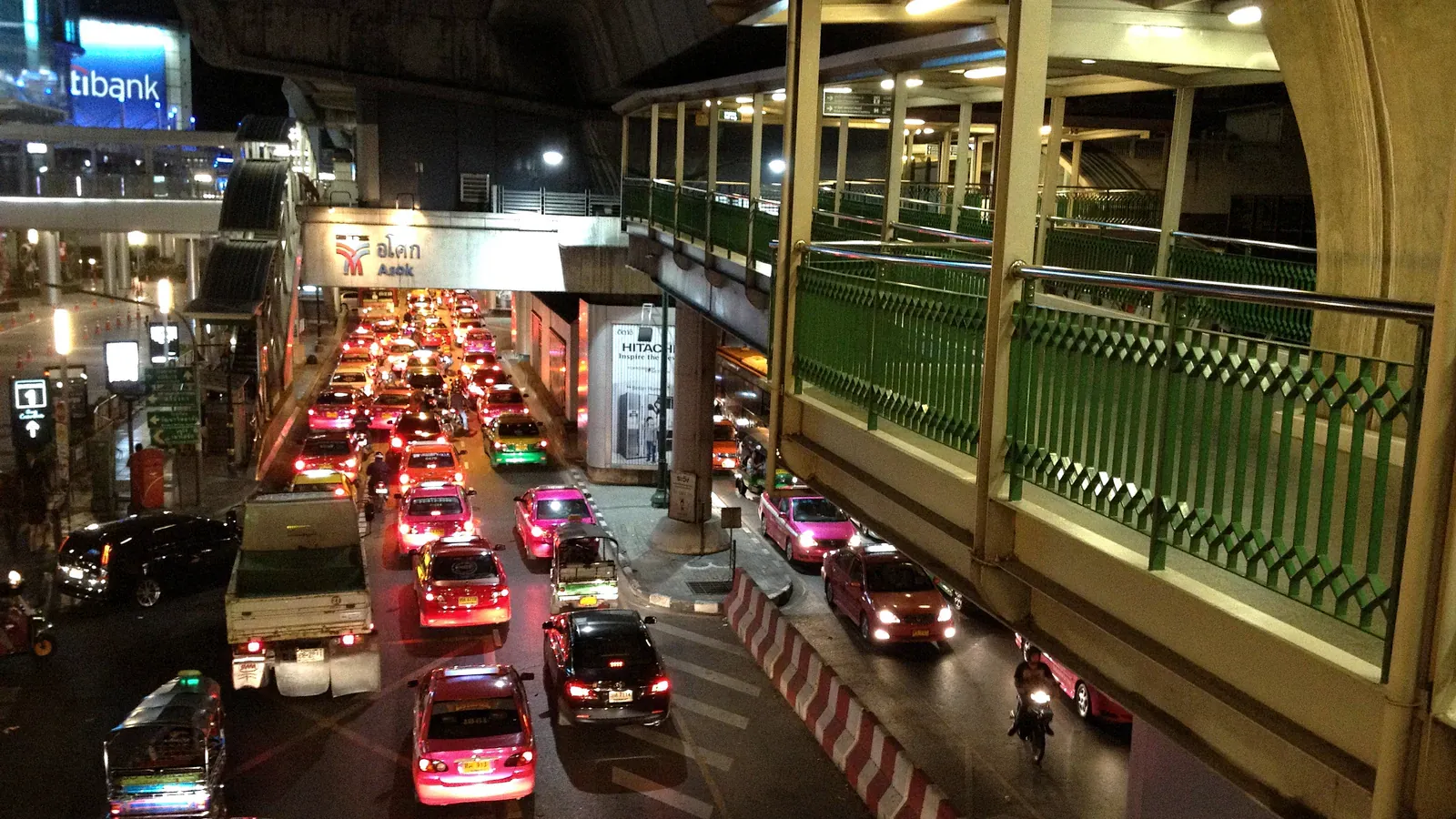
The single most useful fact in this whole comparison: BTS and MRT trains run on a fixed, grade-separated track, so rush hour doesn’t slow the train down the way it slows a taxi stuck in Bangkok’s famously congested road network. What rush hour adds to a rail commute is almost entirely queuing, boarding delay from a fuller platform, and a slightly higher chance of needing to let one full train pass before boarding, not a train stuck in traffic.
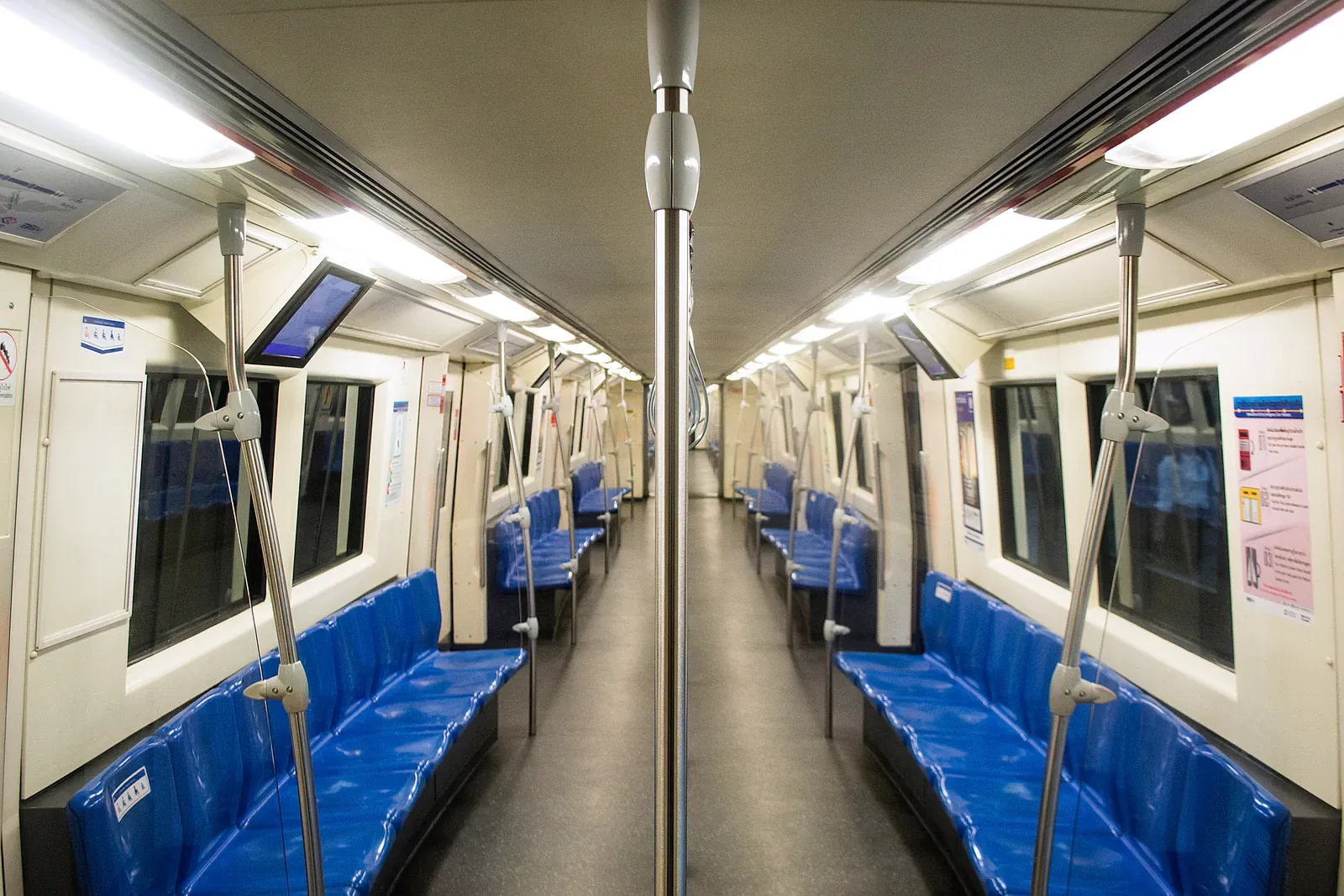
That’s why the off-peak-to-rush-hour gap in the chart above is modest, typically 6 to 10 minutes, rather than the doubling or tripling a road-based commute can see in the same city during the same hours. A taxi or Grab covering the same Silom-to-Bang Na distance can take 90 minutes or more at rush hour against 35 to 40 off-peak; rail simply doesn’t have that failure mode.
How predictable is each commute, not just how long
Average minutes hide a second variable that matters just as much day to day: how much a specific commute varies from one day to the next. A single-line, no-change trip is inherently more predictable than a two-leg journey with an interchange, since there’s only one point of possible delay instead of two or three.
- Silom already at the CBD
- 5 out of 5
- Ari / Victory Monument single line, no change
- 4.5 out of 5
- On Nut single line, longer ride
- 4 out of 5
- Rama 9 direct to Si Lom, occasional Asok change
- 3.5 out of 5
- Bang Sue single line, distance is the main variable
- 3.5 out of 5
- Bang Na single line, longest direct ride on Sukhumvit
- 3.5 out of 5
- Nonthaburi two legs, one interchange, most exposed to delay
- 2 out of 5
Editorial rating, 1 to 5, based on number of interchanges and line length, not measured punctuality data.
What a longer commute is actually worth trading for rent
A rough rule from these numbers: each interchange or extra 15 to 20 minutes of one-way commute costs a resident somewhere between 40 and 70 minutes of their week compared with a single-line, closer alternative, once both directions and a typical work week are counted. Whether that trade is worth it depends entirely on how often the trip is required. A remote worker who visits a CBD office once a week absorbs a Nonthaburi or Bang Na commute far more easily than someone commuting five days.
Match that trade-off against the actual rent gap, not an assumed one, using Cost of Living by Bangkok Area: the budget-tier areas in that comparison overlap heavily with the longer commutes here, and the premium tier overlaps with Silom’s zero-commute baseline. For lifestyle fit beyond the numbers, see Matching Your Lifestyle to a Bangkok Area.
Common questions
Which Bangkok area has the shortest commute to the CBD?
Silom itself, since it sits inside the CBD cluster this comparison measures against. Among areas outside the immediate core, Victory Monument and Ari have the shortest sourced commutes, both under 30 minutes door to door even at rush hour, thanks to a direct single-line BTS ride with no interchange.
Does rush hour really not slow down the BTS and MRT much?
Correct, relative to road transport. Rail runs on a fixed, grade-separated track that traffic can’t reach, so rush hour mostly adds platform crowding and boarding delay, typically 6 to 10 minutes, rather than the much larger delays a taxi or Grab experiences on Bangkok’s roads during the same hours.
Is Nonthaburi too far for a daily CBD commute?
It’s workable but genuinely the longest and least predictable option on this list, at an estimated 50 to 68 minutes door to door with one interchange. It suits someone commuting occasionally, working remotely most days, or prioritising space and lower rent over a daily office trip more than it suits a five-day CBD commuter.
How accurate are these commute estimates?
They’re editorial estimates built from published BTS/MRT operating speeds, station counts and one sourced anchor figure (the On Nut-to-Siam run), not live journey-planner output. Treat them as a comparison between areas rather than a precise prediction for a specific trip, and check a live app for same-day planning.
Does living further from a station matter more than living further from the CBD?
Often, yes. A unit a 15-minute walk from its own station can add more real time than an extra two or three stops on the line itself, since walk time doesn’t benefit from the train’s speed. Factor the walk to your own building’s nearest station into any of the figures above, not just the in-train time.
Part of
Written by
Mike Brochlowski
Founder and editor, travel photographer and designer
I'm Mike Brochlowski, a travel photographer and designer, and I currently live on Koh Samui, Thailand. I built BangkokWiki to put practical, checked information about Bangkok in one place. Every page is researched from official and primary sources, and the text names them. Where a page shows a checked date, that is when its facts were last confirmed. I also run samui69.com, a non-commercial guide to Koh Samui. If you spot an error or something out of date, tell me through the contact page and I will check it and correct the page.
Read all articles
Visas and paperwork
Staying in Thailand longer?
Visas, extensions, documents and banking for longer stays. Rules and fees change often and offices apply them differently, so check the official source before you act.

Places to stay
Find a hotel
Explore the other desks
More from Living
- 10 min read
 10 min read
Freelancer, Employee or Founder: Bangkok Nomad Life
 6 min read
Best Bangkok Neighborhoods for Digital Nomads: Scored

Newsletter
You're subscribed as