Travel
Bangkok Temple Dress Code and Etiquette Guide
What covers shoulders and knees actually means, how strictly it's enforced, and the behaviour around monks, photos and offerings that visitors get wrong.
At a glance
- Reading time
- 13 min read
- Chapters
- 13
- Published
- Sep 20, 2026
On this page
A working Bangkok temple asks for shoulders and knees covered, shoes off before certain buildings, and quiet, low-key behaviour around monks and Buddha images. None of it is complicated, but the rules are enforced unevenly, and the parts visitors get wrong tend to be about respect rather than fabric. This covers both: what to wear, and what a well-behaved visitor does once inside.
What to wear
The baseline, at every temple in the city, is shoulders and knees covered for everyone, regardless of gender. In practice that means:
- Tops: sleeves that reach at least to the top of the shoulder. A vest, tank top or strapless dress fails the check even if it’s otherwise modest. A T-shirt is fine.
- Bottoms: trousers, a skirt or a dress that reaches below the knee when you’re standing, not just sitting. Shorts that hit mid-thigh will be turned away at the stricter sites; shorts to the knee are usually accepted at smaller wats.
- See-through fabric doesn’t count as covered even if it technically reaches the knee or shoulder. Staff at the busier temples will ask for another layer.
- Footwear: anything you can slip off and on quickly. Lace-up boots become a liability once you’re removing and re-tying them a dozen times in one afternoon; sandals or slip-ons are the practical choice, and they matter more here than almost anywhere else on a Bangkok trip.
On fabric: Bangkok’s heat and humidity make clinging synthetic clothing miserable well before it becomes a dress-code issue. Loose cotton or linen breathes, dries faster after the inevitable sweat, and drapes in a way that reads as modest even when it’s covering the same amount of skin as something tighter. Pack for the climate first and the dress code follows naturally.
Enforcement: major sites versus a neighbourhood wat
Enforcement is not consistent across the city, and knowing the difference saves a wasted trip.
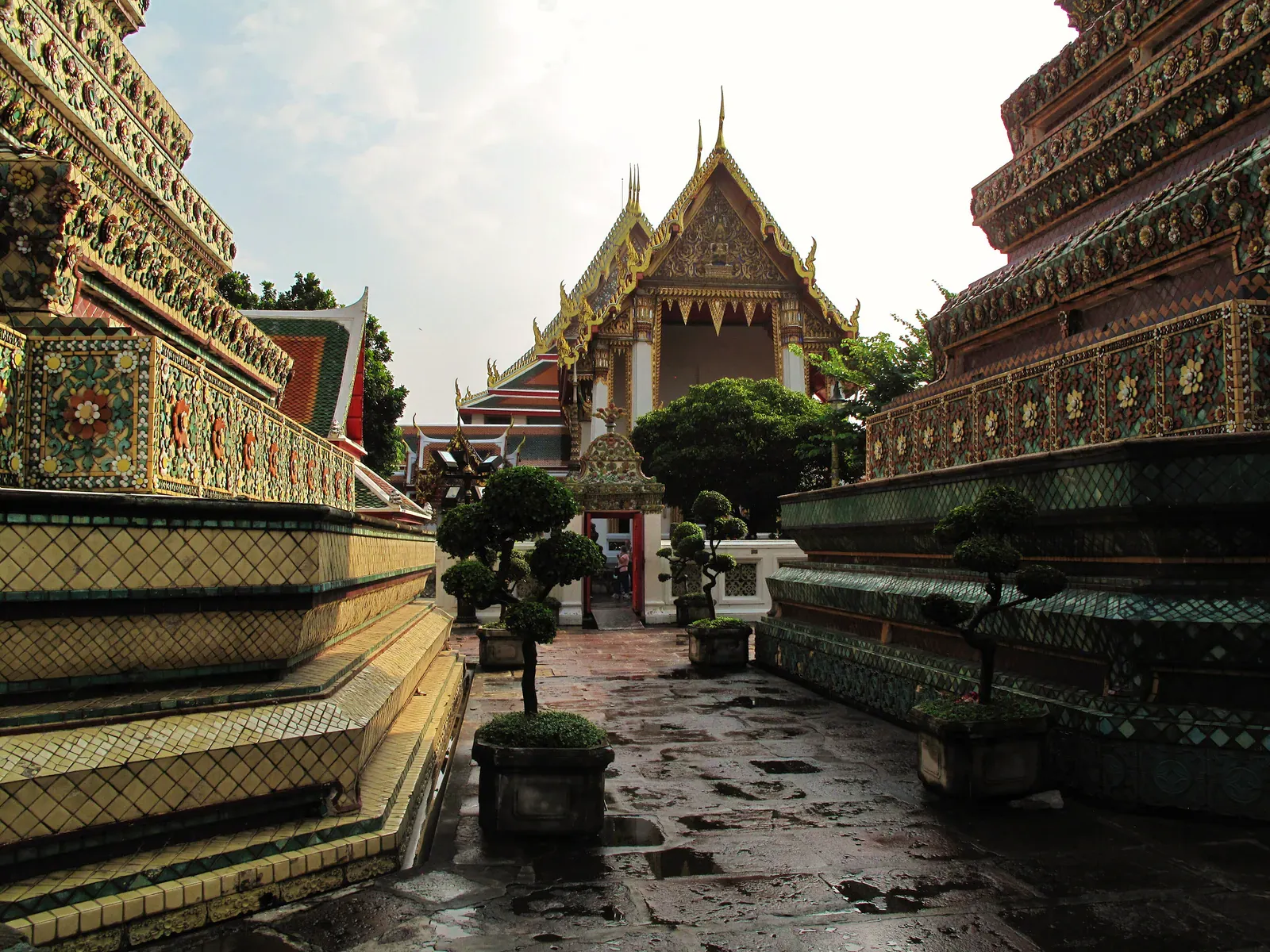
At the Grand Palace and Wat Phra Kaeo, and at Wat Pho, staff check clothing at the entrance as a matter of course. Turned away for bare shoulders or shorts above the knee is a routine occurrence there, not an edge case, and it happens to a meaningful number of visitors every day. These are the two sites to dress for properly before you leave your hotel.
A neighbourhood wat, by contrast, usually has no one checking anything. That doesn’t mean the standard has changed: it means enforcement depends on whoever happens to be around, which might be a monk, a temple caretaker, or nobody at all. Dressing the same way regardless of which kind of site you’re visiting is simpler than trying to judge each one, and it avoids the awkwardness of being underdressed in front of people actually there to worship.
The sarong-rental reality
Both the Grand Palace and Wat Pho rent or lend sarongs and wraps at the entrance for visitors who arrive underdressed, sometimes against a small deposit that’s returned when you bring the item back. It works, but it’s not a comfortable plan: queues form at peak hours, the available sizes and coverage are inconsistent, and a wrap over shorts is hotter and more awkward to manage than clothes you chose for the job. Treat the rental service as a backup for a genuine mistake, not a strategy. A long, lightweight scarf carried in a day bag solves the same problem with none of the queue.
Shoes: where the line is
Shoes come off before entering any building that houses a Buddha image for worship: the main hall (bot or wiharn), and smaller shrine buildings around a temple compound. They generally stay on across open courtyards, on raised terraces between buildings, and around chedis (stupas) you’re not stepping directly into. When in doubt, look at the entrance: a pile of other people’s shoes is the reliable sign, more reliable than trying to guess from the architecture.
Carry a small bag for your shoes if the temple is busy: trays or shelves fill up, and shoes get lost or muddled at the more popular sites. Socks are worth keeping on if the stone floor has been sitting in the sun; some temple floors get uncomfortably hot by midday.
Sitting and posture in front of a Buddha image
Once inside, seating is on the floor, and the position that matters is where your feet point. Feet are the lowest and least respected part of the body in Thai custom, so sitting with legs stretched toward a Buddha image, an altar, or a monk is read as disrespectful even if no rule is posted about it. The standard fix is to sit with your legs folded to one side, feet tucked behind you and pointing away from the image: a position called “mermaid style” by some guides, and one that becomes comfortable with a little practice.
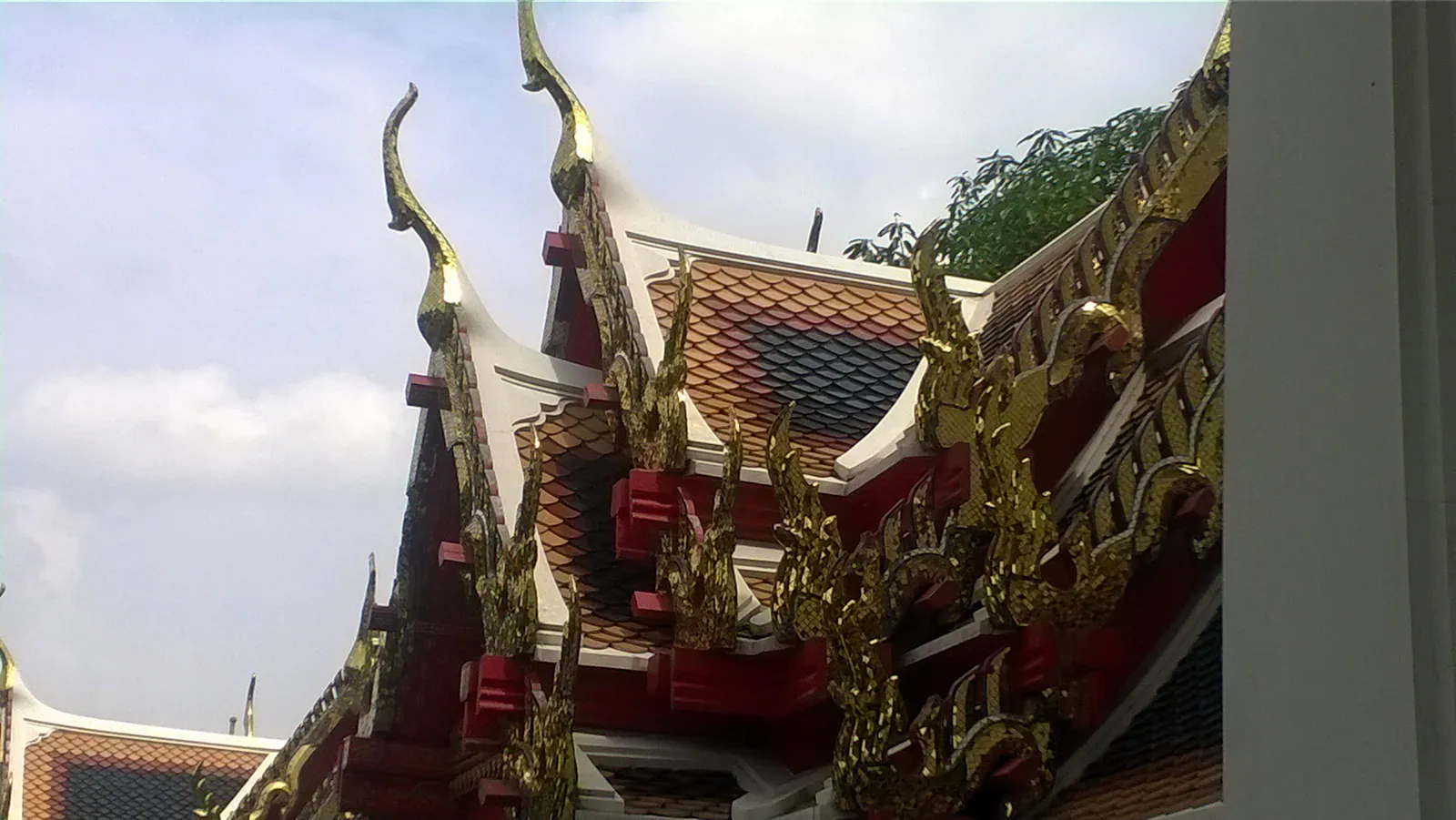
Pointing your feet at a person (stepping over someone, resting a foot on a chair near someone’s head) carries the same weight outside temples too, but it matters most here, where the whole room is oriented toward showing respect to the image at the front.
The wai, used well
The wai (palms together, fingertips toward the chin, with a slight bow) is the standard Thai greeting and gesture of respect, but a visitor doesn’t need to perform it constantly to be polite. A wai toward a Buddha image before sitting or leaving is welcomed and often mirrored by Thai visitors around you; it’s not required from a foreigner, but it isn’t out of place either.
Toward a monk, a wai is a respectful gesture, and it’s fine to offer one on meeting or thanking a monk for a blessing. What a visitor shouldn’t expect is one back: a monk generally doesn’t return a wai to a layperson, because the gesture in that direction runs the other way in Thai social hierarchy. It isn’t rudeness, it’s the convention. Save an enthusiastic wai for greetings rather than using it as a stand-in for “thank you” in every transaction; overusing it toward temple staff or vendors reads as performative rather than respectful. For polite words to pair with it, see our Thai phrases guide.
Monks, personal space, and the rules for women
A monk’s daily life runs on a set of vows that shape how anyone, visitor or Thai, is expected to behave around him. The practical points:
- Keep a respectful distance rather than crowding a monk for a photo or a conversation, especially one who is clearly mid-task: chanting, receiving alms, or walking with purpose.
- Don’t touch a monk, and don’t hand him anything directly.
- Sitting or standing higher than a monk in a shared space (on a chair while he sits on the floor, for instance) is avoided where it can reasonably be helped.
- On public transport, a seat near or next to a monk is customarily given up, and a designated monks-only area exists on some boats and buses.
For women specifically
The rule that matters most, and the one visitors most often don’t know about until they’ve nearly broken it: a monk may not touch a woman, or accept anything directly from a woman’s hand, as part of the vows he keeps. This isn’t a comment on the woman: it applies to every woman, at every stage of contact, without exception, and it exists to remove any suggestion of impropriety from a monk’s conduct.
In practice, if a woman wants to offer something to a monk (a donation, an object, food during an alms round), the object goes down first: onto a table, a tray, or a cloth the monk holds out for exactly this purpose (sometimes called a “receiving cloth”), from which he then picks it up himself. No physical exchange happens hand to hand. If no cloth or surface is obviously available, placing the item down nearby and stepping back is the safer default. A monk who steps back from a queue, moves to keep distance, or asks someone else to pass something along on his behalf is following his own rule, not being cold.
Photography: welcome, forbidden, and the selfie problem
Most temple courtyards, chedis, and exterior architecture are fair game for photography, including with people in the shot. Where it tightens up:
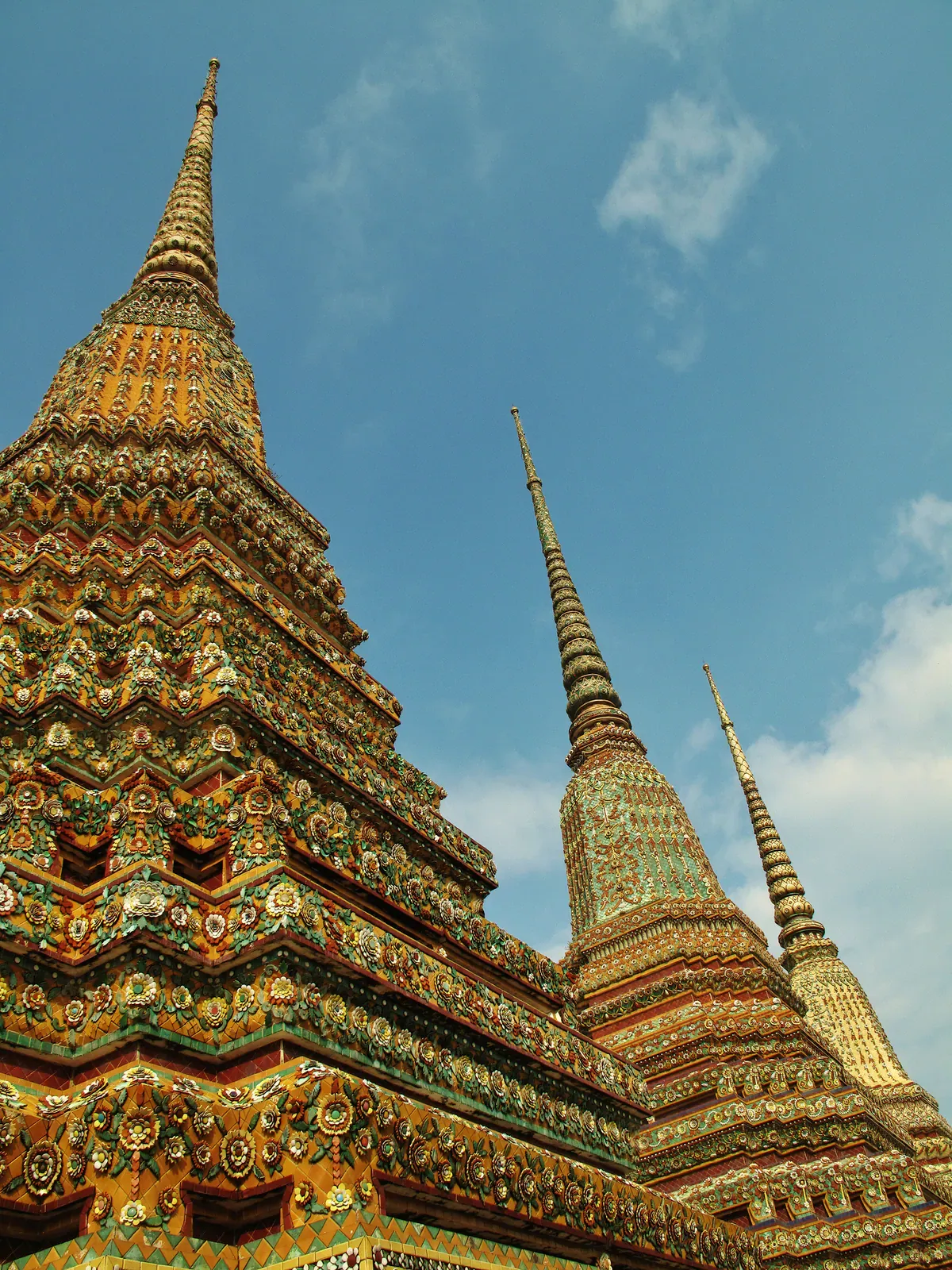
- Inside the main hall, some temples restrict photography of the principal Buddha image, particularly during active worship, chanting, or a ceremony. A posted sign or a caretaker’s gesture is the cue; follow it without arguing.
- Ceremonies and private rituals (ordinations, funerals, merit-making for a family) are not backdrops. Photograph from a respectful distance if at all, and only if nobody present signals discomfort.
- Flash photography near an image or during a ceremony is generally unwelcome even where a photo itself is tolerated.
The one that catches visitors out hardest is posing with a Buddha image: climbing onto a statue, sitting on a pedestal, mimicking its posture, or turning your back to it for a selfie. This isn’t a grey area of taste. Buddha images are objects of active worship, not photo props, and treating one as a prop has led to real legal consequences for tourists in Thailand, including detention and prosecution in high-profile cases. Photograph the image respectfully, at a distance, the way you’d photograph an altar in active use anywhere, because that’s what it is.
Donations, offerings, incense, candles and gold leaf
Temples generally don’t charge a formal fee for entry to worship (ticketed sites like the Grand Palace complex are a separate, tourism-facing arrangement), but a donation box near the entrance or main hall is standard, and a small contribution is customary if you’ve spent time inside. There’s no fixed amount expected of a visitor; a few tens of baht in a donation box is a normal gesture, and a larger amount is entirely a personal choice, not an obligation.
Around most Buddha images you’ll find the makings of an offering: lotus buds, incense sticks, small candles, and sometimes squares of thin gold leaf for sale nearby. The common pattern (not a rule you must follow, but the one you’ll see repeated) is lighting incense (often three sticks) and a candle, placing them in the sand-filled urns provided, and pressing a small square of gold leaf onto a designated part of a Buddha image (never onto a monk, a person, or an image not set up for it). If you’re unsure whether an image is one people leave gold leaf on, watch what others are doing before joining in, or simply skip the gesture: nobody expects a visitor to make an offering, and doing it visibly wrong draws more attention than not doing it at all.
Walking into a ceremony or a funeral
Bangkok’s working temples run ordinations, merit-making ceremonies, and funerals more or less constantly, and a visitor can easily wander into one without meaning to. If that happens:
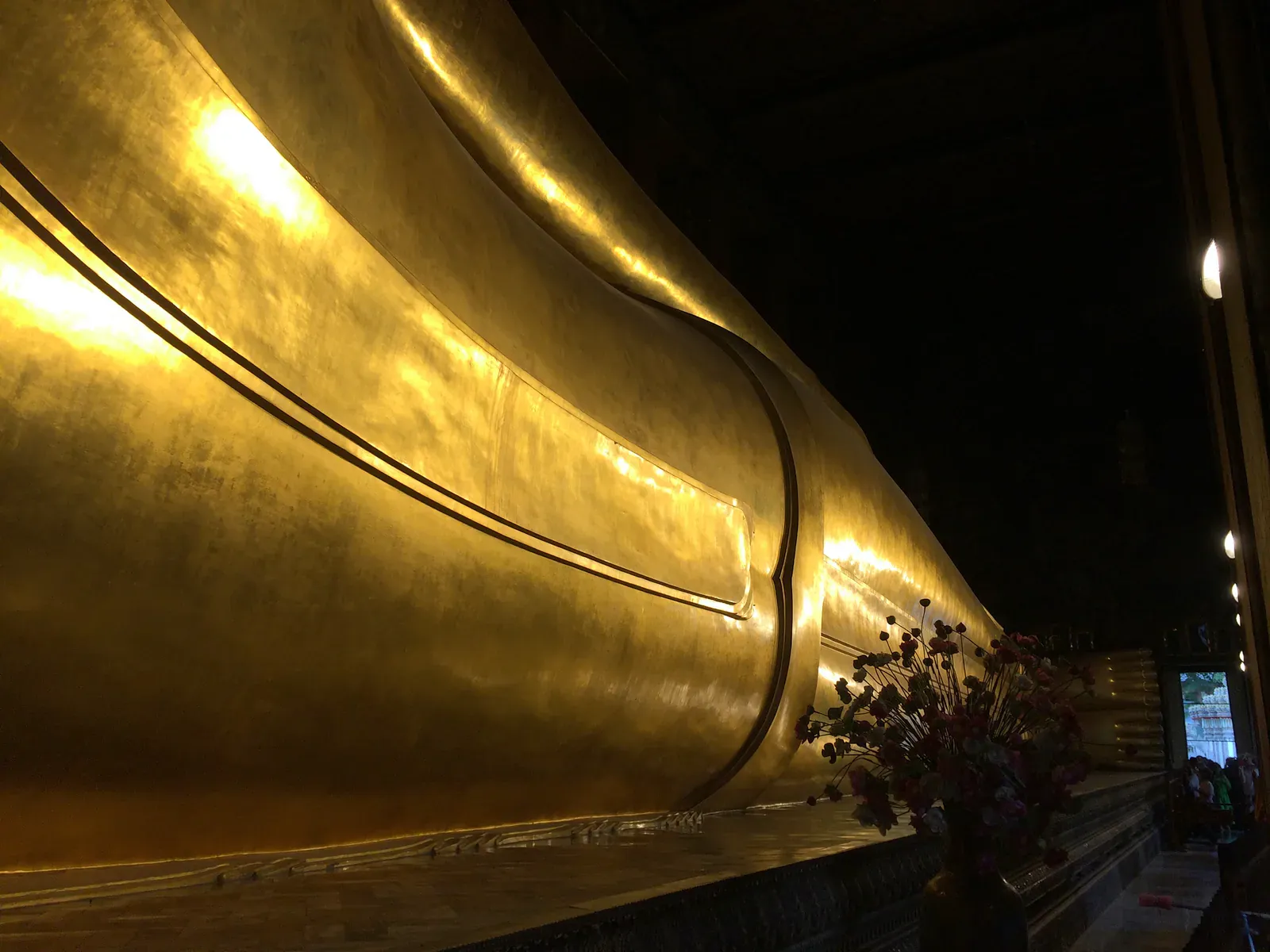
- Lower your voice and slow down; don’t walk through the middle of a seated group to get a better view.
- Dress modestly regardless of what you were already wearing: a funeral in particular calls for subdued colour, and white or black is the safer choice over bright prints if you happen to be dressed for it.
- Don’t photograph a funeral or a private family ceremony unless you have a clear, specific reason and nobody objects; as a passing visitor, the answer is generally “don’t.”
- If monks are chanting, stay quiet until the chant finishes rather than moving through the space.
- It’s fine to observe respectfully from the edge for a few minutes; it’s not fine to linger as though it were a performance.
The legal edge: lese-majeste, religious insult, and tattoos
Two separate Thai laws sit behind everything above, and both carry real weight. Lese-majeste law protects the monarchy and is a distinct issue from temple conduct, but the same climate of taking symbolic offence seriously extends to Buddhism: Thailand’s criminal code includes an offence for insulting or defaming a religion, covering acts that demean Buddhist images or practice, and it has been used against both Thai citizens and foreign visitors. Penalties can include imprisonment.
This is the legal backdrop to the posing-with-a-Buddha problem above, and to the recurring debate around Buddha tattoos. A tattoo of the Buddha is not itself illegal to have, but it sits in a genuinely sensitive space: Thai authorities and cultural bodies have periodically pushed back against tourists getting large or visible Buddha tattoos, particularly on the lower body, on the grounds that it demeans a sacred image by association with a part of the body Thai custom treats as low or profane. “It’s just a tattoo, it’s not meant as an insult” is not a defence that has reliably worked, and visible Buddha tattoos have drawn scrutiny at temples and occasionally at the border. If you have one, covering it inside a temple is the safer, lower-friction choice.
Children, heat, and older travellers
Children: temples are genuinely good places to bring kids (cool stone floors, open courtyards, and enough visual interest to hold attention), but the same dress code and quiet-voice expectations apply to them as to adults. Cover shoulders and knees on children too, keep them from touching Buddha images or offerings, and treat a temple as somewhere to explain, briefly and honestly, why people are quiet and why shoes come off, rather than as a rule to enforce without context. A running, shouting child in a temple courtyard draws visible disapproval faster than almost any adult misstep.
Heat and older travellers: the big three sites (Grand Palace, Wat Pho, Wat Arun) involve substantial walking across open, largely shadeless stone, plus stairs at some stopping points. Midday sun on pale stone is genuinely gruelling even for visitors used to heat. An early start, a hat, water carried rather than bought once you’re thirsty, and a willingness to sit in whatever shade is available between stops make a bigger difference here than at almost any other stop on a Bangkok itinerary. For a full day covering multiple sites, the temple-hopping route sets out a pace and a shorter version built around exactly this concern.
What changes on Buddhist holy days
Wan Phra (the Buddhist observance day, tied to the lunar calendar and falling roughly every seven or eight days) brings more Thai worshippers to temples than an ordinary day, along with more merit-making activity, chanting, and sometimes queues for popular images. The major annual holy days (Visakha Bucha, Asalha Bucha, Makha Bucha, and the start of the Buddhist Lent period known as Khao Phansa) bring this up further, along with a nationwide ban on alcohol sales for the day. Some temples hold evening candlelit processions on the biggest of these dates.
For the background to these customs, see our Bangkok history and culture guide. For mosques and prayer, see Bangkok mosques and halal food.
None of this closes an active temple to visitors, but it does mean larger crowds, more ceremony to be careful around, and a stronger case for dressing and behaving conservatively without needing a staff member to remind you. If a specific hall or area is closed for a private ceremony on the day you visit, that’s normal and not a sign anything is wrong: see it as evidence the temple is a working religious site, which is the whole point, and which the quieter temples across the city make just as obvious on an ordinary Tuesday.
Common questions
Do I really need to cover my knees at every single temple, even small ones?
Yes, in principle: the standard is the same everywhere, even though enforcement varies. A small neighbourhood wat is far less likely to check, but showing up correctly dressed avoids putting worshippers in the position of having to say something, and it costs you nothing to plan for.
Can I wear shorts if they’re knee-length?
At the strictest sites (Grand Palace, Wat Pho) knee-length shorts are usually accepted if they genuinely reach the knee while standing; anything shorter risks being turned away or asked to rent a wrap. At smaller wats, knee-length shorts are rarely questioned.
Is it rude to take photos inside a temple at all?
No, most temple exteriors and courtyards are photographed constantly and nobody minds. The line sits around active worship, ceremonies, and treating a Buddha image as a photo prop rather than an object of respect.
What should I do if I don’t have small change for the donation box?
Nothing is expected of you specifically. A donation is customary, not compulsory, and skipping it because you don’t have cash on you draws no attention at all.
Why won’t a monk shake my hand or take something I’m handing him?
He’s following a vow that applies to physical contact and direct exchange with women in particular, and more broadly to informal contact generally. Placing an item down for him to collect, or waiting for a monk to gesture how he’d like something handled, resolves it without awkwardness on either side.
Are the rules different at Wat Arun or Wat Pho compared with a neighbourhood temple?
The underlying etiquette is identical everywhere; what differs is how likely you are to be corrected if you get it wrong. Wat Arun and Wat Pho see enough visitor traffic that staff actively manage dress code and photography at the main structures (full detail on that route sits in the temple-hopping route guide), while a neighbourhood wat relies on visitors already knowing and following the same standard unprompted. For where to go, see our guide to famous Bangkok temples, the Marble Temple guide and the Erawan Shrine guide.
Written by
Mike Brochlowski
Founder and editor, travel photographer and designer
I'm Mike Brochlowski, a travel photographer and designer, and I currently live on Koh Samui, Thailand. I built BangkokWiki to put practical, checked information about Bangkok in one place. Every page is researched from official and primary sources, and the text names them. Where a page shows a checked date, that is when its facts were last confirmed. I also run samui69.com, a non-commercial guide to Koh Samui. If you spot an error or something out of date, tell me through the contact page and I will check it and correct the page.
Read all articles
Where to stay
Pick the area before the hotel
Traffic and heat make Bangkok distances feel longer than they look on a map, so the area shapes a trip more than the hotel does. Our guides match areas to trip types and explain the trade-offs.

Places to stay
Find a hotel
Explore the other desks
More from Travel
- 6 min read
 5 min read
Tipping in Bangkok Restaurants: What to Actually Pay
 11 min read
Bangkok Scams and Safety: What to Know

Newsletter
You're subscribed as